
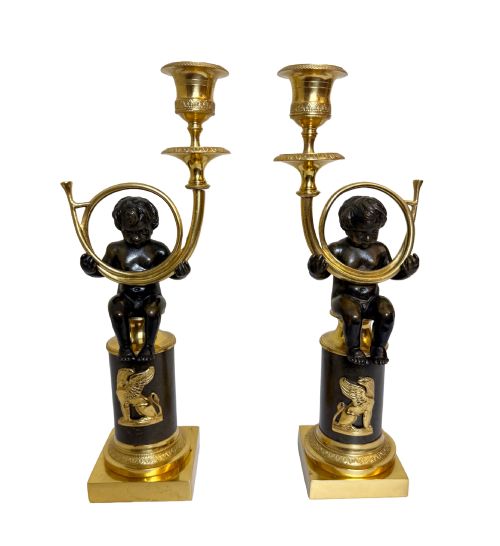


Putti Gilt Bronze Candleholder
These putti gilt bronze candleholder examples bring the sculptural elegance of nineteenth-century French lighting into a room.
Putti Gilt Bronze Candleholder
When you search for putti gilt bronze candleholder, you are looking at nineteenth-century decorative lighting cast in bronze and detailed with mercury gilding or ormolu. Most examples encountered here take the form of pairs, featuring cherubs or putti supporting branches or sockets.
The materials combine cast metals with carved stone bases, predominantly utilising marble and porphyry. Dating spans the Victorian era and the later decades of the nineteenth century, reflecting enduring revivals of French Louis XVI and Rococo styles.
Forms range from single candlesticks to multi-light candelabra with two, three, or five branches. These pieces function as decorative table ornaments as well as functional light sources.
How they were made
Maker's workshops cast these figures using traditional bronze foundry methods, capturing the fine details of the cherub anatomy and drapery. The metal surfaces received either rich gilt finishes, patinated bronze treatments, or polished ormolu highlights.
Turned or carved marble and porphyry bases provide sturdy foundations for the heavy metal figures. Component parts are typically secured with threaded pins and nuts, allowing for assembly and maintenance.
Listings feature pieces from the Victorian era and the late nineteenth century, predominantly rendered in gilt bronze, ormolu, and marble.
What varies in quality
The choice and preparation of the stone base also signal quality, with select pieces utilising finely veined marble or heavy porphyry. Preserved original gilding with balanced matte and burnished areas indicates better preservation and higher workshop standards.
Claude Clodion
The Putti Gilt Bronze Candleholder Glossary
- Ormolu
- Gilt bronze created by applying a mercury and gold amalgam to a bronze object before firing. The technique produces a deep, durable golden finish characteristic of French decorative arts.
- Porphyry
- An igneous rock with large crystals embedded in a fine-grained groundmass. It provides a dense, purple-red stone base prized for its ornamental weight and historic use.
- Patinated bronze
- Metal that has been treated with chemical solutions to produce a controlled surface colour ranging from dark brown to green. This treatment protects the bronze while defining sculptural details.
- Candelabra
- A branched candlestick designed to hold multiple tapers or candles simultaneously. These fixtures often feature removable branches to convert multi-light units into single candlesticks.
Putti Gilt Bronze Candleholder: Frequently Asked Questions
How do I clean a gilt bronze candleholder?
Dust the surface gently with a soft, dry brush to prevent accumulation in the crevices of the cast decoration. Avoid abrasive metal polishes or chemical cleaners that can strip the delicate gilt or ormolu layers.
Keep the pieces away from direct moisture and handling oils to preserve the original patina and finish of the metal.
Are these candleholders wired for electricity?
Most period examples are designed strictly for taper candles and retain their original sockets and drip pans. Converting them requires careful assessment by a specialist to ensure the wiring does not damage the antique bronze structure.
Many collectors prefer to use them with traditional wax candles to maintain their historical integrity and appearance.
How do I date a nineteenth-century candelabra?
Examine the casting quality, assembly screws, and the style of the marble base for clues to the manufacturing period. Pieces from the middle of the century often show heavier patination and distinct Louis XVI revival motifs.
Compare the chasing work on the bronze figures with dated examples from similar French workshops to narrow down the decade.
Why are most of these pieces pairs?
Nineteenth-century interior design conventions required symmetrical arrangements on mantelpieces, sideboards, and pier tables. Candlesticks and candelabra were manufactured in matching pairs to balance formal room decor.
Finding an intact pair ensures uniform height, matching patination, and corresponding sculptural details.