
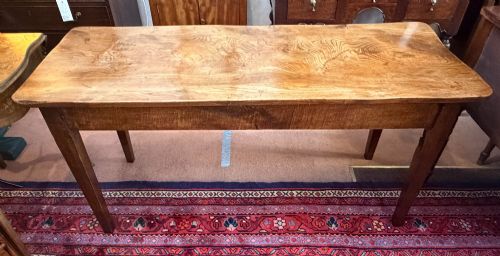
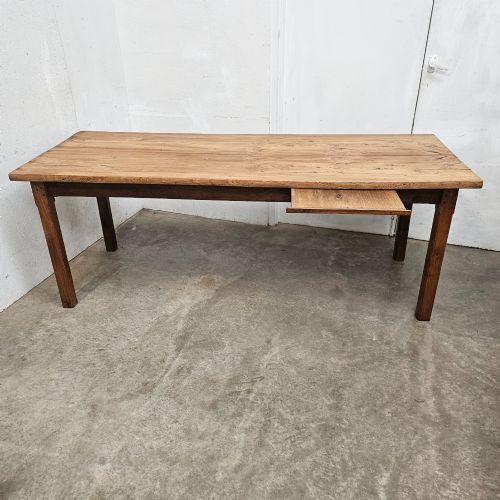


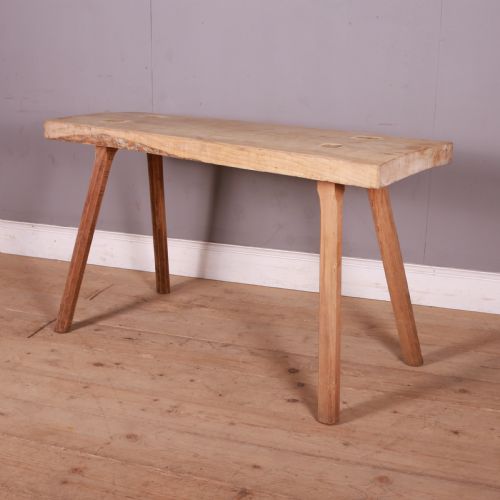


Provincial Elm Dining Table
A provincial elm dining table brings hard-wearing timber and rustic warmth to a room, built for daily use.
Provincial Elm Dining Table
A provincial elm dining table is a heavy dining surface originating from rural regions, constructed from local timbers and designed for daily household use. When searching for a provincial elm dining table, buyers encounter pieces spanning the eighteenth century, the nineteenth century, and eighteen eighty.
The selections on this page feature regional forms including French farmhouse tables, English country tables, and harvest tables. Alongside these, buyers find trestle tables and dropleaf centre tables built for practical domestic spaces.
Most examples rely on generous timber tops, sometimes constructed from two boards or planks. These tables reflect rural woodworking traditions where function dictated the final shape.
How they were made
Craftsmen built these tables using domestic hardwoods, primarily elm, alongside sycamore and oak. Elm was chosen for its tough grain and resistance to splitting under heavy use.
Construction methods prioritize durability over fine cabinetmaking, utilising thick plank tops and sturdy trestle or four-legged frames. Surfaces often show the scrubbed finish of active farmhouse kitchens.
Listings feature elm, sycamore, and oak across the eighteenth and nineteenth centuries, spanning French, English, and Chinese origins.
What varies in quality
Quality in these pieces depends upon the selection of timber and the integrity of the original construction. Tables featuring substantial two-board elm tops display greater balance than assembled multi-plank variants.
The proportion of the legs and the preservation of the scrubbed surface dictate the visual strength of the table. Unaltered historical joinery elevates a piece above later adaptations.
The Provincial Elm Dining Table Glossary
- Elm
- A durable hardwood with an interlocked grain that resists splitting, making it ideal for heavy kitchen and dining surfaces. It was widely used by rural carpenters across Europe and Asia.
- Sycamore
- A dense hardwood often paired with elm in nineteenth-century French tables to create contrasting top surfaces. It takes a clean scrubbed finish well.
- Trestle table
- A table consisting of two or more supports connected by a longitudinal beam, holding a loose or fixed plank top. This form maximises legroom along the length of the table.
- Dropleaf centre table
- A table with a fixed central section and hinged flaps that fold down when not in use. This mechanism allowed rural households to adjust table footprints for different occasions.
Provincial Elm Dining Table: Frequently Asked Questions
What rooms suit a provincial elm dining table?
These tables fit naturally into large kitchens, open-plan dining spaces, and rustic living areas where everyday durability matters. Their generous proportions provide a central gathering point for family meals.
The warm tones of aged timber complement both traditional interiors and modern minimalist spaces. They function effectively as working surfaces as well as formal dining spaces.
How do I care for an elm dining surface?
Protect the wood from excessive moisture and extreme temperature fluctuations by using coasters and mats. Regular dusting with a dry cloth keeps the surface clean without stripping the natural patina.
Avoid harsh chemical cleaning agents that can damage historical finishes. Simple maintenance preserves the tactile quality of the scrubbed timber.
How do I distinguish eighteenth-century from nineteenth-century tables?
Earlier tables typically display hand-cut joinery marks and deeper patination resulting from decades of domestic use. Timber availability and regional tool marks also offer clues to the approximate date of construction.
Later nineteenth-century examples often incorporate standardised framing techniques while retaining traditional timber choices like elm and sycamore.
Why are two-board tops significant?
A two-board top indicates that the maker utilised wide planks from mature trees, which requires fewer seams across the dining surface. This construction method creates a visually unified expanse of elm.
Narrower plank configurations are more common, making wide two-board tops notable examples of rural carpentry.