
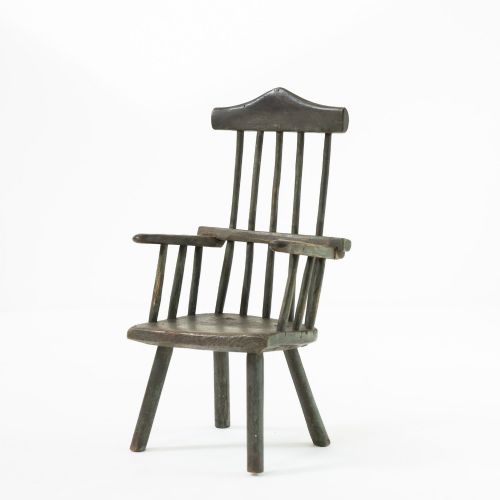
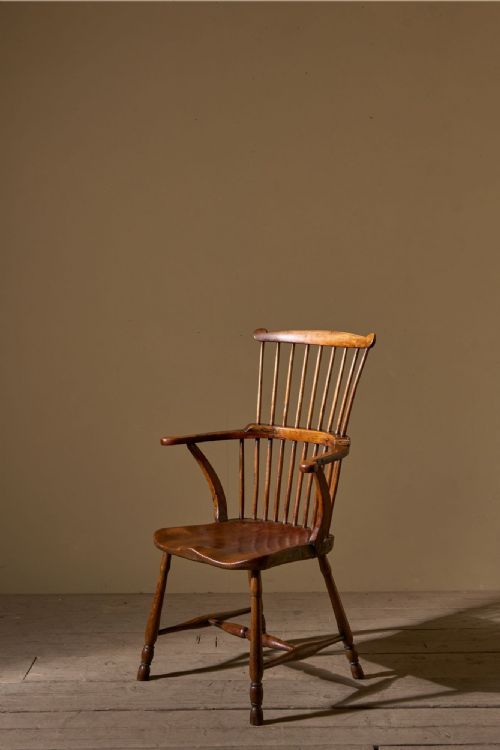


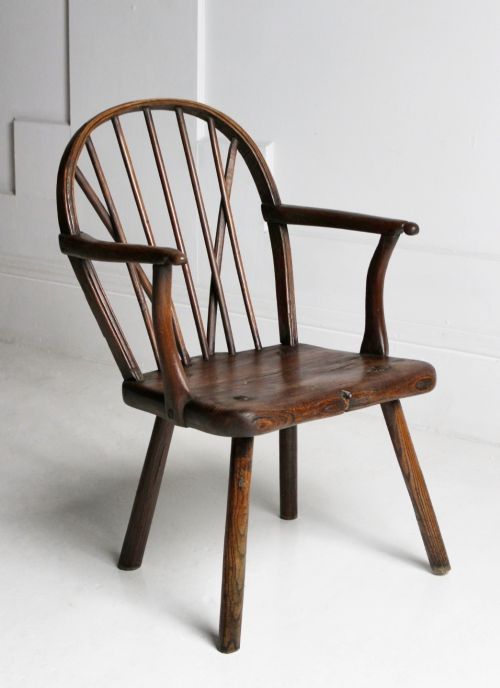


Primitive Elbow Chair
A primitive elbow chair offers rugged vernacular character and honest country craftsmanship, making it a robust seat for daily use.
Primitive Elbow Chair
A primitive elbow chair is a piece of vernacular country seating shaped by regional makers working outside urban guild traditions. These chairs combine deep seats with sturdy arm supports, often designed for farmhouse kitchens or fireside placement.
The primitive elbow chair examples on this page span the eighteenth and nineteenth centuries, including Georgian country pieces and Irish vernacular items. Adult armchairs appear alongside smaller children's armchairs and stick back designs.
Makers utilised local timbers rather than exotic imports, resulting in honest regional variations. You are most likely to meet elm and ash combinations, alongside comb back and stick back forms.
How they were made
Construction relies on solid native timbers, pairing elm for carved seats with ash, beech or fruitwood for bentwood bows and spindles. Craftsmen bored legs and spindles directly into thick plank seats using traditional augers.
Comb back and hoop back configurations required steam-bending green wood to form the curved armrests and crest rails. Surviving examples often retain original paint surfaces or scrubbed timber patination built up through generations of use.
Listings feature eighteenth and nineteenth century periods, utilising elm, ash, oak, yew, fruitwood, laburnum, beech and paint.
What varies in quality
Quality rests in the balance of timber selection and the retention of original surface patination. Multi-wood pieces utilising yew, laburnum and fruitwood together command attention through visual depth and complex grain contrast.
Proportion and structural honesty separate everyday utility pieces from exceptional country seating. Chairs retaining their original painted finishes or untouched surface wear demonstrate superior historical integrity.
The Primitive Elbow Chair Glossary
- Vernacular
- Unpretentious regional manufacturing rooted in local tradition rather than high-style metropolitan fashion. These items prioritise functional utility over academic design rules.
- Comb back
- A Windsor chair variation where the vertical spindles extend through a flat top rail, resembling the teeth of a dressing comb. This arrangement strengthens the upper back frame.
- Stick back
- A chair construction method where turned or cleft spindles are wedged directly into a solid wooden seat. It forms a lightweight yet rigid structural support.
- Hoop-back
- A continuous bentwood rail forming both the armrests and the upper back support. It distributes sitting pressure evenly across the frame.
- Elm
- A tough, interlocking timber commonly selected for chair seats because it resists splitting when driven with legs and spindles.
Primitive Elbow Chair: Frequently Asked Questions
What is a primitive elbow chair?
A primitive elbow chair is a traditional country armchair built by regional carpenters using local hardwoods. These seats emphasise structural function and honest joinery over formal decorative styles.
They appear in various regional idioms across eighteenth and nineteenth century Britain and Ireland, reflecting the materials available to local makers.
How were these chairs used?
These chairs served around farmhouse hearths, in kitchens, and within communal cottage spaces for daily seating. Their sturdy arm supports and solid wood seats provided durable comfort for working households.
Smaller children's versions offered portable seating for younger family members in domestic settings.
How do I live with one?
Place a primitive elbow chair where its sculptural lines and aged timber can stand as a focal point in a room. Pair it with simple interiors to let the historic grain and surface patination show clearly.
Keep the timber away from direct heat sources to prevent wood shrinkage and protect the original surface finish.
How do I tell periods apart?
Eighteenth century examples often display deep comb back structures and robust elm and ash construction. Nineteenth century pieces frequently incorporate varied secondary timbers like yew, fruitwood and laburnum.
Form changes over time from heavy joined panel work towards lighter stick and Windsor configurations.