
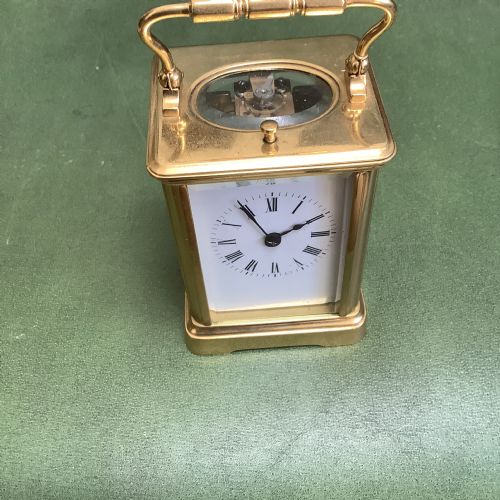


Portable Brass Timepiece
A portable brass timepiece offers mechanical precision enclosed in metal and glass, giving a traveller dependable hours on the move.
Portable Brass Timepiece
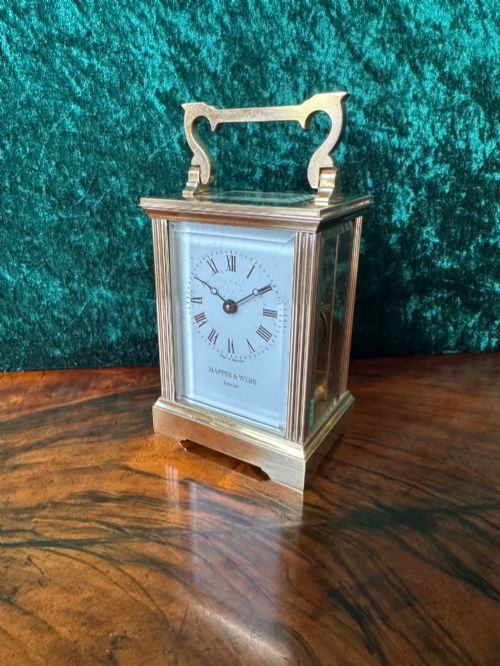
A portable brass timepiece encompasses carriage clocks, pocket sundials, and scientific instruments designed for mobility during the Victorian, Edwardian, and Art Deco eras. When searching for a portable brass timepiece, buyers encounter numerous French and English examples spanning from eighteen fifty to nineteen fifty. The selection on this page centres heavily on carriage clocks housed in brass and gilt brass cases.
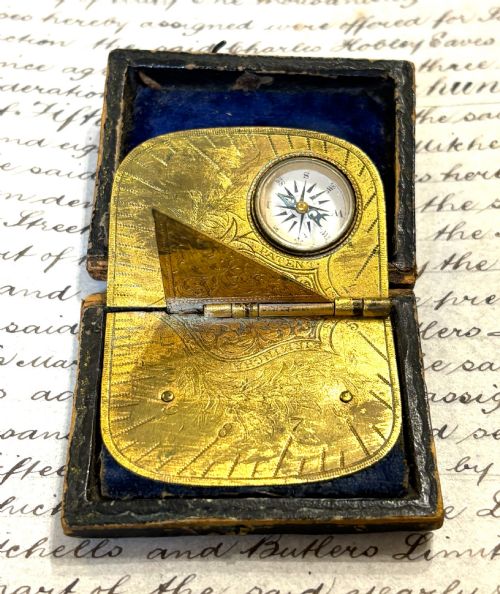
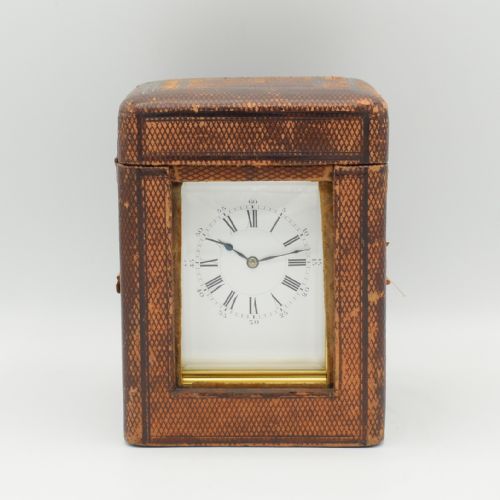
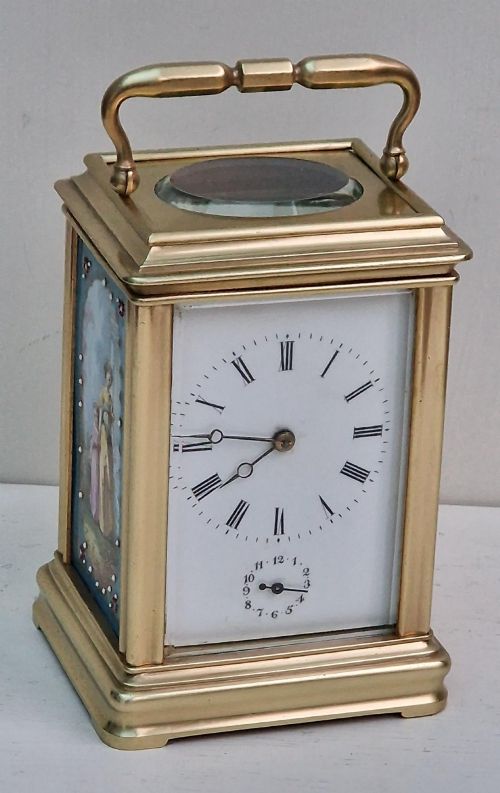
Most items take the form of carriage clocks fitted with glass panels and enamel dials, frequently accompanied by original travel cases in leather or leatherette. Miniature versions and striking models appear alongside specialised pieces like Butterfield type folding pocket sundials and sweep seconds clocks for the China market. These objects reflect the nineteenth and twentieth century reliance on mechanical timekeeping away from the stationary mantel clock.
Materials and construction
Every portable brass timepiece relies on a foundation of brass or gilt brass, cast and polished to form robust protective frames for delicate movements. Glass panels enclose the mechanism, allowing a view of the escapement while shielding the components from dust during travel.
Dials are typically executed in white enamel with painted numerals, paired with fine metal hands. Surviving pieces often retain protective outer cases constructed from leather or leatherette, sometimes lined with velvet or silk.
Some nineteenth-century French makers built specific carriage clocks with sweep seconds specifically for export to the China market.
Judging quality and craftsmanship
Quality in a portable brass timepiece reveals itself in the crispness of the casting and the refinement of the movement. Heavier gilt brass cases and complex complications such as strike repeat functions or porcelain panels indicate superior workshop output.
Makers known for high standards, including Henri Jacot or Paul Garnier, distinguished their output through precision engineering and signed movements. The presence of a matching travel case and undamaged enamel dials further elevates the standing of an individual piece.
Henri Jacot·Mappin and Web·Pickford of London·Paul Garnier
The Portable Brass Timepiece Glossary
- Carriage clock
- A small, spring-driven clock designed for travellers, featuring a carrying handle and glass panels. Originating in the nineteenth century, these clocks use a platform escapement to maintain accuracy despite motion.
- Platform escapement
- The tiny regulating assembly containing the balance wheel and hairspring, mounted on a small platform inside the clock. This innovation allowed portable timepieces to keep accurate time without needing a stationary pendulum.
- Butterfield sundial
- A small folding pocket dial featuring a bird-shaped gnomon adjustable for different latitudes. Invented in the late seventeenth century, these brass instruments remained popular portable timekeepers into the Victorian period.
- Strike repeat function
- A mechanism operated by pushing a button on the case, causing the clock to repeat the last struck hour and quarters. This was essential for checking the time in the dark while travelling.
- Gilt brass
- A brass base metal treated with a thin layer of gold or gold-coloured wash to improve appearance and prevent tarnish. This finish was standard for higher-end nineteenth-century carriage clocks.
Portable Brass Timepiece: Frequently Asked Questions
What is a portable brass timepiece?
A portable brass timepiece is a mechanical clock or instrument built for travel, housed in a durable metal case with a carrying handle.
These pieces use spring-driven movements and platform escapements rather than pendulums, allowing them to function reliably while being moved.
How were carriage clocks used?
Carriage clocks accompanied nineteenth-century travellers on coaches and trains, providing reliable time away from home.
Owners typically stored them in protective leather cases lined with velvet to absorb the jolts of rough roads.
How do I wind my clock?
Most pieces require a specialised winding key inserted into arbours on the backplate or dial face.
Care must be taken not to over-wind the mainspring, turning the key gently until resistance is met.
How are periods told apart?
Early examples from the mid nineteenth century often feature precision signed movements by makers like Paul Garnier.
Later pieces from the Edwardian and Art Deco periods adopt simpler machine-made standards and distinct geometric case designs.