




Brass Alarm Carriage Clock
A brass alarm carriage clock combines portable timekeeping with a mechanical alarm, housed in a metal case designed for travel.
Brass Alarm Carriage Clock
A brass alarm carriage clock is a portable timepiece developed for travel and domestic use during the nineteenth century. These clocks originate primarily from French makers working in styles spanning the Victorian era, the Second Empire, and the Directoire period. Pieces found here typically date from the middle of the nineteenth century through the year nineteen hundred.
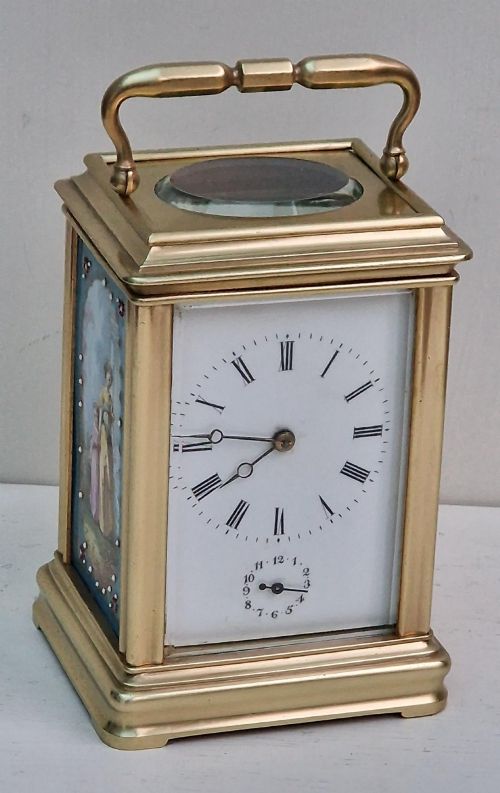
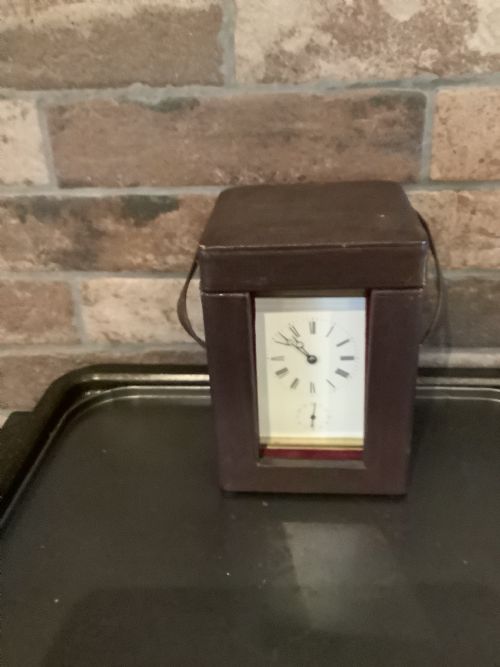
The majority of these objects are housed in polished brass, gilt brass, or gilt bronze cases with glass panels that expose the movement within. Common forms range from corniche and gorge cases to miniature formats, frequently accompanied by original leather travel cases and winding keys. Enamel dials and porcelain panels often decorate the face and sides.
Materials and Construction
Cases rely heavily on brass, gilt brass, and gilt bronze, shaped into corniche or gorge profiles to hold bevelled glass panels. Steel components operate the mechanical gear trains, striking mechanisms, and alarm functions inside the housing. Enamel and porcelain provide smooth surfaces for painted dial faces and decorative side panels.
Movements are built for eight-day operation, incorporating complications such as strike-repeat functions, grande sonnerie or petite sonnerie striking, and alarm mechanisms. Engraving is applied directly to the metal cases and interior masks, while leather forms fitted outer protection boxes for transport.
Listings feature brass and gilt bronze cases housing glass panels, enamel dials, and porcelain panels from the Victorian period.
Quality Variations
The precision of the metalwork distinguishes different tiers of manufacture. Heavily engraved gilt bronze cases and intricate gorge framing require advanced skill compared to plain polished brass corniche designs. Fully engraved masks and detailed enamel work indicate higher standards of workshop production.
Complications integrated into the movement alter the sophistication of a piece. Simple time and alarm pieces differ from those housing grand sonnerie striking, quarter repeating, and patent alarm mechanisms by makers such as Drocourt or Antoine Redier. The presence of original fitted boxes and matching keys further influences the standing of an individual clock.
Antoine Redier of Paris·DROCOURT·J. F. Bautte Et Cie·Bourdin·Hunt & Roskell·E. White
The Brass Alarm Carriage Clock Glossary
- Gorge case
- A stepped brass case design with a concave top moulding commonly found on French timepieces. This style provides a substantial housing for complex striking movements.
- Corniche case
- A rectangular brass case featuring simple columnar pillars at the four corners and flat top and bottom plates. It represents a standard housing shape for nineteenth century travel clocks.
- Grande sonnerie
- A striking system that chimes the hours and the quarters automatically on every quarter hour. It is a complex mechanical complication found in advanced nineteenth century movements.
- Platform escapement
- The horizontal assembly containing the balance wheel and escapement placed visibly at the top of the movement. This regulation unit allows portable clocks to keep time while moving.
- Repeat button
- A button on the top of the case that causes the clock to repeat the last struck hour and quarter on demand. It operates independently of the running gear train.
Brass Alarm Carriage Clock: Frequently Asked Questions
How do I set the alarm on a carriage clock?
The alarm mechanism is typically set using a secondary winding arbor and a small auxiliary dial located on the backplate of the movement. Turning the hand or pointer to the desired hour engages the internal hammer to strike the bell or gong.
Ensure the alarm spring is fully wound using the designated key square. When the hour hand reaches the set point, the mechanical trip releases the alarm train.
What is a gorge case?
A gorge case is a distinct architectural brass housing style characterised by its stepped top plate and concave moulding beneath the handle. This robust frame holds bevelled glass panels securely on all sides.
Originating in nineteenth century French workshops, it often encloses movements with high-grade striking and repeating complications.
How do I wind an antique carriage clock?
Winding requires a matching double-ended key fitted to the arbors on the backplate. Timekeeping, striking, and alarm functions each have separate arbors that require gentle tension.
Care must be taken not to over-wind the mainsprings. Most nineteenth century movements operate for eight days on a full wind.
What is the difference between petite sonnerie and grande sonnerie?
A petite sonnerie strikes the hours on the hour and only the quarters on the quarter hours without repeating the hour. A grande sonnerie strikes both the hours and the current quarters every time the quarter chimes sound.
Both systems represent high levels of nineteenth century horological complexity.
Are original leather cases common?
Original leather travel cases survive with select pieces, designed to protect the brass housing and glass panels during transit. These fitted cases often feature velvet or silk linings and cutouts for the winding key.
Finding a clock with its matching box adds significantly to the historical completeness of the object.