



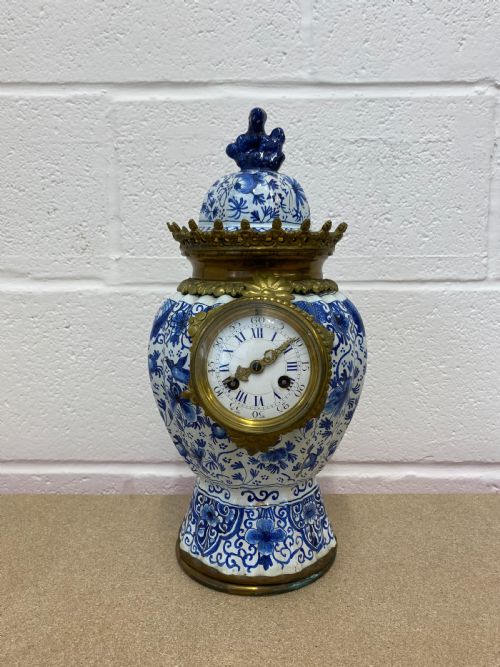


Porcelain Urn Mantel Clock
A porcelain urn mantel clock marries timekeeping with sculptural ceramic artistry, bringing nineteenth-century French elegance straight to the mantelpiece.
Porcelain Urn Mantel Clock
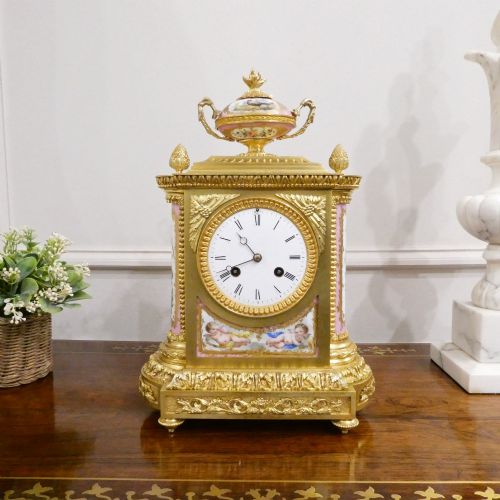
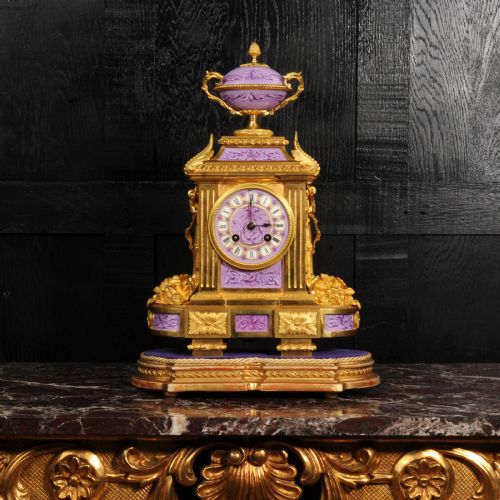
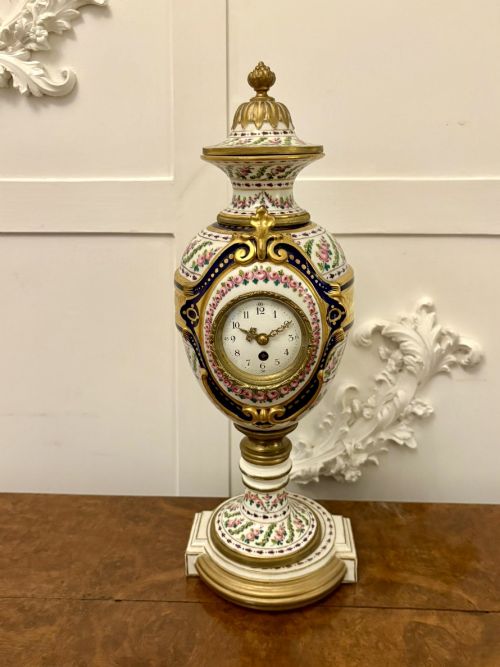
When you search for a porcelain urn mantel clock, you encounter decorative timepieces fashioned primarily during the nineteenth century, often within French workshops. These objects frequently take the form of classical urns mounted on ornate bases, combining functional clock movements with hand-painted ceramic vessels.
The pieces appearing on this page span the Victorian era, the Second Empire, and the Belle Epoque, with dates ranging from the middle of the nineteenth century into the nineteen-hundreds. Alongside single mantel clocks, many examples arrive as three-piece garniture sets accompanied by matching side vases.
Makers and makers' marks point firmly towards Parisian production centres and notable German porcelain houses like KPM Berlin, alongside occasional Chinese export adaptations mounted in gilt bronze. French Rococo Revival and Louis XVI styles dominate the designs, marked by symmetry, classical foliage, and urn configurations.
Judgements of quality
Distinctions across the range depend heavily on the crispness of the gilt bronze or ormolu chasing and the finesse of the hand-painted porcelain. Superior examples display deeply sculpted mounts with clean, sharp details alongside finely articulated ceramic painting rather than transfer prints.
Complete three-piece garniture sets featuring original glass domes sit higher in desirability than isolated timepieces. Furthermore, documented movements by known makers such as Japy Frères or Achille Brocot elevate the standing of a piece compared to unmarked anonymous machinery.
Porcelain Urn Mantel Clock Retail Price Guide 2026
Typical asking prices for porcelain urn mantel clock among the pieces listed under this phrase on Sellingantiques today, from the lower quarter to the upper quarter. They describe what is for sale here now, not the wider market.
Listings feature nineteenth-century pieces spanning the Victorian, Second Empire, and Belle Epoque periods, constructed from porcelain, gilt bronze, ormolu, and onyx.
Japy Freres·Jean-Baptiste Delettrez·Achille Brocot·Japy Frers·KPM Berlin·Vincenti of Paris
The Porcelain Urn Mantel Clock Glossary
- Ormolu
- Gilt bronze produced by applying a finely ground mercury and gold amalgam to a bronze casting, then heating to drive off the mercury. This technique yields a durable, rich golden surface typical of nineteenth-century French luxury goods.
- Garniture set
- A matched group of decorative ornaments, usually consisting of a central clock flanked by two matching vases or candelabra. These sets were designed to display symmetrically on a mantelpiece or sideboard.
- Japy Frères
- A prominent nineteenth-century French manufacturing dynasty known for producing robust, high-volume clock movements. Their works appear frequently in better-quality mantel clocks of the period.
- Sèvres style
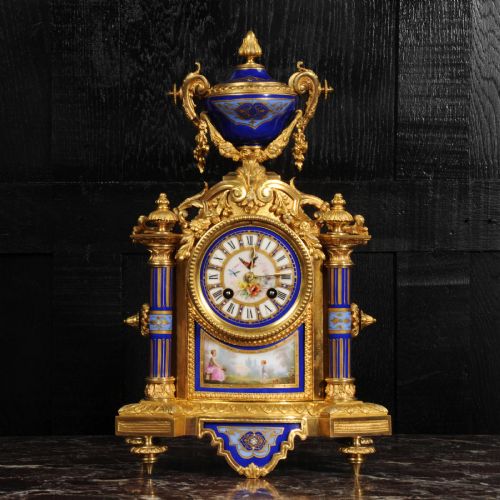
- A term describing porcelain decorated in imitation of the famous French royal factory, typically featuring rich blue grounds, hand-painted reserves of figures or flowers, and heavy gilding. Much of this work dates from nineteenth-century revival periods.
- Cloisonné
- A technique where enamel paste is applied within compartments created by soldering flat metal wires to a metal base. This method adds vibrant colour and intricate pattern to decorative clock mounts.
Porcelain Urn Mantel Clock: Frequently Asked Questions
What is a clock garniture?
A clock garniture is a matched decorative set comprising a central mantel clock accompanied by two side pieces, such as urns or vases. These items were designed to create a balanced, symmetrical display on a fireplace mantel.
The side pieces often mirror the materials of the clock, combining porcelain urn bodies with gilt bronze mounts to tie the decorative scheme together across a room.
How do I wind the clock?
Winding typically requires a specific key inserted into winding holes on the enamel dial. Turning the key tensions the internal springs that drive the timekeeping and striking trains.
Care must be taken not to over-wind the movement, as this can damage the internal springs. Many nineteenth-century movements require careful handling by someone familiar with mechanical clocks.
Are these clocks accurate timekeepers?
Nineteenth-century mechanical movements can keep reasonable time when properly serviced, but they rarely match the precision of modern quartz clocks. Changes in temperature and the levelness of the mantelpiece affect their daily performance.
Routine maintenance by a professional clockmaker is usually necessary to keep the pendulum beating steadily and the strike train functioning correctly.
How do I identify a Sèvres style clock?
Sèvres style clocks generally feature rich coloured grounds, most notably deep cobalt blue, paired with hand-painted pastoral scenes or floral bouquets framed in raised gilding. Faux factory marks are common on nineteenth-century revival pieces.
The quality of the hand-painting on the porcelain panels and the weight of the gilt bronze mounts usually distinguish finer decorative interpretations from simpler commercial pieces.
Where should I place a glass dome?
Glass domes sit directly over the clock or garniture set on a matching wooden or brass base to protect delicate gilding and dust-sensitive painted surfaces. They were popular in the nineteenth century to preserve fragile ormolu and porcelain.
Placement requires a stable, flat surface away from high-traffic areas to prevent accidental knocks, as nineteenth-century blown glass and heavy bronze bases can be hazardous if tipped.