



Pink Hand Painted Vases
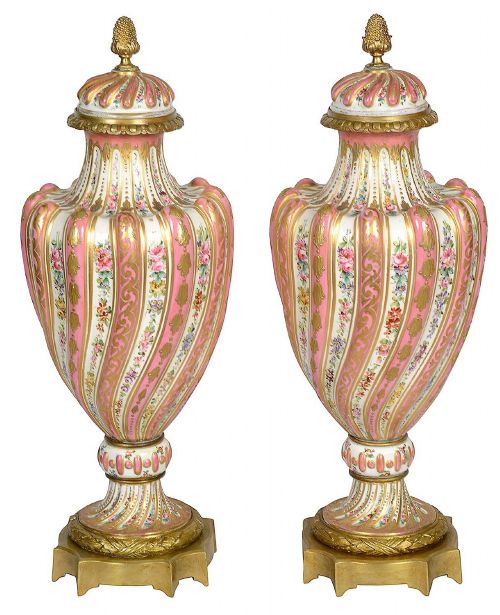
Pink hand painted vases bring together delicate porcelain forms and expressive brushwork, offering a striking display of colour and craftsmanship.
Pink Hand Painted Vases
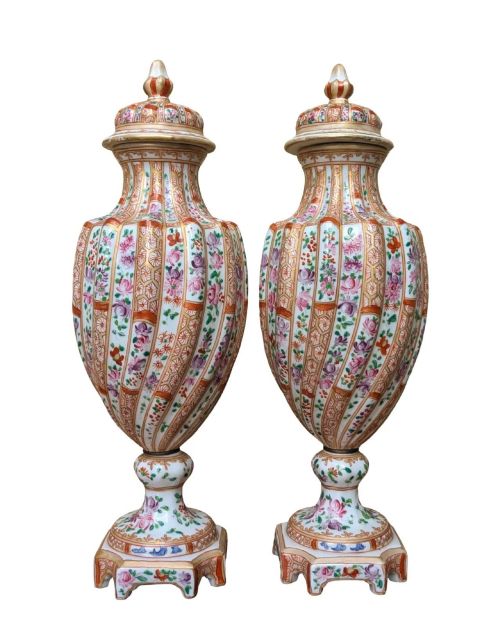
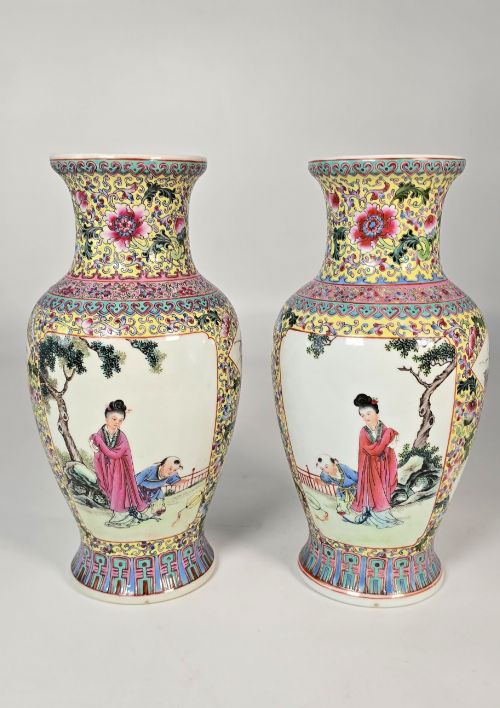
These pink hand painted vases span diverse origins and forms, ranging from nineteenth-century Chinese export porcelain to Victorian English glassware and European factory pieces. You will frequently encounter nineteenth-century production, including Canton and Famille Rose wares alongside English and continental porcelain.
The selections on this page comprise decorative urns, lidded jars, ginger jars, and twin-handled vessels, as well as several pieces converted into table lamps. Forms vary from monumental floor vases to modest mantel garnitures and table companions.
Makers and regional styles represented include Chinese Qing dynasty workshops, French Sevres-style porcelain, and English manufacturers such as Royal Worcester and Thomas Webb.
How they were made
Makers applied hand-painted enamel and glaze directly onto porcelain bodies or coloured glass, often incorporating gilt and gold leaf highlights. Technique relied on precise brushwork for figurative and botanical scenes, fixed by kiln firing.
Mounts in brass, ormolu, and wood frequently complement the ceramic and glass bodies, adding structural support and decorative framing to urns and lidded vessels.
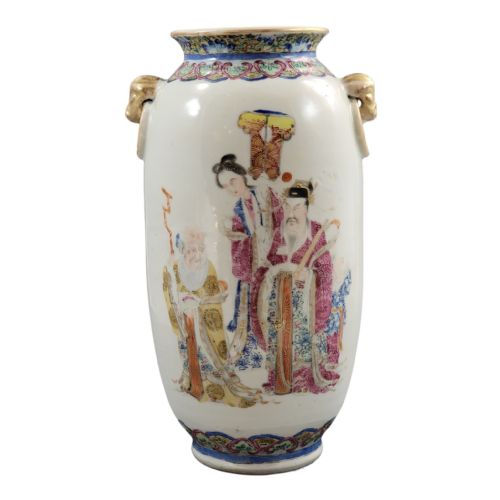
Magu and Shoulao occasionally share the pink porcelain stage with Taoist immortals and courtly figures.
What varies in quality
Quality rests in the precision of the hand-painted brushwork and the delicacy of the enamel work on the pink ground. Superior examples exhibit intricate detail in figures and flora, with crisp definition where glaze meets body.
The crispness of gilding and the weight and clarity of the underlying porcelain, glass, or crystal define the upper tier of the range. Mounting work in ormolu or brass also distinguishes standard production from more ambitious decorative items.
Thos. Webb & Sons·Royal Worcester·Coalport·Derby·Vion & Baury
The Pink Hand Painted Vases Glossary
- Famille rose
- A major palette of Chinese ceramic glazes introduced in the Qing dynasty, distinguished by opaque pink enamel derived from colloidal gold. This palette allows for soft gradations of tone in floral and figurative panels.
- Lustre
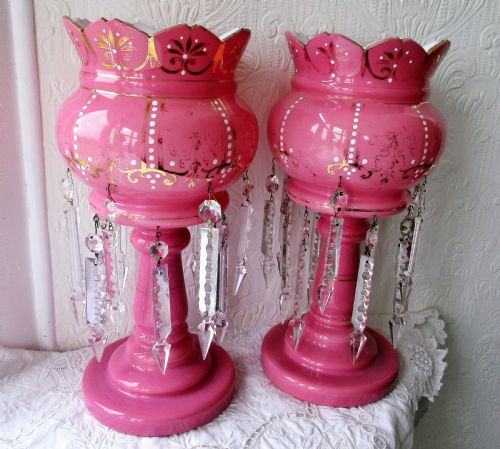
- A type of decorative vase or urn hung with cut glass prisms, designed to reflect candlelight from a mantelpiece. Victorian examples frequently utilise pink glass.
- Rose medallion
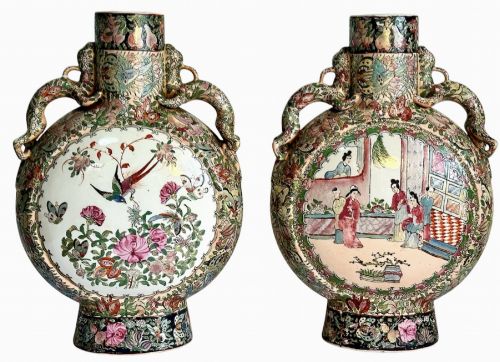
- A compartmentalised style of Canton porcelain decoration featuring alternating panels of figures and birds set against pink grounds and floral infill. The style became immensely popular for export during the nineteenth century.
- Orsola
- An alternative spelling reference or misreading for ormolu, denoting cast and gilt-bronze mounts applied to ceramic bodies. These mounts elevate the decorative presence of European lidded vases.
- Burmese ware
- A shaded art glass shading from pale yellow to pink, developed by makers such as Thomas Webb and Sons. The glass reacts to heat during manufacture to produce its distinctive graduated colour.
Pink Hand Painted Vases: Frequently Asked Questions
What periods do these pink hand painted vases come from?
The selection spans primarily the nineteenth century through the early twentieth century. You will find Victorian English pieces alongside Qing dynasty Chinese export works.
Dates range from the mid nineteenth century into the Edwardian era and 1930s. Each period brings distinct ceramic bodies and painting styles.
How do I distinguish Chinese export from European porcelain?
Chinese pieces often feature Famille Rose palettes, Rose medallion panels, and specific export forms like moon flasks and ginger jars. The paste and iron-foot marks differ markedly from European factories.
European makers such as Royal Worcester or Sevres-style ateliers adopt distinct porcelain formulas and characteristic western floral or figurative motifs.
Were glass lustre vases used for lighting?
Mantel lustres were designed primarily to sit on mantelpieces and catch the ambient light from fires and candles through their hanging glass prisms. Their reflective pink glass enhanced the illumination in Victorian rooms.
They served a decorative function as garniture sets rather than serving as functional vessels for cut flowers.
Can converted lamp bases be returned to standard vases?
Many vases were mounted and wired as table lamps during the twentieth century, sometimes with drilled bases or fitted collars. Reverting them depends entirely on the method of conversion used.
Buyers should examine how the fitting was secured to assess whether original ceramic or glass integrity remains intact beneath the electrical hardware.