
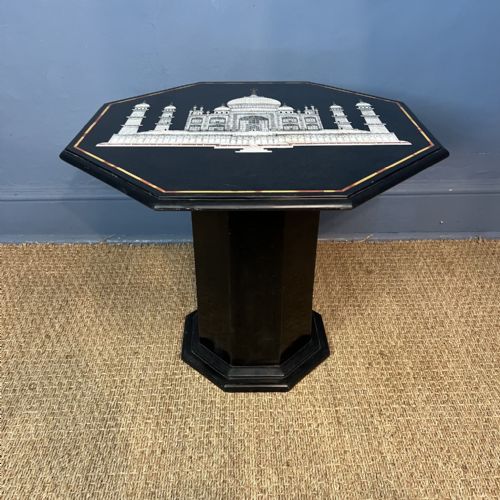


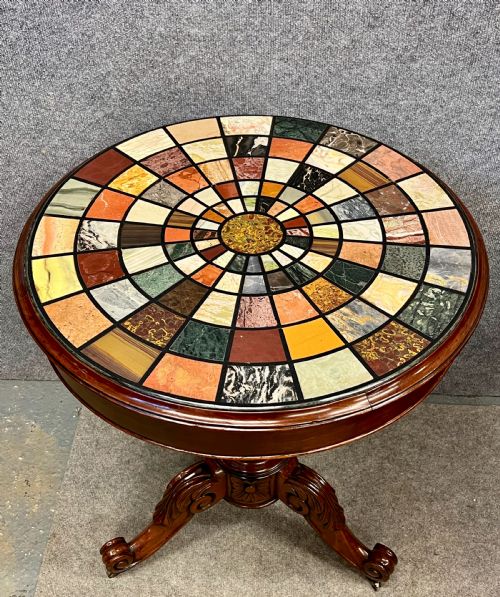


Pietre Dure Table
These pietre dure tables combine hardstone mosaic tops with timber frames, offering a striking centrepiece for any room.
Pietre Dure Table
The most common examples on this page date from the nineteenth century, including Regency and Victorian periods, alongside Grand Tour pieces and Italian works. These tables serve both decorative and functional roles in a room.
Support structures vary widely, from mahogany and rosewood to oak and walnut, occasionally featuring specific designs like swan supports. Tables may take circular, octagonal, or low rectangular shapes depending on their origin and intended use.
Materials and construction
The defining characteristic of these pieces is the hardstone or specimen marble top, composed of meticulously fitted coloured stones. Artisans shape jaspers, agates, and marbles to form geometric patterns or pictorial designs.
Timber frames use cabinet timbers such as rosewood, mahogany, satin birch, and walnut. Brass mounts and slate foundations occasionally provide additional structural support and weight to the table tops.
Object forms include chess tables, lamp tables, desks, and low centre tables.
Qualities of execution
Quality in a pietre dure table rests on the precision of the stone inlay work and the tightness of the joints between individual marble pieces. Finer examples display seamless integration of the hardstones with minimal grout lines.
The timber chassis and support structures match the standard of the stone top, utilising dense hardwoods like rosewood or mahogany. Superior pieces exhibit refined turning, carving, and stability in bases such as swan supports.
Joseph Darmanin and Sons
The Pietre Dure Table Glossary
- Pietre dure
- Hardstone mosaic work using sliced and fitted coloured stones to create decorative patterns. This Italian technique forms the visual centrepiece of these tables.
- Specimen marble
- Marble tops assembled from various distinct types and colours of stone. These pieces often record geological variety in a single surface.
- Grand Tour
- The nineteenth-century practice of wealthy travellers collecting art and furniture across Europe. Tables from this context often incorporate Italian marble work.
- Centre table
- A freestanding table designed to be viewed from all sides in the middle of a room. These forms frequently showcase elaborate inlaid stone tops.
- Bonheur du jour
- A small ladies writing desk with a raised cabinet or tier. Listed examples incorporate inlaid stone panels within the writing surface.
Pietre Dure Table: Frequently Asked Questions
How do I care for the stone top?
The inlaid marble and hardstone surfaces require gentle cleaning with a soft, dry cloth to prevent scratching. Avoid acidic liquids or harsh chemical cleaners that can etch the polished stone.
Wooden bases benefit from occasional polishing with traditional beeswax suited to the specific timber. Keeping the table away from direct heat sources prevents the wood from warping and protects the stone joints.
Where were these tables made?
Many pietre dure tables originate from Italy, particularly associated with nineteenth-century Grand Tour travel and Florentine workshops. Maltese makers also produced notable examples during the same period.
English cabinet makers frequently imported these stone tops or created local frames to house them. This accounts for the presence of typical English Regency and Victorian furniture styles combined with continental stone tops.
How do I date a pietre dure table?
Dating relies primarily on the style of the wooden base, such as Regency or Victorian aesthetic markers. Timber choices, including rosewood and mahogany, align with specific decades of nineteenth-century production.
The construction methods of the table frame and the mineral composition of the specimen marble provide further chronological clues. Earlier eighteenth-century pieces display heavier proportions and distinct Italian construction techniques.