




Persian Tribal Saddle Bag
A persian tribal saddle bag brings the textured geometry of nomadic weaving directly into a room.
Persian Tribal Saddle Bag
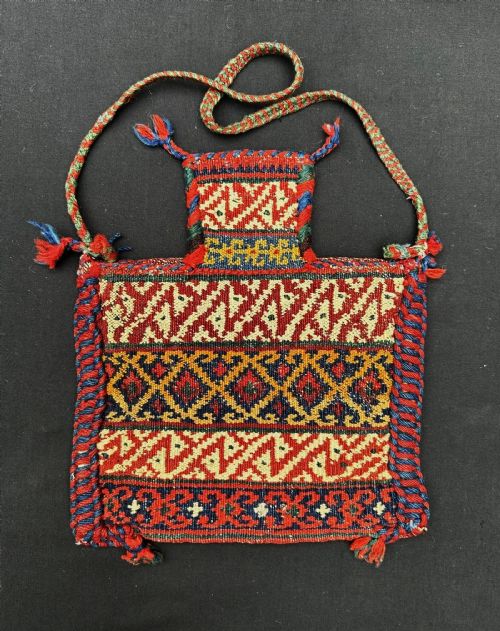
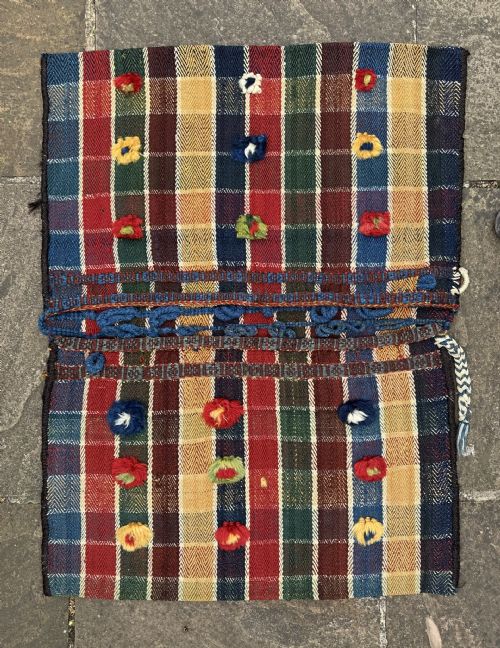
The format appears on this page as complete pairs, single faces, half bags, and vanity bags, alongside related forms like tobacco and pipe bags and khorjin. Many survive as solitary bag faces because the plain weave backs wore away through years of ground use or separation.
Dating across the listings spans the mid-nineteenth century through the early twentieth century, capturing the period before synthetic materials displaced traditional village production. Pieces originate from specific regional hubs such as Fars, Luristan, Azerbaijan, and Kerman Province.
How They Were Made
Weavers utilised hand-spun wool for the pile and foundation, combining it with cotton and occasionally leather or metal elements for structural reinforcement. Natural dyes provide the palette, yielding saturated tones that develop depth over decades of handling.
Construction techniques include pile weaving, soumak flatweave, and kilim structure, sometimes deployed within a single piece to create contrasting textures between field and border. Plain weave backs often accompany the decorated faces on complete examples.
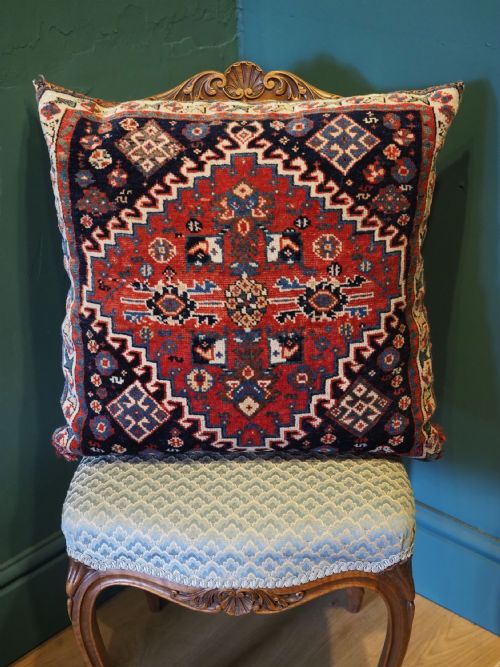
Many pieces started life strapped to a donkey and now lead a tranquil retirement as scatter cushions.
What Varies in Quality
Quality rests upon the handled handle of the wool and the crispness of tribal motifs such as boteh, tile patterns, and geometric medallions. Lustrous, luminous wool grade and precise structural execution distinguish superior nomadic weaving from standard utility output.
Preservation of the original format, whether a complete double bag with surviving plain weave back or an intact face with strong edge finishes, dictates the character of the piece. The complexity of regional design attributions and the clarity of natural dye saturation further separate examples.
The Persian Tribal Saddle Bag Glossary
- Khorjin
- The traditional Persian term for a saddle bag. These double-sided containers were slung across pack animals during tribal migrations.
- Soumak
- A flatweave technique involving wrap-threads around the warp, creating a textured surface without cut pile. Shahsavan weavers utilised this method frequently.
- Boteh
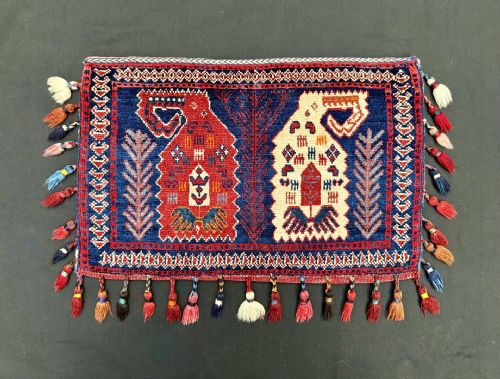
- A stylised floral motif resembling a curved almond or pear shape. Afshar and Qashqa'i pieces often feature this recurring design.
- Kilim
- A flatweave textile lacking pile. Several listings employ this structure for lightweight storage bags.
- Face
- The decorated front panel of a saddle bag. Many surviving examples exist as individual faces after the plain weave backs deteriorated.
Persian Tribal Saddle Bag: Frequently Asked Questions
What is a persian tribal saddle bag?
A persian tribal saddle bag is a utilitarian woven container made by nomadic groups in Iran for animal transport.
Weavers constructed them in pairs connected by a central web, utilising wool and natural dyes to form distinct geometric and tribal patterns.
How were saddle bags used?
Nomadic tribes packed these bags with household goods, grain, or personal possessions during seasonal migrations across Persia.
They hung across the flanks of horses, donkeys, or camels, functioning as heavy-duty storage on the move.
How do I live with a bag face?
Bag faces adapt easily to modern interiors as wall hangings, small floor rugs, or cushion covers when stuffed.
Their compact scale allows them to fit into hallways, studies, or smaller spaces where standard carpets prove too large.
How do I tell tribal groups apart?
Tribal attribution relies on specific structural habits, colour palettes, and motif variations native to particular regions.
For example, Shahsavan pieces often display soumak technique from Azerbaijan, while Qashqa'i and Afshar examples reflect the design vocabulary of Fars and Kerman.