

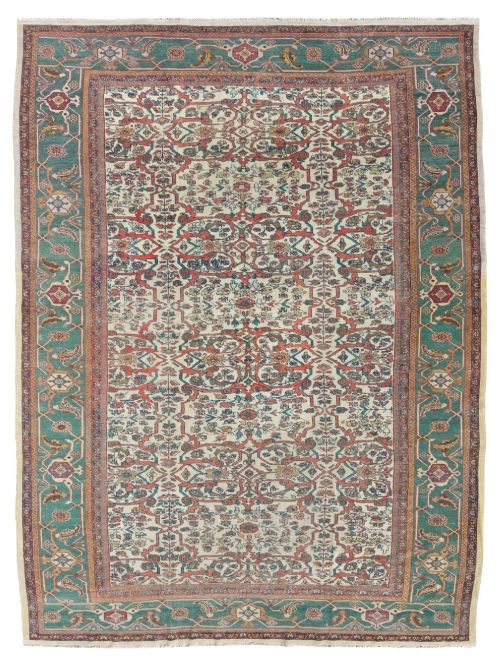


Persian Rug Green
These persian rug green examples bring rich historical tones and intricate patterns into a room, offering genuine character for traditional interiors.
Persian Rug Green
A persian rug green selection encompasses woven floor coverings and carpets originating from Persian workshops, featuring verdant ground colours from soft sage to deep emerald. Buyers seeking this phrase encounter room-sized carpets, gallery runners, and smaller area rugs dating from the mid-nineteenth century through to the early twentieth century.
Materials and construction
These textiles are constructed using natural materials such as wool, cotton, and occasionally silk foundations, combined with natural dyes derived from plants and minerals. Artisans knotted the pile by hand onto sturdy cotton or wool warps and wefts, creating dense structures designed for durability.
Block printing and painting techniques also appear on mid-nineteenth-century Qajar textiles, demonstrating varied artisan methods beyond knotted pile. The application of natural dyes ensures that the green grounds age with subtle tonal variations over decades.
Persian Rug Green Retail Price Guide 2026
Typical asking prices for persian rug green among the pieces listed under this phrase on Sellingantiques today, from the lower quarter to the upper quarter. They describe what is for sale here now, not the wider market.
Judging the quality
Quality rests upon the fineness of the knotting, the complexity of the design execution, and the stability of the natural dyes used across the green ground. Superior examples display precise drawing in the borders and field, alongside well-preserved pile height that maintains the integrity of the design.
The distinctiveness of the weaving style, whether a grand Fereghan carpet or a finely detailed Kashan, dictates the standing of an individual piece. Condition and the preservation of scarce colour grounds further distinguish finer examples from standard production.
Mohtasham Kashan·Ziegler And Company
The Persian Rug Green Glossary
- Ground
- The background field colour of a rug behind the primary motifs and medallions. In these pieces, the green ground is a defining characteristic.
- Boteh
- A traditional almond or paisley shaped motif filled with floral or vegetal details. This symbol appears frequently in Persian weaving.
- Warp
- The vertical threads stretched tightly on the loom that form the structural foundation of a knotted rug. Fringe is typically formed from the extended warp threads.
- Weft
- The horizontal threads passed across the warp threads between rows of knots to bind the structure together. It contributes to the rigidity and handle of the carpet.
- Medallion
- A large central decorative ornament placed in the middle of the rug field. It serves as the focal point of traditional Persian design.
Persian Rug Green: Frequently Asked Questions
How do I date a green persian rug?
Dating relies on stylistic indicators, structural analysis, and material evidence such as the use of natural dyes typical of nineteenth and early twentieth-century production.
Comparing knot density and design motifs with documented regional examples helps narrow the period of manufacture.
Are green grounds common in antique Persian carpets?
Green grounds are relatively scarce in antique Persian weaving because green dye was complex to produce stably using natural dyestuffs.
Most surviving traditional carpets utilised red or blue grounds, making verdant examples sought after by collectors.
How should I care for an antique wool rug?
Protect the textile from direct sunlight to prevent fading of the natural dyes and vacuum gently using a suction-only attachment without a rotating brush.
Professional cleaning by a specialist in antique oriental carpets is recommended every few years.
What is the difference between a Mahal and a Sultanabad?
Sultanabad and Mahal carpets share origins in the same region, with Sultanabad often denoting slightly finer knotting and bolder, large-scale Ziegler-influenced designs.
Both types are celebrated for room-sized formats and robust wool construction.