
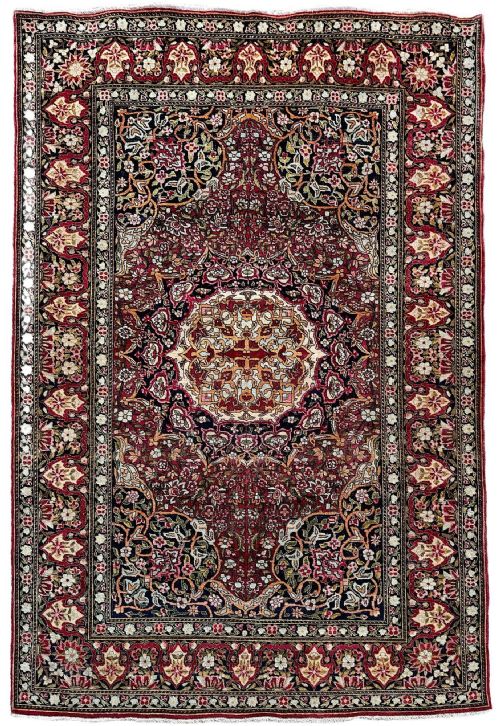
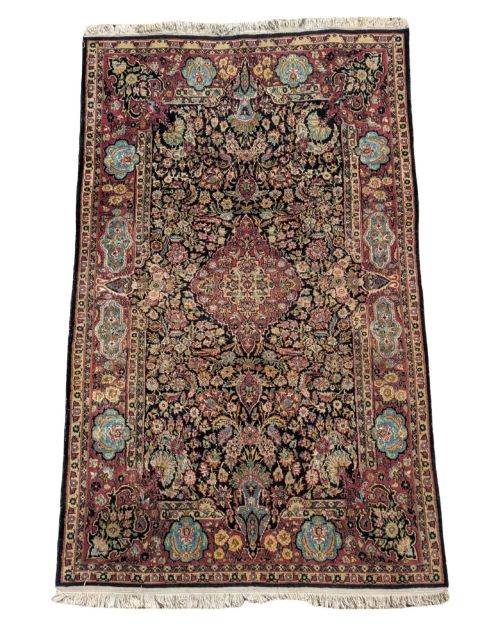
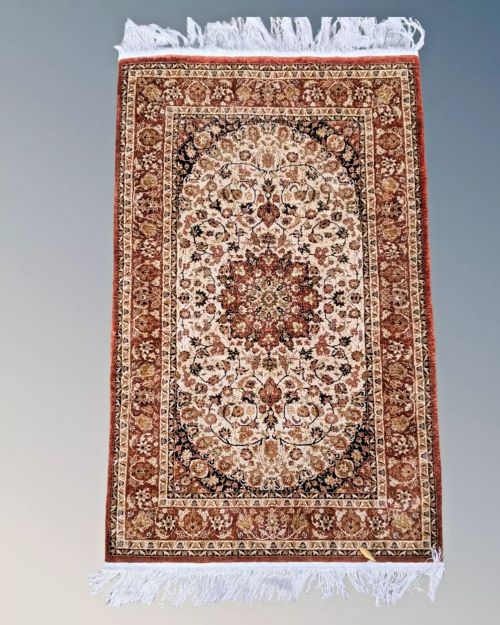
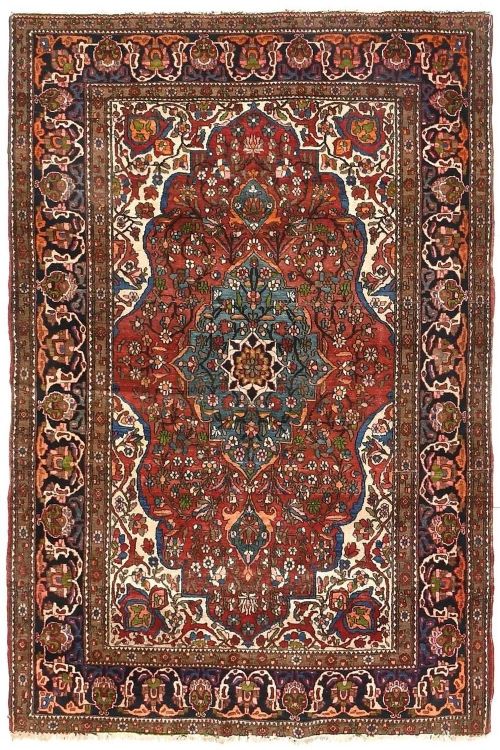


Persian Medallion Silk Rug
A persian medallion silk rug brings intricate central motifs and fine woven detail into a room, offering rich historical craftsmanship.

Persian Medallion Silk Rug
A persian medallion silk rug centres on a prominent central motif surrounded by detailed field patterns, often reflecting traditional weaving centres across Iran. The pieces available here span various formats including carpets, area rugs, and textile panels dating from the mid-nineteenth century to the early twentieth century.
Buyers encounter regional variations such as Isfahan, Tabriz, Kashan, Nain, and Senneh styles, alongside Kashmiri oriental examples and Rasht embroidered panels on felt. These items range from full silk constructions to wool foundations featuring distinct silk highlights or part-silk compositions.
How they were made
The construction relies on fine natural fibres, predominantly silk foundation yarns or silk pile combined with cotton and wool elements. Certain textile panels utilise silk embroidery stitched directly onto wool felt backings.
Weavers employed traditional techniques to articulate complex star and floral medallion designs, incorporating careful colour gradation and precise knotting or needlework to achieve enduring structural integrity.
Listings feature items spanning from 1850 through the 1900s, 1910, and 1930, utilising silk, cotton, wool, and wool felt.
What varies in quality
Quality rests in the precision of the medallion geometry and the crispness of the surrounding floral or field motifs. Tighter knot counts and finer silk thread create sharper definition and a more fluid drape.
The choice of materials also dictates the character of the piece, distinguishing full silk constructions from those utilising wool or cotton foundations with silk highlights.
The Persian Medallion Silk Rug Glossary
- Medallion
- A central ornamental motif forming the focal point of the rug design. It anchors the symmetry of the field patterns.
- Silk highlights
- Specific areas woven in silk to add lustre and contrast against a wool or cotton background. This technique accentuates particular floral or geometric elements.
- Rasht embroidery
- Needlework originating from northern Iran where coloured silk threads are applied to a felt backing. It produces dense, flat decorative panels with distinct floral motifs.
- Foundation
- The underlying structure of warp and weft threads that supports the pile or embroidery. Its material composition determines the flexibility and weight of the textile.
Persian Medallion Silk Rug: Frequently Asked Questions
How do I care for a silk rug?
Keep these textiles away from direct sunlight to preserve the natural dyed colours. Gentle professional cleaning is essential when needed, as moisture can damage delicate silk fibres.
Place the rug in low-traffic areas of the home to minimise friction and wear on the fine pile. Avoid harsh chemical treatments entirely.
How are different regional styles distinguished?
Regional types like Isfahan, Tabriz, Kashan, and Nain differ in their specific colour palettes, floral motifs, and knotting density. Each weaving centre developed distinct aesthetic preferences over generations.
Examining the border patterns and secondary motifs helps identify the specific origin. Materials and foundation structures also offer clues to provenance.
Are these pieces made entirely of silk?
While some examples utilise pure silk construction throughout the pile and foundation, others incorporate silk highlights on wool or cotton bases. Certain items are also executed as silk embroidery on felt.
Checking the specific material description clarifies the construction method used. Each variation offers a different texture and weight.