




Period Oak Trestle Table
These heavy timbers give a period oak trestle table its enduring gravity, offering substantial dining surfaces rooted in centuries of craftsmanship.
Period Oak Trestle Table
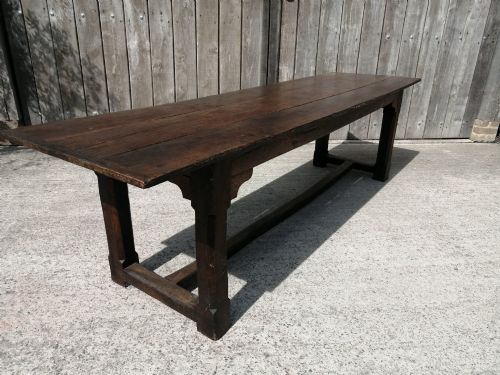
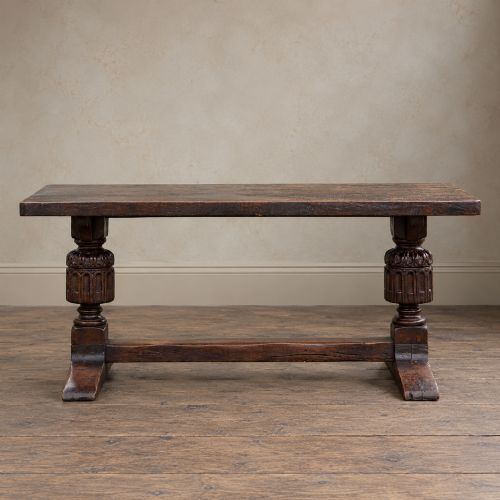
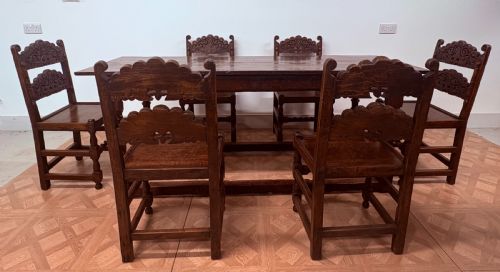
A period oak trestle table brings sturdy dining or library surfaces into a room, drawing on centuries of English cabinet-making traditions. When searching for a period oak trestle table, buyers encounter robust forms spanning the Tudor, seventeenth-century Jacobean, Charles II, George I, and William IV eras.
The selection here ranges from authentic sixteenth and seventeenth-century examples with single plank elm tops to later eighteenth-century interpretations and nineteenth-century library tables of broad scale. Makers often combined oak frames with elm tops to handle the daily demands of households.
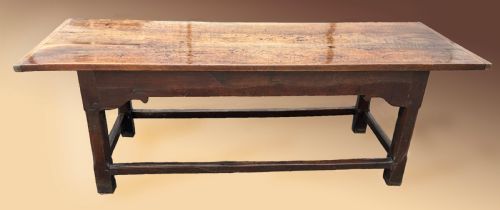
Farmhouse dining tables and refectory forms dominate the inventory, carrying the distinctive patination of age across their structural timbers. These large dining pieces anchor a space with functional history rather than mere decoration.
How they were made
Carpenters built these tables using solid oak for the primary framework, selected for its density and strength in supporting large surface areas. Tops frequently incorporate elm alongside oak, utilising timber grown locally to create thick boards secured to trestle bases.
Joinery relied on traditional pegged mortise and tenon joints rather than modern fasteners, allowing the wood to move naturally with seasonal humidity changes. Surfaces finished with simple hand-planing reveal the tool marks of early makers who shaped the boards by eye.
Period Oak Trestle Table Retail Price Guide 2026
Typical asking prices for period oak trestle table among the pieces listed under this phrase on Sellingantiques today, from the lower quarter to the upper quarter. They describe what is for sale here now, not the wider market.
Some tabletops retain the accidental notch marks of medieval diners who carved their lunch directly into the wood.
What varies in quality
The integrity of the original top relative to the base defines the standing of an antique table. Pieces retaining their original timber boards command greater respect than those assembled from mixed periods.
Proportion and scale dictate the visual weight of the piece, where broad widths and balanced underframes separate standard workshop production from finer examples commissioned for prominent interiors.
The Period Oak Trestle Table Glossary
- Refectory table
- A long dining table traditionally used in monastic refectories and later adopted in domestic halls. These forms provide the structural blueprint for many large wooden tables.
- Trestle base
- A support structure consisting of horizontal feet connected to upright posts that hold the main tabletop. This design offers maximum legroom along the length of the furniture.
- Plank top
- A surface constructed from several long boards joined edge to edge. Single or three-plank configurations are common in early examples.
- Patina
- The deep surface sheen developed through decades of handling, polishing, and natural oxidation. This finish indicates genuine age on hardwood furniture.
- Mortise and tenon
- A joint formed by inserting a shaped projection into a corresponding cavity and securing it with a wooden peg. It forms the backbone of traditional timber framing.
Period Oak Trestle Table: Frequently Asked Questions
How do I care for an old timber table?
Keep the wood away from direct heat sources and sudden humidity swings to prevent splitting in the boards.
Apply traditional beeswax occasionally to nourish the grain and maintain the natural sheen of the surface.
Can I use a historic table for daily dining?
These pieces were built for heavy domestic use and handle everyday family life quite well.
Use placemats and coasters to protect the aged finish from moisture rings and thermal shock.
How can I tell the period of the wood?
Examine the underside of the top and the joinery for hand-tool marks and structural wear patterns.
Early pieces show irregular tool texturing and pegged joints that differ markedly from later machine-cut methods.
What is the difference between refectory and library tables?
Refectory tables typically feature simpler trestle or four-leg underframes designed for dining halls.
Library tables often display broader proportions and occasional drawer arrangements suited for reading and writing.