




Period Mahogany Dining Suite
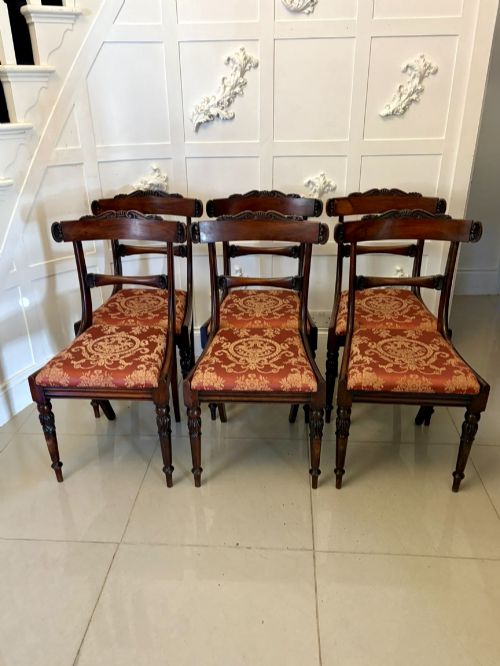
A period mahogany dining suite brings together matching chairs crafted from rich timber across Georgian, Victorian, and Edwardian eras for your principal room.
Period Mahogany Dining Suite
A period mahogany dining suite comprises matched sets of seating designed around a central table for formal meals and gatherings. These suites typically emerge from Georgian, Victorian, and Edwardian periods, reflecting changing tastes in domestic interiors.
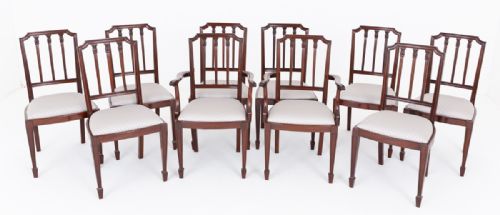
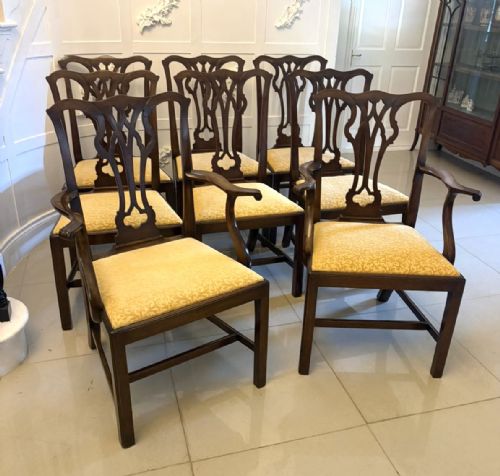
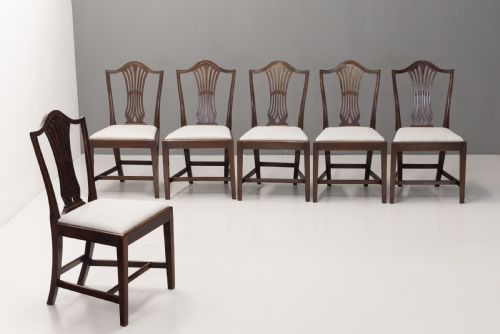
The selections available here consist entirely of dining chairs and salon chairs made from mahogany. Sets range from smaller groupings of four up to extensive suites of eighteen chairs, often combining carvers and single chairs.
Makers drew upon classical design vocabularies including Hepplewhite style, Chippendale revival, and George IV forms. Scottish origins and string inlay also appear among the listed pieces, demonstrating regional variation in British cabinetmaking.
How they were made
Cabinetmakers utilised solid mahogany and applied satinwood inlay to create durable frames with decorative contrast. Artisans shaped high splat backs, balloon backs, and straight or curved stiles using traditional hand woodworking techniques.
Upholstery materials such as fabric, textile, and leather were integrated into seat pads, secured with brass detailing. Frames incorporate structural timbers alongside the primary mahogany to ensure stability across large sets.
Period Mahogany Dining Suite Retail Price Guide 2026
Typical asking prices for period mahogany dining suite among the pieces listed under this phrase on Sellingantiques today, from the lower quarter to the upper quarter. They describe what is for sale here now, not the wider market.
The listings span multiple historical eras, recording pieces from the Georgian, Victorian, and Edwardian periods alongside specific dates from 1800 to 1900.
What varies in quality
Quality rests in the cohesion of the set and the crispness of carved details upon the mahogany frames. Larger suites that retain their original matched number of carvers and single chairs command greater attention from collectors.
The refinement of stylistic details, such as delicate string inlay or high splat back construction, distinguishes standard production from finer workshops. Selection of timber figure and the preservation of original upholstery materials also influence the character of each suite.
The Period Mahogany Dining Suite Glossary
- Carver
- An armchair with wooden armrests, historically placed at the head of a dining table. These frequently accompanied larger sets of single chairs.
- Satinwood
- A pale, lustrous timber utilised for contrasting inlay work on mahogany furniture. Cabinetmakers employed it to trace delicate lines across chair rails and splats.
- Splat
- The vertical wooden strip down the centre of a chair back. High splat versions offer distinct aesthetic profiles within nineteenth-century dining seating.
- Balloon back
- A rounded, scroll-topped chair profile popular during the Victorian era. This curved wooden form provided ergonomic support while softening the room's geometry.
- String inlay
- Fine, narrow threads of contrasting wood embedded flush into the primary surface. This linear ornament highlights the structural outlines of Edwardian salon chairs.
Period Mahogany Dining Suite: Frequently Asked Questions
How many chairs form a complete suite?
Dining suites vary considerably in size, ranging from intimate groupings of four chairs to large sets comprising ten, sixteen, or eighteen pieces.
Larger suites usually pair a smaller number of carvers with a larger count of single chairs to accommodate extended tables.
What is the difference between carver and slipper chairs?
Carver chairs feature supportive armrests and traditionally sat at the head and foot of the dining table.
Slipper chairs lack arms, allowing them to slide neatly beneath dining tables or serve as lighter salon seating.
How do I identify the period of a mahogany suite?
Dating relies upon stylistic markers such as Hepplewhite proportions, Victorian balloon backs, or Edwardian string inlay.
Examining timber selection, construction methods, and design revival movements helps narrow the decade of manufacture.
Are these chairs suitable for daily dining use?
These period suites were built from solid mahogany to withstand generations of domestic use and formal dining.
Living with them involves appreciating their structural durability while maintaining their upholstery and timber surfaces.