
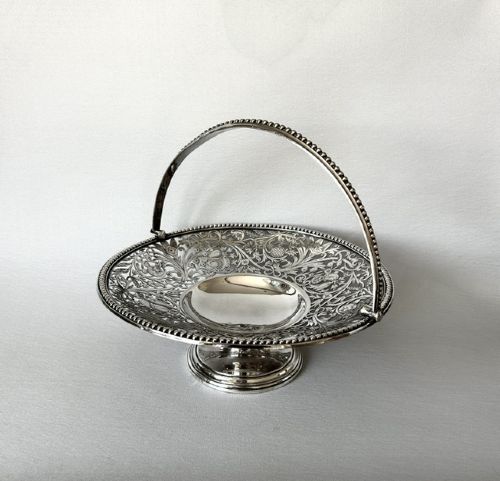
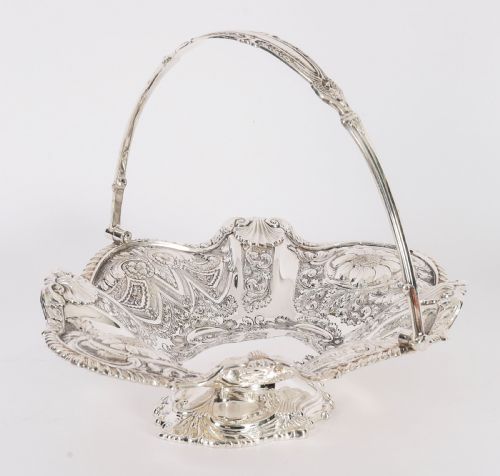
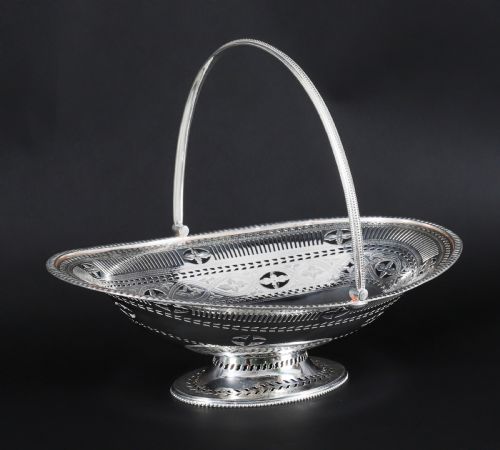
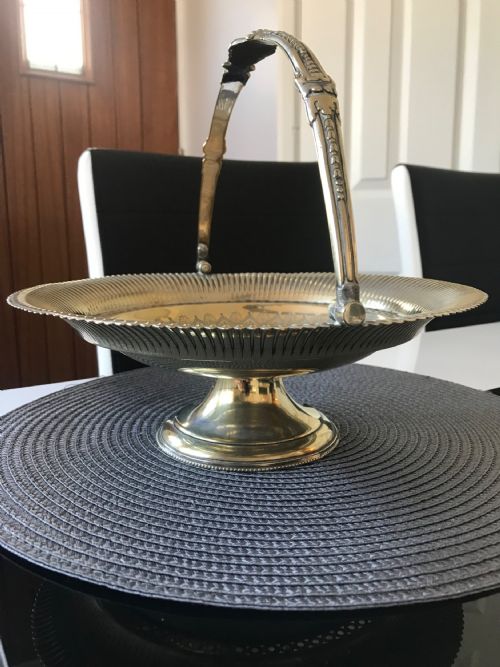


Pedestal Silver Cake Basket
A pedestal silver cake basket lifts your afternoon tea service with traditional elegance and raised display.
Pedestal Silver Cake Basket
A pedestal silver cake basket elevates sweet confections and fruit upon a raised foot, offering a distinct presence on the dining table. When searching for a pedestal silver cake basket, you encounter pieces spanning the Victorian and Edwardian eras, produced in both solid silver and silver plate.
The forms encompass elaborate Victorian neoclassical designs alongside flowing Art Nouveau curves, frequently featuring swing handles and pierced or fretwork galleries. Most examples function equally well as fruit baskets, bread baskets, or decorative centrepieces.
Victorian and Edwardian makers utilise traditional metals and glass inserts, creating substantial serveware intended for formal hospitality. These elevated vessels remain central to period dining arrangements and decorative displays.
Materials and construction methods
Silversmiths constructed solid sterling silver and silver plated items using techniques such as piercing, embossing, and fretwork to create delicate lattice patterns. Manufacturers like Hammond, Creake and Co and James Deakin and Sons applied these detailed embellishments across sturdy metal frames.
Electroplated nickel silver became a common base for silver plating during the nineteenth century, providing durability while maintaining a bright reflective finish. Swing handles were engineered with robust hinges to support the weight of the basket and its contents during service.
Listings feature items from the nineteenth century up to 1920, encompassing both solid silver and silver plate.
Assessing quality in period baskets
The depth and crispness of pierced fretwork and embossed detailing distinguish finer examples from standard production pieces. Heavier gauge metal ensures the pedestal base remains rigid and stable under weight, whereas thinner vessels flex too easily.
Intact silver plating without excessive wear to the base metal indicates careful preservation and superior original manufacturing standards. Maker marks from established firms like George W Scott and Sons or WMF also contribute to the distinction of a piece.
George W. Scott & Sons Ltd·Hammond, Creake & Co·James Deakin & Sons
The Pedestal Silver Cake Basket Glossary
- Pierced work
- Metalwork pierced through with decorative patterns to create openwork lattice designs. This technique lightens the visual weight of the vessel.
- Swing handle
- A movable arched handle attached to the rim by pivots, allowing it to drop to the sides. It facilitates easy lifting and compact storage.
- Electroplated nickel silver
- A base metal alloy coated with a layer of silver through an electrolytic process. It offered an accessible alternative to solid sterling silver.
- Neoclassical
- A decorative style drawing inspiration from classical Greek and Roman art. It relies on symmetry, urn motifs, and restrained geometric patterns.
Pedestal Silver Cake Basket: Frequently Asked Questions
What were pedestal silver cake baskets used for?
These elevated vessels served cakes, pastries, and bread during formal nineteenth and twentieth-century tea gatherings. Their raised pedestal kept food clear of the main table surface and presented baked goods prominently to guests.
Today, they transition easily into living spaces as decorative fruit bowls or standalone table centerpieces. Their generous proportions accommodate various display uses beyond traditional dining.
How do I clean a silver plated basket?
Clean silver plated baskets gently using a specialised silver polish and a soft cloth to protect the underlying metal. Avoid abrasive scrubbing pads that strip thin silver layers from electroplated surfaces.
Store the basket in a dry environment away from direct sunlight to minimise tarnishing between uses. Regular gentle dusting preserves the intricate pierced and embossed details.
How can I tell Victorian and Edwardian baskets apart?
Victorian examples often display heavy Rococo Revival curves or formal Neoclassical symmetry with deep embossing and ornate piercing. They date from the mid to late nineteenth century and frequently use silver plate.
Edwardian pieces tend to feature lighter lattice work or fluid Art Nouveau motifs reflecting early twentieth-century tastes. Hallmarks on solid silver versions often provide precise assay office dates for this later period.
Do swing handles indicate a specific period?
Swing handles appear frequently on baskets from both the Victorian and Edwardian eras. Their primary function was practical, allowing the basket to sit flat on a sideboard before being carried.
The presence of a swing handle does not date a piece on its own, but the style of the hinge and the shape of the handle match broader period aesthetics.