
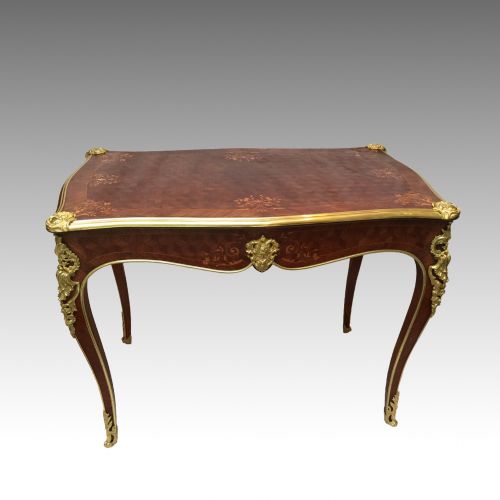
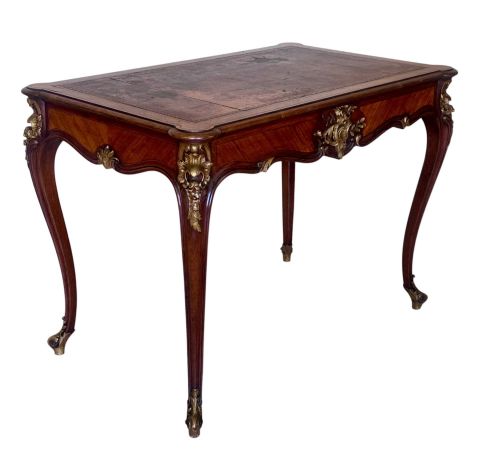
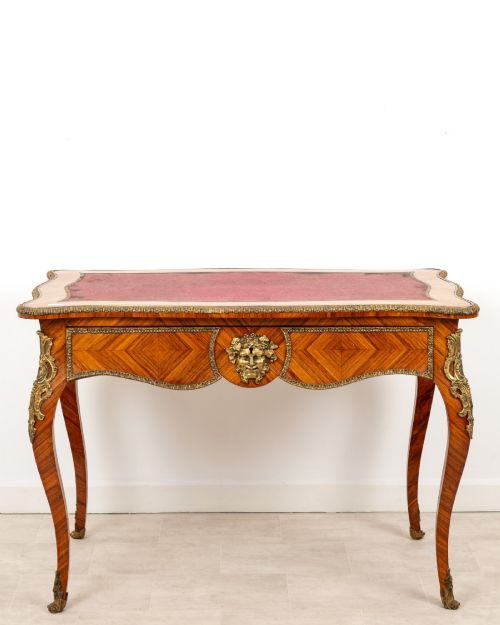
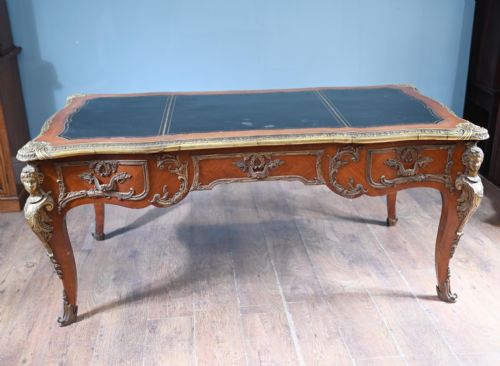




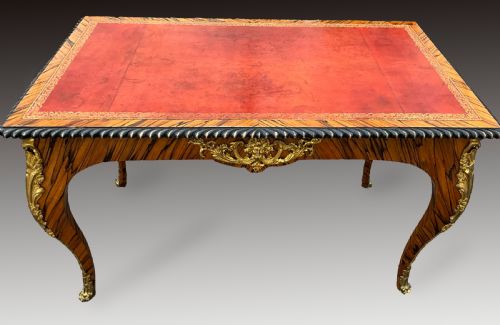
Parquetry Library Table
A parquetry library table offers a geometric wooden surface for study and writing, built from figured veneers and set upon substantial legs.
Parquetry Library Table
A parquetry library table is designed for study and correspondence, taking forms such as writing tables, bureau plats, and centre tables. These pieces emerge from the seventeenth, eighteenth, nineteenth, and early twentieth centuries, spanning Victorian, Edwardian, and Regency periods.
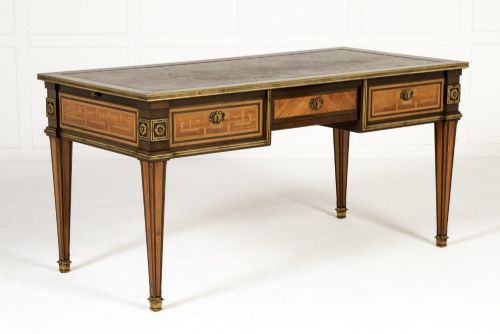
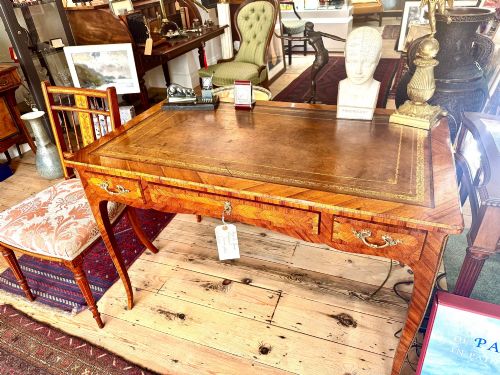
The version most commonly met on this page is a nineteenth-century French creation influenced by Louis XV or Louis XVI styles. Such examples often feature inlaid geometric wooden patterns across the top surface, accompanied by drawers and sometimes original leather writing inserts.
Construction and materials
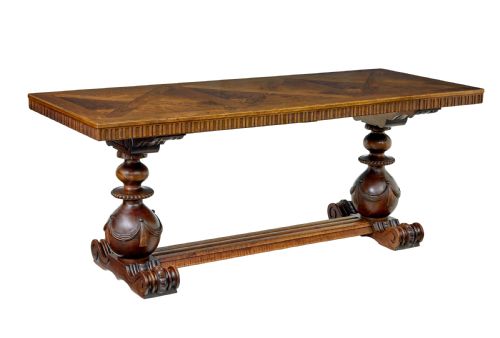
Cabinet makers construct these tables using a solid carcase of mahogany, walnut, or oak, which is then overlaid with choice veneers like kingwood, rosewood, and coromandel. These timbers are cut and fitted into precise geometric parquetry patterns across the main surface.
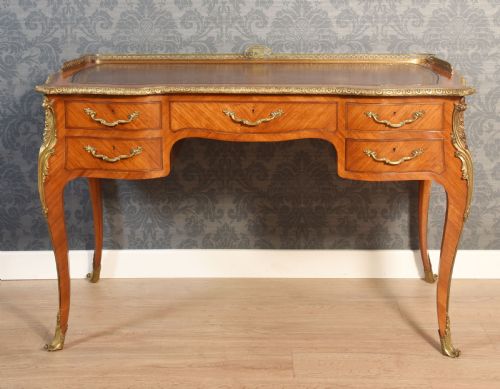
Metal ornamentation plays a central role in the finishing process, utilising cast or chased ormolu and gilt bronze mounts upon corners and legs. Brass detailing and fitted leather writing panels complete the functional construction of the desk.
Listings feature periods ranging from the seventeenth to the twentieth century, alongside styles spanning French revival, Victorian, and Arts and Craft.
Markers of quality
The standard of a parquetry library table rests on the precision of the wood mosaic and the crispness of the cast metal mounts. Master cabinet makers align the grain so that the geometric pattern appears sharp and balanced across the entire surface.
Heavier, finely chased ormolu mounts and substantial timbers indicate superior workshops, whereas simpler tables rely on understated walnut or oak frames without gilt bronze enrichments.
CH Jeanselme and Co·Donald Ross·Howard and Sons
The Parquetry Library Table Glossary
- Parquetry
- A geometric mosaic of wood veneers used to cover floors or furniture surfaces. It creates patterned arrangements like cubes and chequers.
- Bureau plat
- A freestanding double-sided writing desk with drawers in the frieze. It usually stands on cabriole or tapered legs and dates to French periods.
- Ormolu
- Gilt bronze ornamentation applied to the mounts and feet of fine furniture. It provides a bright golden contrast to dark woods.
- Kingwood
- A dense, richly figured Brazilian timber utilised in high-end cabinet making. It displays contrasting dark and light brown striping.
Parquetry Library Table: Frequently Asked Questions
What is a bureau plat?
A bureau plat is a specific form of writing desk that stands away from the wall, featuring a finished back and drawers set within the frieze. These tables were designed for the centre of a room.
They typically present a leather-lined writing surface surrounded by wooden parquetry and metal mounts. The form originates from French cabinet making traditions.
How do I care for leather tops?
Original leather writing surfaces require gentle dusting and occasional nourishment with specialist leather balms to prevent drying. Avoid placing liquids directly onto the hide.
Keeping the table away from direct sunlight preserves both the colour of the leather and the polished tone of the surrounding timber veneers.
Where were these tables used?
These tables served primarily in studies, libraries, and formal reception rooms for handling correspondence and reading. Their finished backs allowed them to sit prominently in the middle of a space.
Wealthy households utilised them as functional writing furniture that also displayed the status and taste of the owner through fine woodwork.
How do I identify Louis XV style?
Louis XV style furniture is characterised by curving lines, cabriole legs, and asymmetrical floral or scrolling ormolu mounts. The overall silhouette appears organic and flowing.
In contrast, later Louis XVI revival pieces adopt straighter lines, symmetrical parquetry, and classical architectural motifs such as fluted legs.