
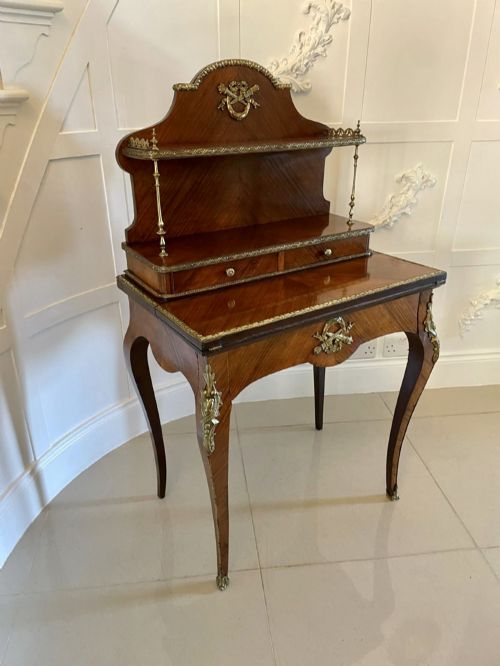
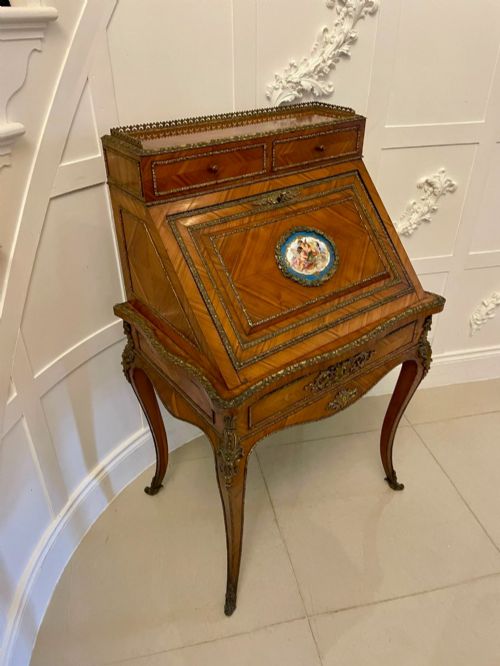
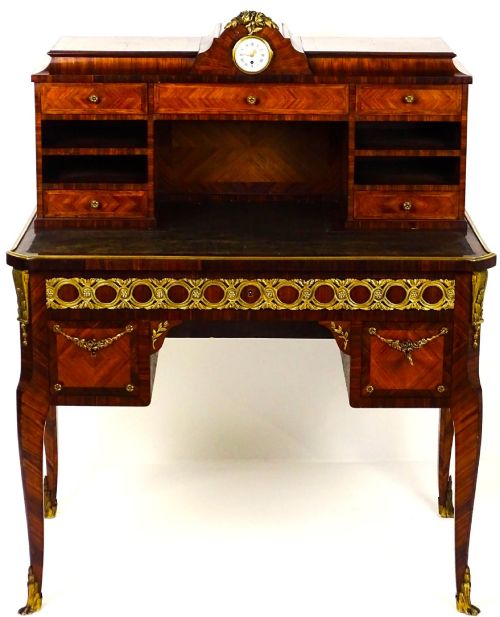
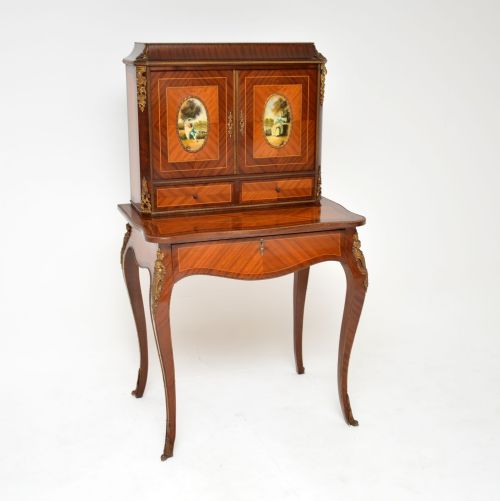


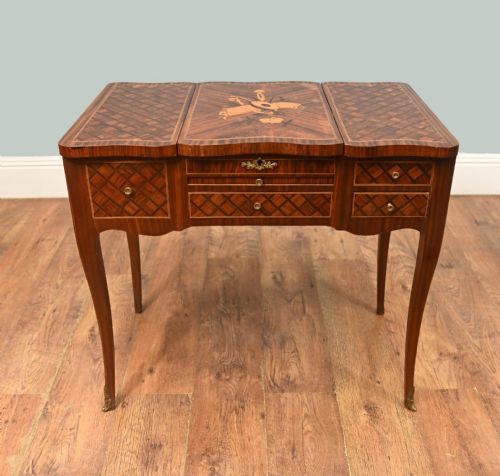


Parquetry Bonheur Du Jour
A parquetry bonheur du jour is a refined ladies writing desk combining small drawers, a cabinet top, and intricate geometric wood veneers.
Parquetry Bonheur Du Jour
A parquetry bonheur du jour is a small, elegant writing desk designed primarily for ladies, featuring an upper section with compartments, shelves, or small doors sitting upon a writing surface. These pieces frequently appear in nineteenth century forms, drawing heavily on French revival aesthetics.
The styles seen on this page span Louis XV and Louis XVI revivals, French Chateau, and Grand Regency. Makers often utilised elaborate geometric wood patterns across the writing surfaces and small internal drawers.
Forms range from dedicated writing desks and bureaux to dressing tables and writing cabinets. Most examples date from the Victorian era and the broader nineteenth century, reflecting a sustained demand for compact, highly decorative writing furniture.
Materials and construction
Cabinet makers constructed these desks using dense hardwoods like kingwood and rosewood, applying precise parquetry veneers to create geometric surface patterns. The underlying carcase typically supports these delicate exterior veneers.
Ormolu and gilt bronze mounts decorate corners, legs, and borders, framing the wood panels and porcelain plaques. Glass, leather, and brass also appear as supplementary materials for writing surfaces and hardware.
Some nineteenth century ladies kept secret compartments hidden behind decorative parquetry panels for storing genuine love letters and small keepsakes.
Determinants of quality
Quality rests upon the precision of the parquetry work and the crispness of the cast ormolu mounts. Finer pieces display seamless veneer matching and substantial, highly detailed bronze or ormolu hardware rather than lightweight plated metal.
The integration of hand-painted porcelain plaques, such as Sevres inserts or Vernis Martin panels, elevates certain pieces. Superior examples also show careful attention to secondary timbers and the smooth operation of internal drawers and writing slides.
Paul Sormani·Jean Werner
The Parquetry Bonheur Du Jour Glossary
- Bonheur du jour
- A small lady's writing desk with an upper tier of compartments, popular in eighteenth century France and revived in the nineteenth century. The phrase translates directly to daytime happiness.
- Parquetry
- A geometric mosaic of wood veneers used to decorate furniture surfaces. Cabinet makers arrange contrasting timber tiles to form patterns like cubes, chequers, and herringbones.
- Ormolu
- Gilt bronze ornamentation applied to furniture mounts, feet, and handles. Makers cast and chase the bronze before applying a fine layer of gold.
- Sevres
- Porcelain produced by the royal French manufactory, frequently mounted into nineteenth century cabinetwork. These plaques display hand-painted scenes or floral motifs against coloured grounds.
- Vernis Martin
- A type of simulated Japanese lacquer developed by the Martin brothers in eighteenth century France. It provides a glossy, translucent finish often used on decorative cabinet panels.
Parquetry Bonheur Du Jour: Frequently Asked Questions
What is a bonheur du jour used for?
These desks served as private writing stations for correspondence, keeping stationery, ink, and small personal valuables close at hand.
Ladies used the writing surface for daily letter writing while keeping papers organised in the upper compartments and small drawers.
How do I identify a Louis XVI style desk?
Louis XVI style pieces typically feature straight tapered legs, fluted columns, and restrained neoclassical symmetry, contrasting with the curved lines of earlier rococo designs.
Look for geometric parquetry patterns and crisp ormolu mounts arranged with architectural balance rather than asymmetrical scrollwork.
Where should I place a bonheur du jour in a room?
Because these desks are relatively compact and finished on multiple sides, they function well as freestanding pieces or against a principal wall in a reception room or study.
Ensure the writing surface receives adequate natural or task lighting to appreciate the detailed kingwood parquetry and bronze mounts.