

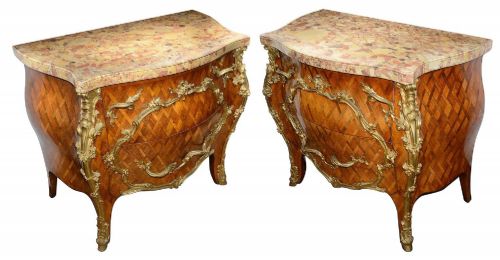


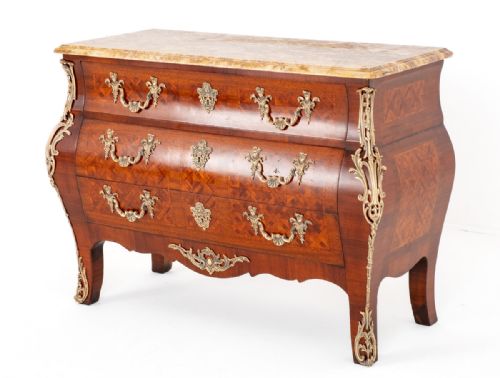


Parquetry Bombe Chest
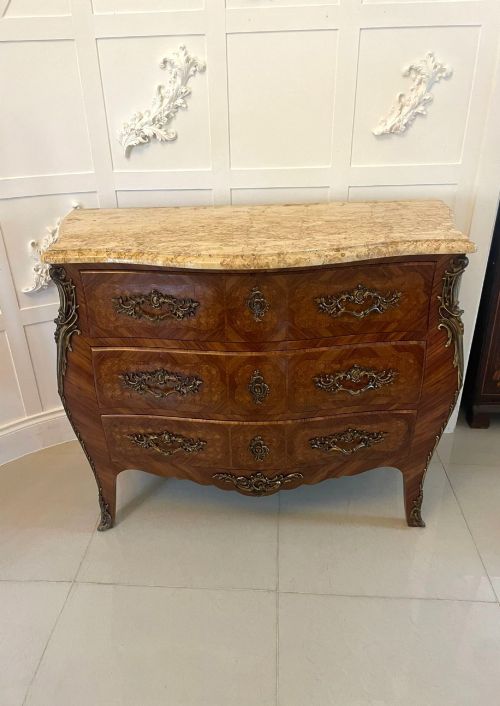
A parquetry bombe chest brings together swelling serpentine curves and intricate wood veneers, offering substantial storage with distinct continental flair.
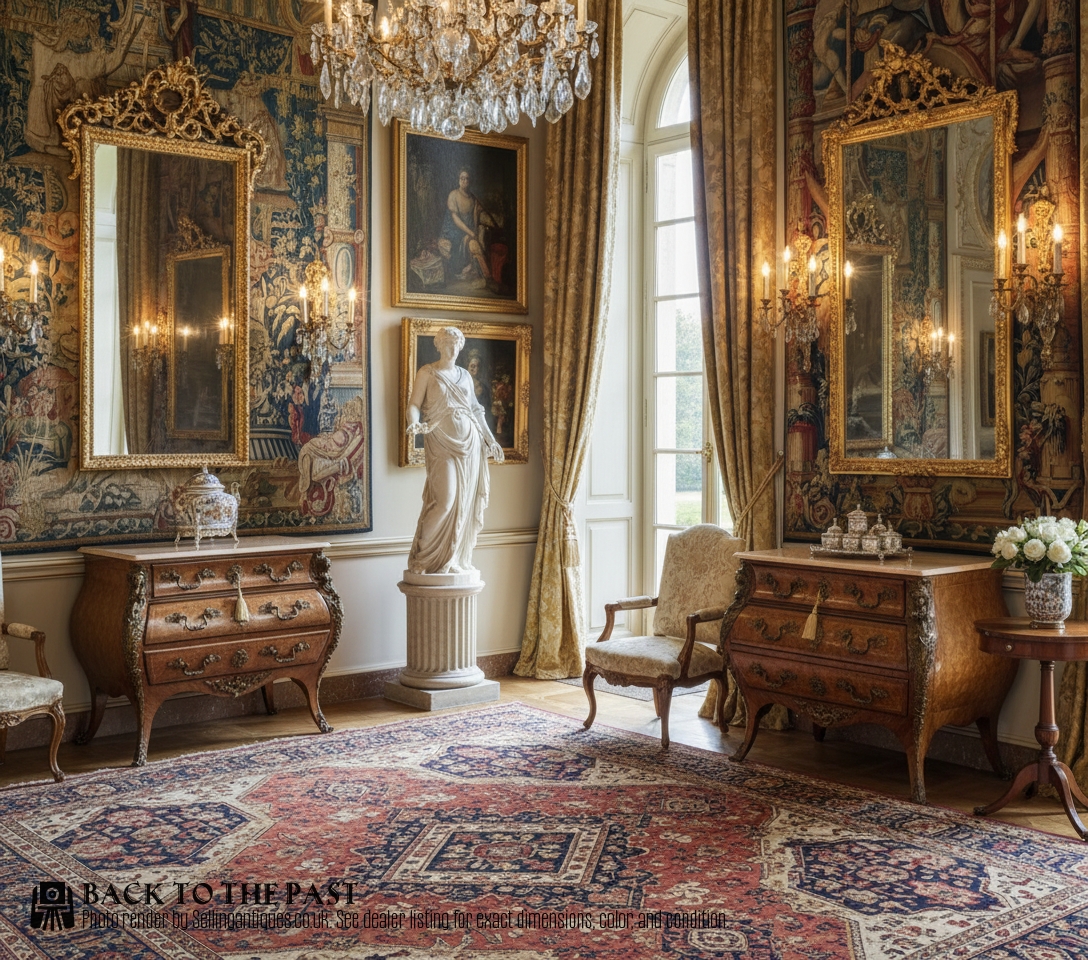
Parquetry Bombe Chest
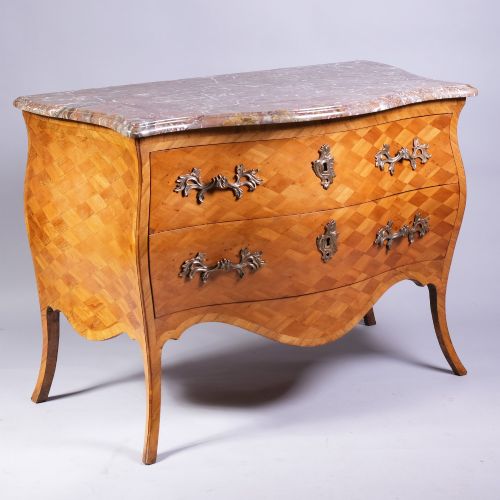
When you search for a parquetry bombe chest, you encounter case furniture defined by convex and concave contours across the front and sides. These pieces primarily appear as commodes, chests of drawers, and bedside cabinets originating from continental traditions.
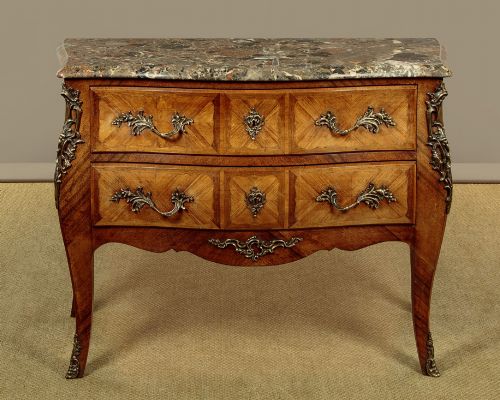
The materials and aesthetic lean heavily towards French designs, notably Louis XV and Louis XVI styles, alongside Swedish Rococo examples. You will frequently find these forms rendered with marble tops and decorative metal mounts.
Dated examples span from the eighteenth century through to later revivals in the nineteenth and twentieth centuries. The assortment includes full-scale storage commodes as well as smaller bedside pieces and miniature furniture.
Materials and construction methods
Cabinetmakers utilised timber veneers such as walnut, kingwood, fruitwood, and plum applied over structural carcass woods to achieve geometric parquetry patterns. The swelling bombe profile requires skilled shaping of the wooden framework to support the curved veneer surfaces.
Mounts cast in ormolu, gilt bronze, and brass accent the corners, handles, and apron centres. Marble tops, often shaped to follow the serpentine contours of the carcass, complete the construction of the upper surface.
Parquetry Bombe Chest Retail Price Guide 2026
Typical asking prices for parquetry bombe chest among the pieces listed under this phrase on Sellingantiques today, from the lower quarter to the upper quarter. They describe what is for sale here now, not the wider market.
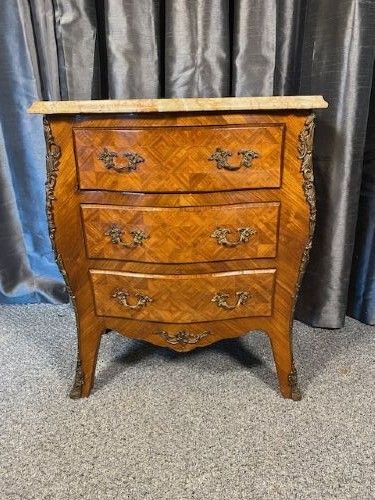
Miniature commodes offered cabinetmakers a compact canvas to showcase their parquetry skills to prospective clients without building a full-sized chest.
Assessing quality in the details
Quality rests significantly on the precision of the parquetry layout and the selection of timber grains across the curved surfaces. Grain matching that flows naturally around the swelling corners separates superior execution from standard work.
The refinement of the cast bronze or ormolu mounts indicates the original workshop's standing. Crisp chiselling and secure integration with the wooden carcass distinguish finer pieces from simpler productions.
The Parquetry Bombe Chest Glossary
- Bombe
- A swelling, outward-curving contour on the front and sides of a piece of furniture. This profile demands advanced woodworking techniques to shape the carcass and lay the veneer.
- Parquetry
- Geometric patterns formed by fitting small pieces of wood veneer together. Cabinetmakers arrange contrasting timbers to create visual depth on the drawer fronts and sides.
- Ormolu
- Gilt bronze mounts applied to furniture for decoration and edge protection. These cast metal elements follow the curves of the wooden frame.
- Commode
- A low chest of drawers originating in France. They typically feature decorative mounts and marble tops in period examples.
- Serpentine
- A line or surface featuring a curving contour that is convex at the centre and concave at the sides. This shape frequently appears along the front edges of these chests.
Parquetry Bombe Chest: Frequently Asked Questions
What rooms suit a parquetry bombe chest?
These pieces function well as statement storage in bedrooms, hallways, or living spaces. Their rounded profiles soften corners and fit easily against walls where sharp angles might obstruct movement.
Matching the scale of the chest to the room ensures the swelling silhouette commands the right amount of visual space without overwhelming the interior.
How do I care for the marble top?
Clean the marble surface using a soft cloth dampened with warm water and mild, non-acidic soap. Avoid abrasive cleaners or acidic substances like citrus and vinegar that can etch the polished stone.
Using coasters and placemats protects the surface from moisture rings and scratches during daily use.
How do I distinguish eighteenth-century pieces from later revivals?
Examine the construction methods visible on the interior drawer linings and backboards for tool marks and timber ageing characteristics. Eighteenth-century examples display hand-cut joints and native secondary woods appropriate to their region of origin.
Revival pieces from the nineteenth and twentieth centuries often utilise machine-sawn elements and standardised hardware fittings while replicating earlier Louis XV or Louis XVI styles.
Why do some chests have marble tops while others are wood?
Marble tops provided a durable, stain-resistant surface for washing and placing objects in period domestic settings. Cabinetmakers often integrated stone tops into commodes destined for formal rooms.
Wooden top variants relied on matched veneers to display the grain patterns of walnut, kingwood, or fruitwood across the entire upper surface.