

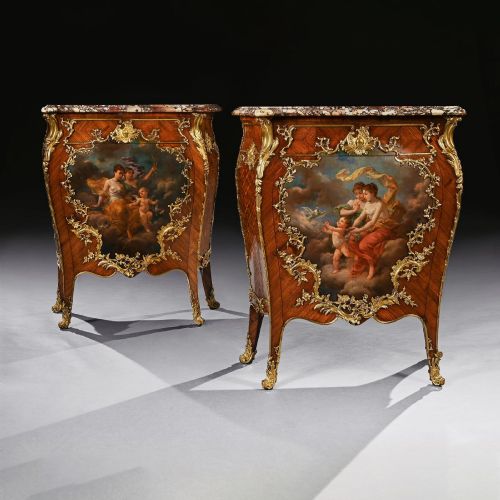
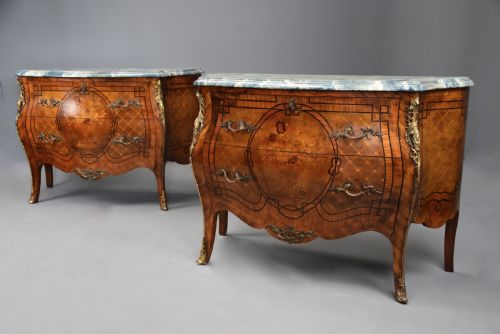
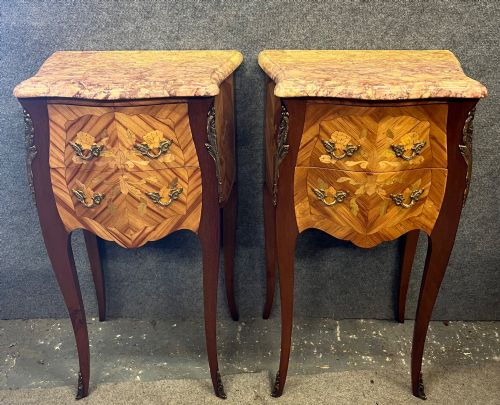
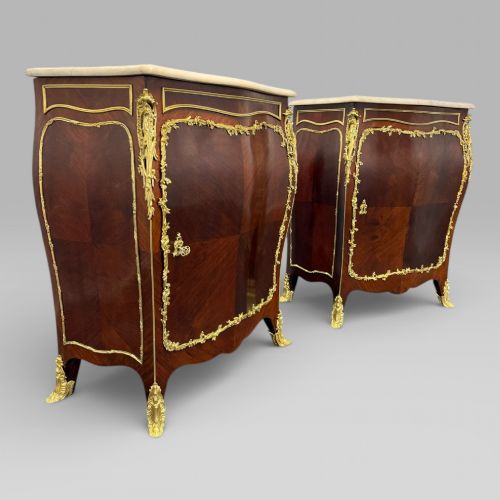
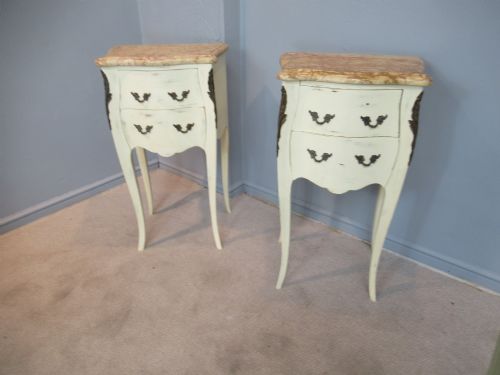
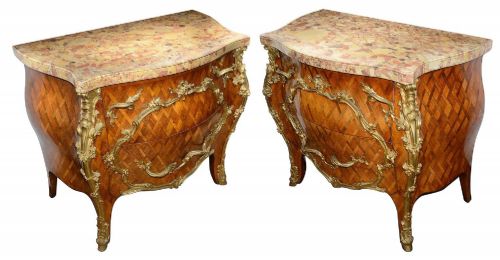


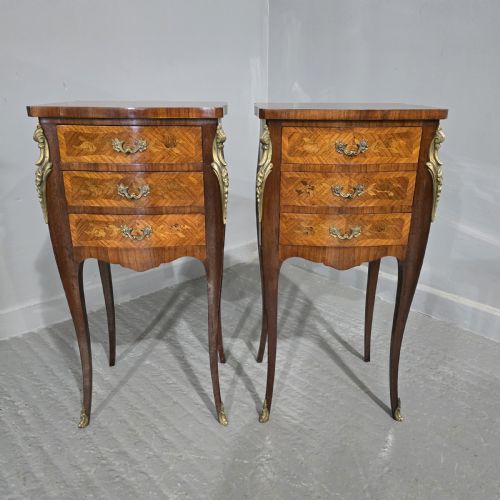


Pair Rococo Commodes
Pair rococo commodes bring exuberant French and Italian styling into a room, offering matched storage scaled for bedrooms and reception spaces.
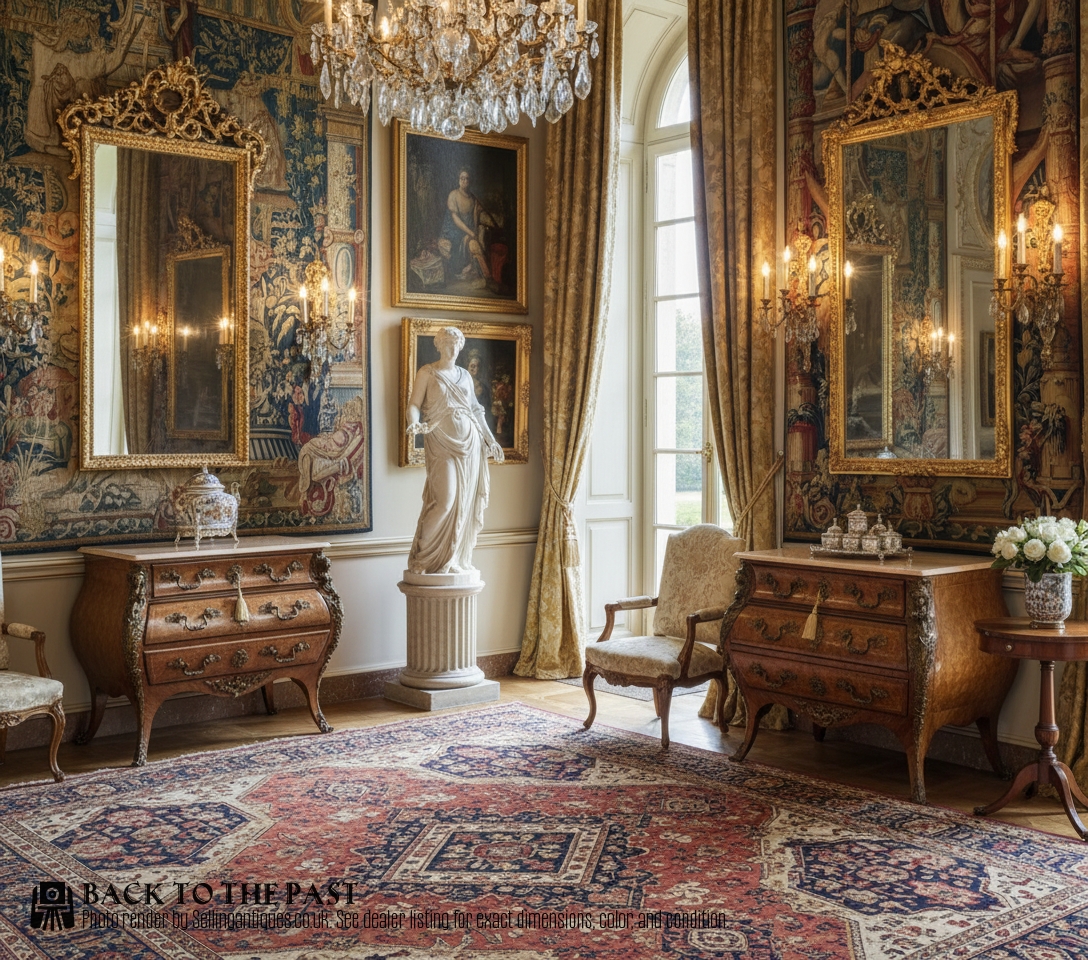
Pair Rococo Commodes
These items comprise matched sets of drawer units and small cabinets designed in revivalist styles, predominantly drawing on French Louis XV and Italian aesthetics. Most examples appearing here take the form of bedside chests, lamp tables or petite commodes rather than grand salon furniture.
The construction spans several decades around the turn of the nineteenth and twentieth centuries, incorporating revival periods such as nineteen-ten, nineteen-hundred and eighteen-eighty alongside the nineteen-thirties. Makers during these eras frequently looked back to earlier eighteenth-century forms to satisfy contemporary demand for ornate bedroom suites.
Forms often feature serpentine or bombe profiles, creating curved drawer fronts and sides that reflect classical rococo movement. Buyers encounter both French-inspired marquetry pieces and Italian walnut cupboards sharing the characteristic asymmetry and fluid lines of the style.
How they were made
Carpenters utilised timber frameworks of kingwood, walnut, burr walnut and rosewood, often laying intricate marquetry veneers across the exterior surfaces. These wood selections provided rich natural grain patterns that complemented the curved contours of bombe chests.
Mounts cast in ormolu, brass and gilt bronze decorate corners, handles and feet, accentuating the structural lines with metallic lustre. Marble slabs frequently form the upper surface, resting atop the wooden carcase to provide a durable and polished top.
Pair Rococo Commodes Retail Price Guide 2026
Typical asking prices for pair rococo commodes among the pieces listed under this phrase on Sellingantiques today, from the lower quarter to the upper quarter. They describe what is for sale here now, not the wider market.
Listings feature revival periods spanning from eighteen-seventy to nineteen-thirty, with materials including kingwood, burr walnut, ormolu and marble.
What varies in quality
The refinement of the cast bronze or ormolu mounts distinguishes finer examples from simpler production, particularly where chiselling defines the foliage and scrolls. Heavier, crisper metalwork indicates higher workshop standards during manufacture.
Precision in the marquetry patterns and the matching of wood veneers across both pieces in a pair dictates overall harmony and execution standard. Subtlety in the curvature of bombe woodwork and the integration of marble tops further separate standard production from superior pieces.
E. Kahn
The Pair Rococo Commodes Glossary
- Bombe
- A bulging, outward-curving swelling on the front and sides of a cabinet or commode. This swelling shape requires skilled woodworking to ensure drawers operate smoothly within curved frames.
- Ormolu
- Gilded bronze ornamentation applied to furniture mounts and decorative hardware. The technique involves coating metal with a mercury-gold amalgam before firing.
- Marquetry
- Inlaid wood veneers arranged in pictorial or geometric patterns across furniture surfaces. Craftsmen cut contrasting timber veneers to fit tightly together within the design.
- Vernis Martin
- A type of simulated Japanese lacquer developed in France during the eighteenth century and replicated in later revival pieces. The finish uses multiple layers of varnish to achieve a glossy decorative sheen.
- Serpentine
- A curved line or edge that waves inward at the centre and outward at the ends. This contour appears frequently on the top slabs and drawer fronts of rococo revival chests.
Pair Rococo Commodes: Frequently Asked Questions
Where do pair rococo commodes fit best?
These matched cabinets find a natural home beside a bed or flanking a fireplace in a reception room. Their scaled dimensions provide surface space for lamps and small objects while maintaining visual symmetry.
Because they arrive as a pair, placement benefits from balanced positions such as either side of a bed or framing a doorway. The decorative carving and marble surfaces draw the eye, making them focal points in a bedroom suite.
How do I care for marble and wood?
Marble tops require simple dusting and prompt wiping of liquid spills to prevent staining on polished stone. Avoid abrasive cleaners that might dull the natural finish.
Wooden surfaces benefit from occasional waxing with traditional beeswax to nourish the kingwood or walnut grain. Keeping the furniture away from direct heat sources prevents timber movement and veneer separation.
How do I distinguish French and Italian pieces?
French revival models frequently incorporate kingwood veneers, elaborate ormolu mounts and intricate marquetry panels inspired by Louis the Fifteenth designs. They often display bombe silhouettes with a lighter, more ornate decorative scheme.
Italian examples commonly utilise burr walnut or regional fruitwoods with carved giltwood details or Venetian characteristics. The carving tends to be robust, reflecting local craft traditions distinct from Parisian cabinetmaking.
Are these commodes seventeenth or nineteenth century?
The listings on this page originate primarily from the nineteenth and early twentieth centuries, spanning periods from eighteen-seventy through to nineteen-thirty. They represent revival movements rather than original period furniture from the seventeen-hundreds.
Stylistic labels such as Louis the Fifteenth style indicate the aesthetic inspiration rather than the actual date of manufacture. Construction techniques and hardware reflect late nineteenth or early twentieth-century workshop practices.