
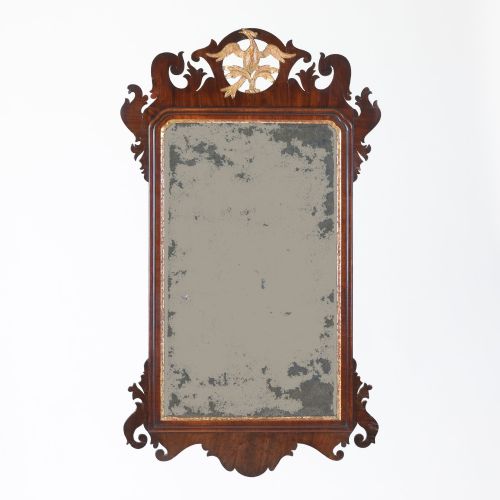


Parcel Gilt Fret Mirror
A parcel gilt fret mirror brings Georgian proportion and carved detail to a room, combining dark timber with bright gilded highlights.
Parcel Gilt Fret Mirror
A parcel gilt fret mirror is a wall-hanging pier mirror defined by its pierced wooden frame and partial gilding. These pieces belong predominantly to the Georgian and 18th Century periods, alongside later revival interpretations.
The version you are most likely to meet on this page combines a mahogany or walnut plate frame with a scrolling fret-cut silhouette, often topped by a carved Ho-ho bird. Such wall mirrors range from compact domestic chambers to large architectural wall pier mirrors.
Originating in the mid-18th century under George II and George III designs, these mirrors also appear in Edwardian and Victorian revivals. Walnut and mahogany form the primary body timber, while the gilded elements catch the light on the inner moulding or cresting.
Materials and construction
Makers constructed these frames from solid hardwoods, principally mahogany and walnut, frequently utilising burr veneers to achieve rich grain patterns on the backplate. The timber was then sawn into intricate scrolling borders using fret-cutting techniques.
Partial gilding, or parcel gilding, was applied using gold leaf onto a prepared gesso layer over specific carved sections like the cresting or inner sight edge. This left the polished wood grain visible alongside the bright gilded details.
Mirror glass was set into the rebate from the rear, often backed with old pine or cedar boards. The overall structure relies on precise joinery to support the cantilevered fret-cut ears and scrolled bottom aprons.
Listings feature walnut, mahogany, and giltwood materials across Georgian, 18th Century, and 19th Century periods.
Distinctions in quality
The sophistication of the fret-cut piercing sets apart the finer examples, where the saw work remains crisp and deeply undercut rather than flat or blocky. Superior carving defines the feathers of the Ho-ho bird and the acanthus scrolls on the ears.
Timber selection plays a major role, with figured burr walnut or well-figured Cuban mahogany indicating a more costly original commission. The depth of the moulding and the proportion of the parcel-gilt highlights relative to the dark wood create a balanced visual harmony found in the best pieces.
The Parcel Gilt Fret Mirror Glossary
- Parcel gilt
- Partly gilded with gold leaf, leaving areas of the underlying wood or dark finish exposed. This technique highlights specific carved details such as crests and mouldings.
- Fretwork
- Ornamental design executed by piercing thin wood with a fret-saw to create geometric or scrolling patterns. It forms the characteristic side wings and crests of these mirrors.
- Pier mirror
- A tall wall mirror designed specifically to hang on the narrow pier of wall space between windows. They often paired with console tables beneath.
- Ho-ho bird
- A stylized Chinese phoenix commonly carved into the cresting of mid-18th century mirrors. It symbolizes virtue and grace in oriental-inspired design.
- Cresting
- The decorative carved ornament at the top of a mirror frame. On these pieces, it frequently incorporates the Ho-ho bird and scrolling foliage.
Parcel Gilt Fret Mirror: Frequently Asked Questions
How do I hang a heavy fret mirror safely?
These frames require solid wall fixings rather than simple picture wire, using the wooden backing structure to bear the weight.
Ensure the fixing engages directly with a wall stud or uses appropriate heavy-duty wall anchors suited to the plaster.
Are these mirrors original 18th-century pieces?
The selection includes genuine 18th-century Georgian examples alongside later 19th-century and Edwardian revival pieces made in the same style.
Examination of the timber backing, mirror plate characteristics, and secondary woods helps determine the exact period of manufacture.
What rooms suit a parcel gilt fret mirror?
Their vertical proportions make them well-suited for placement above a fireplace mantelpiece or between architectural windows.
The dark timber and gilt accents complement both traditional period interiors and modern neutral spaces.
How should I clean the antique glass?
Wipe the mirror glass gently with a soft microfibre cloth slightly dampened with distilled water or a mild glass cleaner.
Avoid spraying liquid directly onto the frame to protect the aged wood finish and delicate gold leaf.