
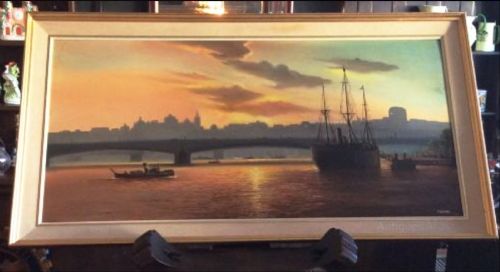


Panoramic Landscape Artwork
Panoramic landscape artwork captures expansive vistas on canvas and paper, drawing the eye across wide river views, coastal towns, and industrial valleys.
Panoramic Landscape Artwork
When you search for panoramic landscape artwork, you are looking at wide-format visual pieces designed to stretch across a wall and draw the viewer into a broad scene. The examples listed here span from the 18th century through to the mid 20th century, offering everything from early Georgian estates to mid-century modern cityscapes.
You are most likely to meet framed oil paintings on canvas and watercolour paintings on paper on this page. These works capture specific geographies, including the River Thames, Niagara Falls, the River Seine, and Cannes.
The formats range from large framed oils and detailed watercolours to sets of framed coloured prints. Each piece utilises its elongated proportions to create a sense of scale and distance.
How they were made
The physical build of these pieces relies primarily on oil on canvas and watercolour pigment applied to paper. Canvases are frequently stretched over wood frames and housed within protective wood or giltwood surrounds.
Artists structure these wide compositions using careful perspective to handle the extended horizontal format. Detail work ranges from fine brushstrokes in maritime and realism styles to fluid watercolour washes.
Materials recorded across the inventory include paper, oil on canvas, wood, canvas, glass, giltwood, watercolour pigment, and wood frames.
What varies in quality
Quality in these wide compositions depends on how well the artist manages the extended horizontal format without losing balance across the canvas or paper. Strong works maintain sharp detail in the focal areas, such as dockyards, bridges, or figures, while carrying the distance convincingly.
The execution of light and atmospheric depth separates competent topographical records from striking artistic achievements. Framing and material preservation also influence the overall presence of the piece.
Alexandre Le Bihan·Ron Folland·Sidney Yates Johnson·Will Anderson·Edward Henry Holder·Peter Tillemans·Edmund John Niemann
The Panoramic Landscape Artwork Glossary
- Panorama
- A wide-angle pictorial representation of a physical space. It stretches the field of vision beyond standard proportions to capture an entire horizon.
- Giltwood
- Wood carved and coated with gold leaf or a gold-coloured metallic finish. This material is commonly found on the decorative frames surrounding oil paintings.
- Watercolour pigment
- Colour ground in a water-soluble binder, applied to paper. It creates transparent washes that lend lightness to coastal and rural scenes.
- Maritime art
- Depictions of the sea, ships, and coastal views. This style often encompasses busy river traffic and port infrastructure.
Panoramic Landscape Artwork: Frequently Asked Questions
What periods do these landscapes cover?
The selection includes works from the 18th century, the Victorian era, the Edwardian period, and the mid-20th century. This spans early Georgian topographical views up to mid-century modern cityscapes.
Each period brings distinct framing choices, from simple wood mouldings to elaborate giltwood surrounds, reflecting the interior tastes of their respective eras.
How should I hang a wide landscape?
Because these pieces feature extended horizontal proportions, they require ample wall space to breathe. Placing them above a sofa, sideboard, or fireplace allows the wide composition to anchor the room.
Ensure the hanging height aligns with eye level so the viewer can take in the full sweep of the horizon comfortably.
What subjects appear in these panoramas?
The subjects range widely across geography and human activity, recording river views of the Thames and Seine, industrial valleys, coastal towns like Cannes, and natural wonders like Niagara Falls.
Some pieces focus on architectural details and dockyards, while others capture quiet rural scenes complete with cottages, figures, and horses.