

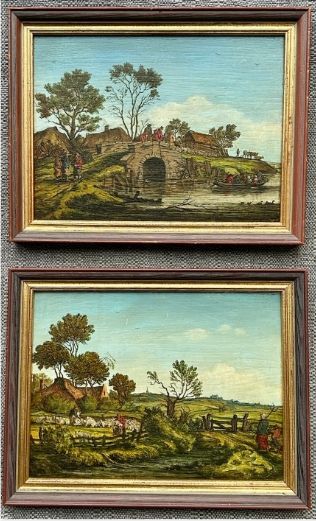
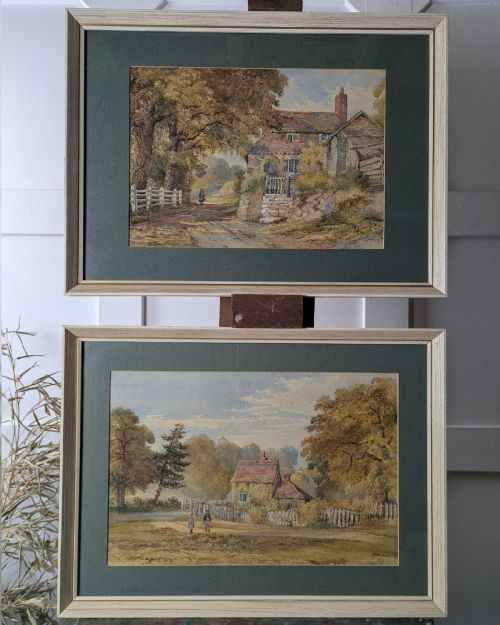


Pair Rural Landscape Paintings
These pair rural landscape paintings bring the quiet fields and country scenes of the past directly to your wall.
Pair Rural Landscape Paintings
A pair rural landscape paintings selection offers matched compositions depicting pastoral views, village scenes, and countryside vistas. These works typically originate from the nineteenth century, capturing the rural world through the eyes of various British and European schools.
You will most commonly encounter framed watercolours and oil paintings on canvas or wood panels, often preserved behind glass within gilt wood frames. The subjects range from agricultural labour and cottages to quiet winter views and riverbanks.
The enduring appeal of these matched pairs lies in their balanced display potential, designed historically to hang symmetrically on either side of a fireplace or doorway. Each pairing provides a dual window into historical rural life and traditional artistic interpretations of the countryside.
How they were made
Artists utilised oil paint and watercolour on varied supports including paper, prepared canvas, wood panels, and boards. These mediums allowed painters to render fine details of foliage, sky, and rustic architecture with distinct atmospheric depth.
Many works incorporate protective glass and are housed within decorative wood frames enhanced with gold leaf or gilt finishes. These frames were integral to the presentation, designed to complement the tonal qualities of the paintings within.
Pair Rural Landscape Paintings Retail Price Guide 2026
Typical asking prices for pair rural landscape paintings among the pieces listed under this phrase on Sellingantiques today, from the lower quarter to the upper quarter. They describe what is for sale here now, not the wider market.
Listings feature works predominantly from the nineteenth century, utilising oil and watercolour on paper, wood, canvas, and board.
What varies in quality
The distinction between average and exceptional works rests upon the confidence of the brushwork and the artist's handling of light and atmospheric perspective. Superior paintings demonstrate a keen observation of natural tones and a more harmonious balance between the two matched compositions.
Condition of the medium and the originality of the framing also dictate the standing of a pair. Works that retain their unblemished paper or stable canvas surfaces without extensive restoration offer a purer historical connection to the period.
W Klombeck·Robert A Nottingham·Th Thibault·Frederick James Knowles·R Palnay·James H Hulse·Alfred Vickers Senior·Arthur Claude Strachan·Alfred Rimmer·George Augustus Williams·John Holland Snr·JS Cooper·John Moore Ipswich·Edward Williams
The Pair Rural Landscape Paintings Glossary
- Watercolour
- A painting method in which the paints are made of pigments suspended in a water-based solution. This technique often appears on paper supports within nineteenth-century British works.
- Gilt wood
- Wood that has been treated and covered with a thin layer of gold leaf or metallic gilt. This material is frequently found on the decorative frames enclosing these paintings.
- Pastoral
- A genre of art depicting the rural life of shepherds, farmers, and country landscapes in an idealized or rustic manner. This style dominates many nineteenth-century country scenes.
- Wood panel
- A flat piece of timber used as a rigid support for oil painting prior to the widespread adoption of stretched canvas. Panels allow for meticulous detail in skilled hands.
Pair Rural Landscape Paintings: Frequently Asked Questions
Why were these paintings created as pairs?
Artists and patrons favoured matched sets to create symmetrical decorative arrangements on drawing room walls. Two complementary scenes provided a balanced visual narrative of the countryside.
This approach to interior display ensured that adjacent walls maintained proportional harmony and shared thematic content.
How do I care for antique watercolours?
Watercolours are sensitive to prolonged exposure to direct sunlight, which can fade the delicate pigments on paper over time. Keeping them in stable indoor environments away from dampness preserves the medium.
Retaining the original glass and frame also protects the paper surface from environmental pollutants and physical damage.
What subjects are typical in these landscapes?
Common subjects include agricultural activities like harvesting, herding cattle, and milking time, alongside quiet village cottages and winter scenes. Artists often focused on the daily rhythms of rural communities.
These depictions reflect both actual countryside observations and romanticised views of nineteenth-century agrarian life.
How can I tell a watercolour from an oil painting?
Watercolours are typically executed on paper under glass, showing translucent washes of colour where the paper texture remains visible beneath. Oil paintings feature thicker, opaque pigments applied to canvas, board, or wood panels.
Oil surfaces often exhibit visible brush texture and a distinct sheen compared to the matte appearance of traditional watercolours.