



Pair of Staffordshire Poodles
A pair of staffordshire poodles brings characteristic Victorian ceramic charm to a mantelpiece, modelled as seated figures often accompanied by tiny pups.
Pair of Staffordshire Poodles
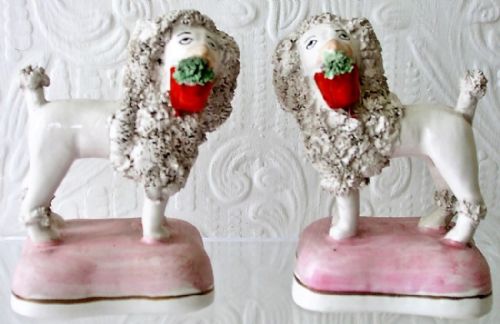
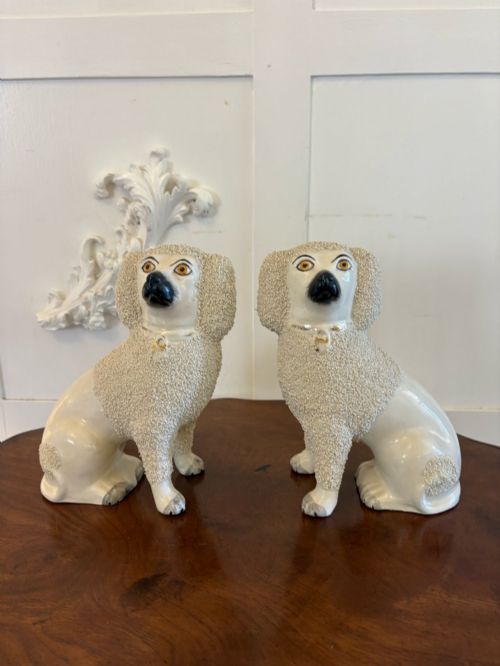
When you search for a pair of staffordshire poodles, you encounter nineteenth-century decorative pottery shaped as matching dogs. These ornamental figures appear frequently from the Victorian period, often featuring seated animals with textured coats.
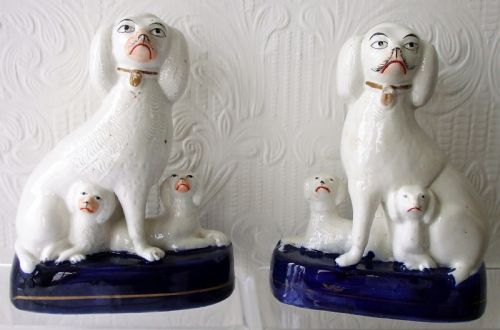
Many examples include accompanying puppies sitting beside the adult dogs, while other entries show miniature versions or creatures posed upon cushions. The majority date across the nineteenth century, spanning from the eighteen-forties up to nineteen hundred.
Makers produced these decorative objects primarily for mantelpiece display in English homes. The pairing remains intact across most listings, preserving the symmetrical arrangement intended by the Victorian potters.
Materials and Methods
Specific textural effects relied on applied clay work, sometimes called encrusting or woolly texturing, to mimic curly canine fur. Firing in traditional kilns set the glaze and fixed the painted decoration across the ceramic surface.
Pair of Staffordshire Poodles Retail Price Guide 2026
Typical asking prices for pair of staffordshire poodles among the pieces listed under this phrase on Sellingantiques today, from the lower quarter to the upper quarter. They describe what is for sale here now, not the wider market.
Several Victorian poodles sit accompanied by tiny ceramic puppies that peer out from the base.
Judgement of Quality
Finishing work on the enamel painting and the crispness of the moulded fur distinguish finer examples from standard production. Softer model definition or smudged colour application separates the more rudimentary pottery from higher grade pieces.
Miniature sizing and the inclusion of detailed puppies or cushioned bases introduce greater complexity to the modelling. The survival of clean gilt and bright glaze without excessive wear indicates superior initial manufacture and careful preservation.
James Dudson
The Pair of Staffordshire Poodles Glossary
- Earthenware
- Porous pottery fired at lower temperatures, commonly used for nineteenth-century decorative figures. It requires a glaze to hold liquids and provide a smooth surface for enamel painting.
- Lead Glaze
- A glossy coating containing lead compounds applied to pottery before firing. This technique produces a shiny, glass-like finish typical of Victorian ceramics.
- Enamel
- Coloured vitreous paint applied over the glaze and fired at a lower temperature. It provides the bright decorative hues found on Staffordshire dogs.
- Encrusting
- Applied small pieces of clay or slip used to create textured surfaces. This method represents curly poodle hair on these figures.
Pair of Staffordshire Poodles: Frequently Asked Questions
What periods do these figures come from?
The pieces span the nineteenth century, with specific examples dating from the Victorian era around eighteen forty-five through to nineteen hundred.
Most items reflect mid to late Victorian Staffordshire pottery production standards and styles.
Are these figures always sold together?
Listings consistently present the dogs as matching pairs designed for symmetrical display on mantelpieces or shelves.
Individual pairs often incorporate accompanying puppies seated beside the adult animals.
How do miniature versions differ?
Miniature pairs share the same earthenware materials and enamel decoration as standard figures but measure significantly smaller in height.
Potters maintained the same seated poodle and puppy configurations on a reduced scale.
What materials make up the coats?
Potters used applied clay techniques, referred to as woolly work or encrusting, to imitate the curly texture of poodle fur.
Painters then finished these textured areas with lead glaze and occasional gilt highlights.