
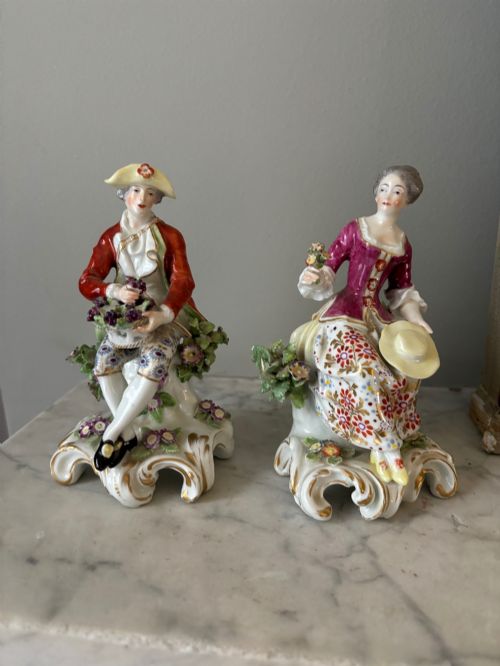


Pair of Porcelain Statuettes
These pair of porcelain statuettes bring balanced charm to a mantelpiece, usually taking the form of allegorical figures, shepherds, or musicians.
Pair of Porcelain Statuettes
When you search for a pair of porcelain statuettes, you encounter dual figural arrangements spanning from the eighteenth century through the Edwardian era, predominantly modelled as matching companions rather than isolated sculptures. The selection includes everything from early English factory pieces depicting elements or seasons to French hard-paste pairs and nineteenth-century Continental revivals.
Most examples on this page date to the nineteenth century, reflecting both original factory productions and deliberate tributes to earlier Chelsea or Derby models. Forms range from miniature domestic dogs to large-scale French and German figures of grape harvesters, gardeners, and musicians made by makers such as Samson, Meissen, and Royal Dux.
Materials and Techniques
Makers utilised hard-paste and soft-paste porcelain shaped in moulds, then refined the raw bodies by hand before firing. Bisque porcelain provided an unglazed, matte finish popular for classical and sculptural subjects, whereas standard porcelain received a transparent glaze.
Hand-painted enamel colours, gold leaf, and rich gilding were applied over or under the glaze depending on the factory and period. Many eighteenth- and nineteenth-century examples incorporated intricate applied details such as bocage foliage backgrounds, delicate lacework effects, and fine facial expressions.
Goats make frequent, surprisingly determined appearances beside tailors and cherubs alike.
Judging Quality and Execution
The sophistication of the palette and the delicacy of supplementary elements, such as naturalistic floral bocage or detailed animal forms, elevate certain pairs above mass-produced counterparts. Original factory marks, where present, help anchor the standard of craftsmanship.
Edme Samson·Meissen Porcelain·Royal Dux·Vion and Baury·Sitzendorf Porcelain·Ernst Bohne and Sohne
The Pair of Porcelain Statuettes Glossary
- Bisque porcelain
- Unfired or once-fired porcelain left unglazed to produce a matte, marble-like surface texture. This finish highlights sculptural modelling without the interference of shiny surface reflections.
- Bocage
- An intricate background of applied porcelain leaves, branches, and flowers framing the figures. It is particularly characteristic of eighteenth-century English factory styles and their nineteenth-century revivals.
- Hard-paste porcelain
- A dense, durable ceramic composition fired at high temperatures using kaolin and petuntse. It produces a clear, ringing body that resists scratching and absorbs glaze evenly.
- Gilding
- The application of gold leaf or powdered gold to highlights, borders, and garment details. This decorative addition signals higher-tier workshop production.
- Soft-paste porcelain
- An early European porcelain body composed of glass frit and white clay, fired at lower temperatures than hard-paste. It creates a creamy, translucent surface prized by early collectors.
Pair of Porcelain Statuettes: Frequently Asked Questions
How were these figures displayed originally?
Pairs were designed to sit symmetrically on mantelpieces, side tables, or as centrepieces for dining furniture. They often flanked a central clock or candelabra to create visual balance.
Their balanced subjects, such as seasonal workers or matching musicians, reinforced the orderly aesthetic of period interiors.
What subjects are most common?
Gardeners, shepherds, and allegorical representations of the seasons or elements appear frequently across both English and Continental production. Romanticized pastoral scenes and musicians also form a large portion of the available designs.
Animals, including miniature dogs and cockerels, offer a different scale of subject matter within the same medium.
How do I distinguish eighteenth-century pieces from nineteenth-century revivals?
Nineteenth-century factories like Samson and various German works often reproduced earlier Chelsea, Meissen, or Derby styles directly. Examination of the paste composition, weight, and the character of the painted marks helps clarify the true age.
Later copies frequently exhibit heavier potting or brighter, more uniform enamel colours than their eighteenth-century prototypes.
Are painted marks reliable indicators of origin?
Factory marks provide a starting point, but many nineteenth-century operations utilised imitation marks of earlier establishments like Chelsea or Meissen. These homage marks require careful contextual reading alongside the style and paste quality.
Unmarked Continental pieces from regional factories also occur regularly and must be judged entirely on their execution.