


Pair of Landscape Canvases
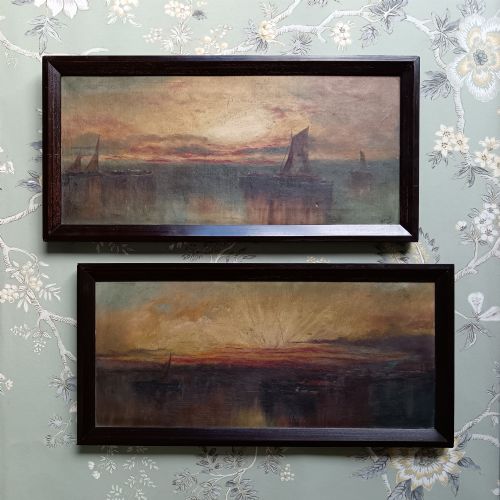
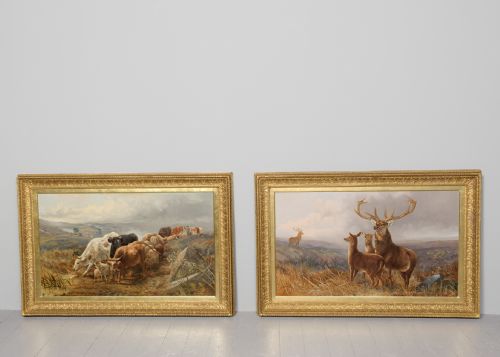
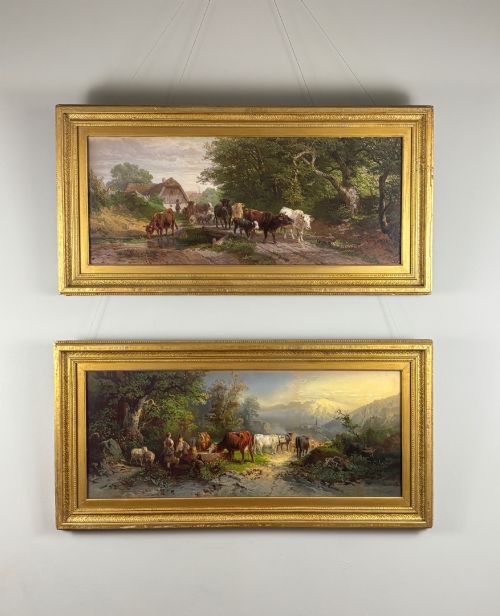
These pair of landscape canvases bring companion views of coastal waters, mountain glens, and pastoral pastures directly onto your walls.
Pair of Landscape Canvases
A pair of landscape canvases comprises two matched oil paintings sharing a subject, artist, or framing scheme intended to be displayed together. When you search this phrase, you encounter nineteenth-century and early twentieth-century works spanning the Victorian and Edwardian eras.
The subjects on this page cover pastoral scenes, Highland views, coastal waters, and maritime shipping. Many examples originate from British and European hands, capturing specific locations from North Wales to Bavarian castles.
Companions often depict contrasting times of day, such as sunrise and sunset, or paired activities like feeding geese and herding cattle. They represent complete artistic statements conceived as a matching set by the painter.
How they were made
These works utilise oil paint applied to woven canvas stretched over wooden frames, often retaining their original giltwood and gesso frames decorated with gold leaf. Painters built up the surface through layered brushwork to capture light on water, foliage, and stone.
The underlying support consists of standard wooden stretcher bars secured by tacks, holding the canvas taut for the artist. Heavy moulded frames finished in giltwood complement the oil paintings and provide structural protection.
Several artists painted companion scenes of feeding geese and herding cattle, proving that farmyard poultry demand just as much artistic gravity as Highland castles.
What varies in quality
Quality rests in the handling of light, atmosphere, and detail across both panels of the set, where superior works display confident brushwork and balanced composition. The relationship between the two canvases matters greatly, as stronger pairs maintain equal artistic vigour and tonal harmony from one frame to the other.
The preservation of the original oil paint surface and the condition of the matching giltwood frames influence the overall standard. Examples that retain their synchronous framing and untouched painted surfaces command greater visual presence.
B. Nash·Robert Cleminson·Johann Friedrich Voltz·John Grenville Fennell·Gustave De Bréanski·Adrian Van Porten·Clarence Henry Roe·Frank Hider·Frederick James Knowles·Sidney Pike·Ebeneezer Colls·Daniel Sherrin·Samuel Sidley·Alfred Vickers Senior·Henry Frederick Lucas-Lucas·Edgar Bundy·Hubert Thornley·John James Wilson·John W Morris·Thomas Rose Miles·Pieter Cornelis Dommersen·Walter Meegan·Frederick Henry Howard Harris·Samuel Hart Turpin·John Holland Snr
The Pair of Landscape Canvases Glossary
- Canvas
- A heavy woven fabric stretched across a wooden frame to serve as the foundation for oil paintings. It provides the textured surface that holds the ground and pigment.
- Giltwood
- Wood carved and coated with gold leaf or metallic paint, frequently used for nineteenth-century picture frames. This finish adds reflective warmth around the artwork.
- Gesso
- A white paint mixture consisting of a binder mixed with chalk, gypsum, or pigment, applied to wooden frames before gilding. It creates a smooth base for the gold leaf application.
- Pastoral
- An artistic style depicting rural country life, typically featuring fields, livestock, and agricultural settings. These scenes offer an idealized view of agrarian existence.
- Seascape
- A painting depicting the sea, coastal views, or marine shipping vessels. Artists used this genre to record maritime activity and coastal weather.
Pair of Landscape Canvases: Frequently Asked Questions
How should I hang a pair of landscape canvases?
Hang the two canvases at eye level with a consistent gap between them to let the matched frames balance each other visually. Aligning the centre points ensures the composition flows naturally across the wall.
Keep them away from direct sunlight and damp walls to protect the canvas tension and the giltwood frame finish over time.
What subjects appear in these nineteenth-century paintings?
The subjects range widely across rural and maritime themes, including Highland cattle, mountain streams, coastal shipping, and foreign townscapes. Many sets contrast daytime activities with evening light.
Artists frequently documented specific locations in Britain and Europe, giving each canvas a distinct sense of place.
Are the frames original to the canvases?
Many nineteenth-century works survive in their period giltwood and gesso frames, which were designed specifically to complement the paintings. Matching frames indicate that the pair has likely stayed together since creation.
Checking the corners and moulding profile helps confirm period manufacture and synchronous design.
How do I care for oil paintings on canvas?
Dust the canvas and frame gently with a soft, dry brush to prevent particle buildup on the oil paint surface. Avoid using water or cleaning solutions on the paint or giltwood.
Maintain stable room temperatures and moderate humidity to prevent the canvas from sagging or the wood from splitting.