



Pair of Hall Armchairs
When seeking a pair of hall armchairs, you enter a lineage of imposing seating designed to anchor grand entrances and reception rooms.
Pair of Hall Armchairs
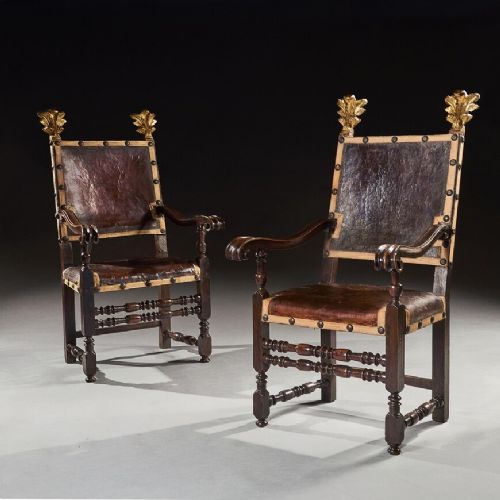
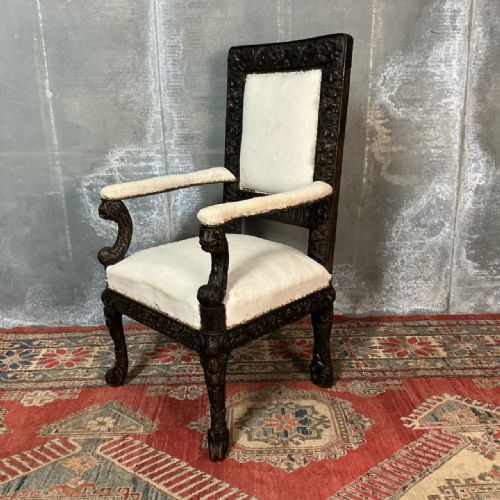
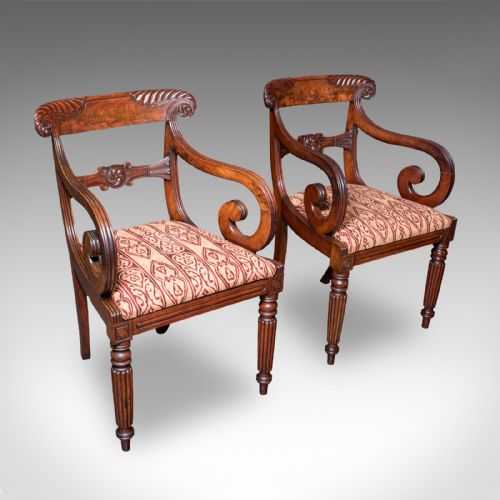
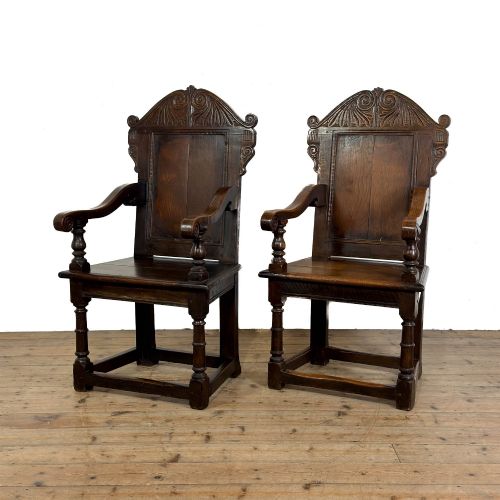
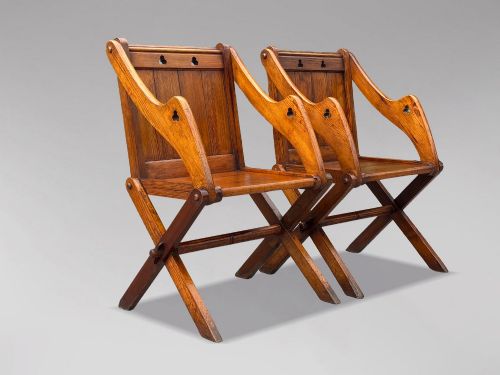
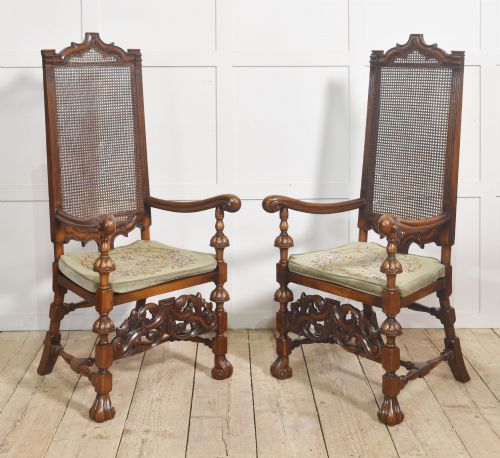
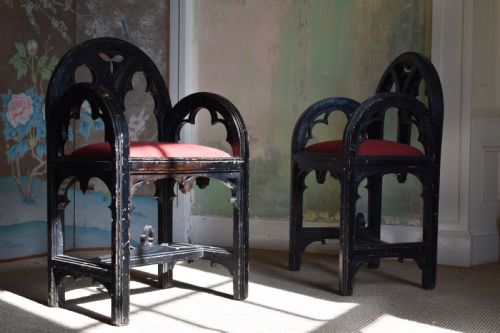
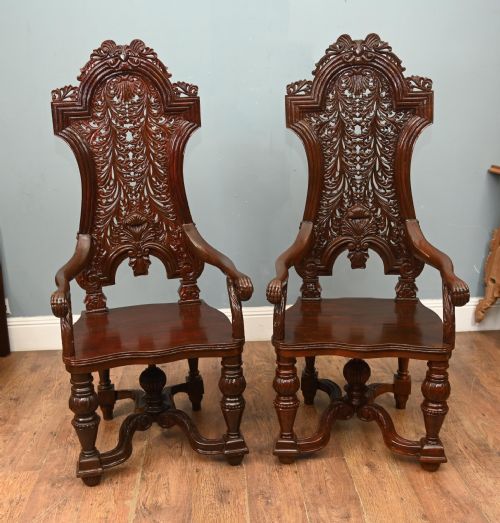
A pair of hall armchairs typically presents a high back, robust structural framing, and a commanding presence intended more for ceremony and transitional spaces than relaxed lounging. The examples encountered on this page stretch across centuries, encompassing substantial Gothic Revival thrones, carved oak wainscot chairs, and lighter Edwardian interpretations.
The materials reflect a preference for durability and gravitas, dominated by sturdy woods like oak, walnut, and mahogany, frequently paired with leather, woven textiles, or brass detailing. These seats serve as architectural punctuation points within a hallway, vestibule, or large landing, balancing utilitarian purpose with theatrical display.
Determinants of Quality
Quality rests primarily in the crispness and depth of the carving, the selection of timber grain, and the integrity of the structural joinery. Superior pairs display harmonious matching between the two chairs, with balanced proportions and wood selection that show deliberate pairing rather than assembly from disparate parts.
The distinction between standard workshop production and exceptional pieces often lies in secondary details, such as original leather upholstery, hand-wrought brass tacks, and the complexity of revival styles like Italian Baroque or Gothic Revival executed with historical precision.
Several heavy oak thrones watch over the room with carved Green Man foliage sprouting directly from their wooden ears.
White, Allom & Co.·A.W.N. Pugin
The Pair of Hall Armchairs Glossary
- Wainscot chair
- A heavy wooden armchair of seventeenth-century origin, characterised by a panelled back and solid wooden seat. They were traditionally constructed from oak and designed for domestic status.
- Glastonbury chair
- A distinctive folding armchair with an X-frame base, sloped arms, and a panelled back. This form gained popularity during various nineteenth-century Gothic revivals.
- Savonarola chair
- An X-frame chair formed of multiple curved wooden slats intersecting to create a rhythmic, scissor-like support. It draws inspiration from Renaissance Italian prototypes.
- Parcel-gilt
- A decorative technique where specific carved details or mouldings are partially gilded with gold leaf against a painted or stained wood ground. This enhances visual depth under changing light.
- Throne chair
- An oversized, high-backed armchair designed to impart authority and status within a hall or reception space. They frequently feature elaborate armorial carvings or figural motifs.
Pair of Hall Armchairs: Frequently Asked Questions
Where were hall armchairs placed?
These chairs stood in grand entryways, hallways, and large landings rather than private sitting rooms. Their primary function was to project status and provide occasional seating for visitors waiting to be received.
Because they were built with solid timber and upright backs, they suited transitional spaces where comfort took second place to architectural presence and display.
How do I identify Gothic Revival examples?
Gothic Revival pieces display architectural motifs borrowed from medieval stone buildings, such as pointed arches, trefoils, tracery panels, and linenfold carving. They are almost invariably constructed from heavy oak.
Look for structural ambition where the woodwork mimics cathedral joinery, sometimes accompanied by buttoned leather upholstery and deep relief carvings.
What is a wainscot chair?
A wainscot chair is an early form of wooden armchair constructed with panelled backs, solid seats, and heavy arm supports. The term derives from wainscot oak, a high-grade timber imported for panelling.
These pieces offer a tangible link to seventeenth-century domestic interiors, prized for their architectural joinery and austere, enduring lines.
Are these chairs comfortable for daily use?
Hall armchairs were designed for posture and ceremony rather than lounging, meaning their seats are typically upright and unyielding. Many versions feature wooden seats or firm leather pads without deep cushioning.
Living with them involves appreciating their sculptural qualities and historical character, using them as statement seating in spacious rooms rather than primary reading chairs.