


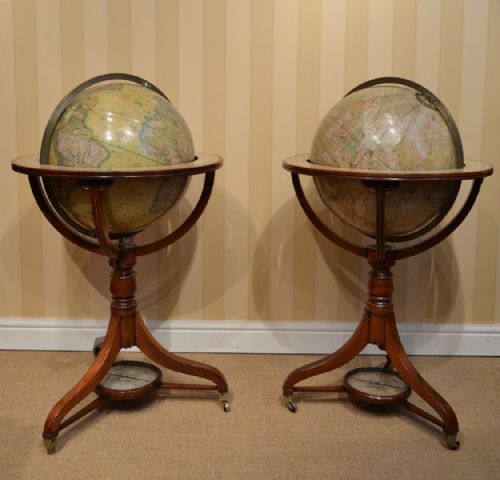


Pair of Globes
A pair of globes brings the earth and sky into a room, offering the twin spheres of terrestrial and celestial mapping.
Pair of Globes
A pair of globes typically comprises a terrestrial globe alongside its celestial counterpart, designed to sit upon library tables or floor stands. These sets span periods from the nineteenth century through the Edwardian era and the nineteen-thirties, reflecting centuries of cartographic study.
The specimens seen here appear in various formats, ranging from twelve-inch and fifteen-inch library models to smaller table variants and floor-standing pieces. Makers such as Cary, Malby, and Crunchley dominate the historical record for these scientific instruments.
Cartographic accuracy and period paper gores define the visual impact of these objects. Buyers most frequently encounter nineteenth-century and early twentieth-century examples framed in timber mountings or brass hardware.
Distinctions in quality
The crispness of the cartographic engraving and the legibility of historical place names determine the primary tier of craftsmanship in a pair of globes. Finer examples retain their original varnished surfaces without excessive darkening or paper loss.
The integrity of the original stands and brass hardware adds considerably to the standing of the piece, as replacements alter the historical balance. Original paper gores intact along the seam lines indicate superior preservation.
The listings show nineteenth-century and early twentieth-century globes mounted on timber and brass stands, alongside related glass and porcelain objects.
G & J Cary·Thomas Malby·Crunchley·Thomas of Paris
The Pair of Globes Glossary
- Gore
- A tapering printed paper strip shaped to cover a spherical globe without creasing. Multiple gores are applied edge to edge to map the entire sphere.
- Terrestrial globe
- A model of the earth showing continents, oceans, shipping routes, and political boundaries. These spheres reflect the geographical knowledge of their specific production era.
- Celestial globe
- A sphere mapping the constellations, stars, and astronomical coordinates from an imagined exterior viewpoint. It traditionally matches its terrestrial partner in size and mounting.
- Meridian ring
- A brass or metal ring encircling the globe in which the sphere pivots on its axis. It allows the globe to be tilted to match different latitudes.
Pair of Globes: Frequently Asked Questions
Were terrestrial and celestial globes always sold together?
Scientific instrument makers traditionally produced them as matched pairs for libraries and studies.
They allowed scholars to study both geography and astronomy using identical mounting styles.
How do I date an antique globe?
Examine the political boundaries, country names, and shipping routes printed on the paper gores.
Cartographers updated their printing plates periodically, recording specific historical events and discoveries.
Where should I place globes in a room?
Position them away from direct sunlight and damp environments to protect the fragile paper.
Stable table surfaces or dedicated floor spaces allow the horizon rings to remain level.