
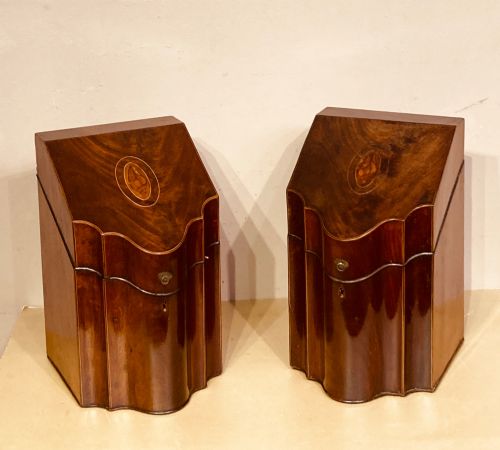
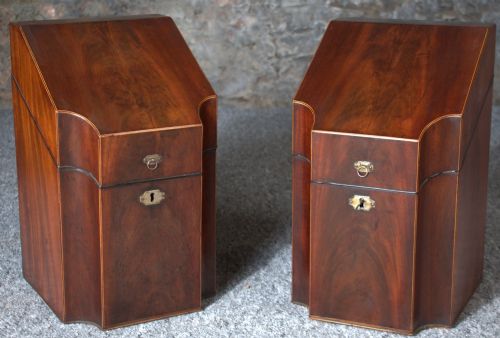


Pair of Cutlery Boxes
These pair of cutlery boxes are formal containers designed to hold flatware, bringing period elegance to any interior.
Pair of Cutlery Boxes
When you search for a pair of cutlery boxes, you encounter formal receptacles originally built to house dining flatware during elaborate meals. The selection centres primarily on Georgian mahogany knife boxes from the eighteenth century, alongside later Victorian and Edwardian iterations.
The dominant forms include slope-front knife boxes and classical urns designed to sit upon dining room sideboards. Many examples from this heritage incorporate fitted interiors intended to keep individual blades and handles separated.
Beyond traditional wooden cases, the broader category encompasses matching cased sets of silver serving pieces and cutlery. These range from nineteenth-century fish servers and grape shears to twentieth-century dessert servers housed in velvet or silk.
How they were made
Cabinet makers utilised dense timbers such as mahogany and satinwood, frequently accentuating the surfaces with boxwood stringing and delicate inlay. Carpenters shaped these materials into sloping lids or curved bodies, securing the joints with precision.
Metalworkers contributed functional hardware including brass hinges, escutcheons, and occasionally solid silver mounts. Interior compartments were often lined with velvet or silk to protect the polished steel and silver contents.
Listings feature mahogany, satinwood, and boxwood construction alongside sterling silver and silver-plated accessories.
What varies in quality
The standard of timber selection and inlay work fundamentally determines the visual merit of each wooden container. Master craftsmen achieved superior patination through the careful choice of figured mahogany grains and precise boxwood detailing.
Internal condition and the preservation of original hardware separate exceptional pieces from standard examples. Retaining the fitted wooden partitions or original velvet and silk linings elevates the integrity of the ensemble.
The Pair of Cutlery Boxes Glossary
- Knife box
- A specialised lidded container, typically featuring a sloping front, designed to store dining knives upright or flat.
- Cutlery urn
- A vase-shaped wooden vessel utilised for holding flatware on sideboards during the eighteenth and nineteenth centuries.
- Patina
- The deep surface sheen and mellow colour developed by aged timber and metal over centuries of handling and polishing.
- Escutcheon
- A protective metal plate surrounding a keyhole, frequently cast in brass on period wooden boxes.
- Stringing
- Narrow inlaid lines of contrasting timber, such as boxwood, used to edge panels on eighteenth-century furniture.
Pair of Cutlery Boxes: Frequently Asked Questions
Where were cutlery boxes placed in a home?
These containers stood upon sideboards or serving tables in the dining room during formal meals. They provided immediate access to knives and forks while keeping the cutlery protected when not in use.
In grander houses, matching pairs framed the sideboard symmetrically. This arrangement contributed to the balanced aesthetic expected in period dining spaces.
How do I care for wooden knife boxes?
Keep the timber away from direct sunlight and sudden temperature changes to prevent the mahogany or satinwood from drying out. Dust the surfaces gently with a dry cloth and avoid harsh chemical polishes.
Preserve the interior velvet or silk linings by keeping them dry and free from moisture. Gentle handling of brass hinges and silver mounts ensures the hardware remains secure.
What is the difference between boxes and urns?
Knife boxes typically feature a sloped lid that lifts to reveal a stepped interior partitioned for blades. They date predominantly from the Georgian period and sit low on the surface.
Cutlery urns adopt a classical vase silhouette with a removable top section. They represent a more architectural approach to dining room storage from the same era.
Are cased serving sets considered cutlery boxes?
While traditional boxes house loose knives, the category also includes fitted presentation cases for specific implements. These often contain sterling silver fish servers, grape shears, or carving sets.
Such cased sets share the same protective intent as wooden containers. They utilise velvet or silk interiors to secure the silver pieces during storage.