
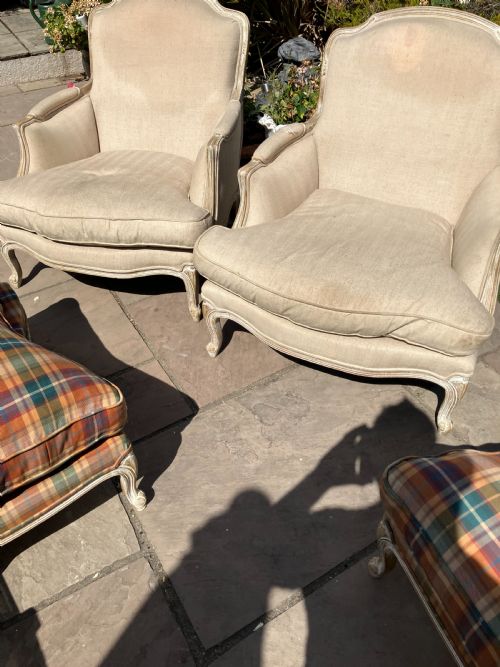
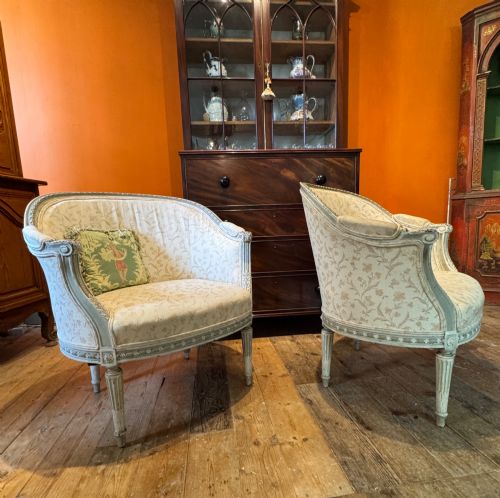
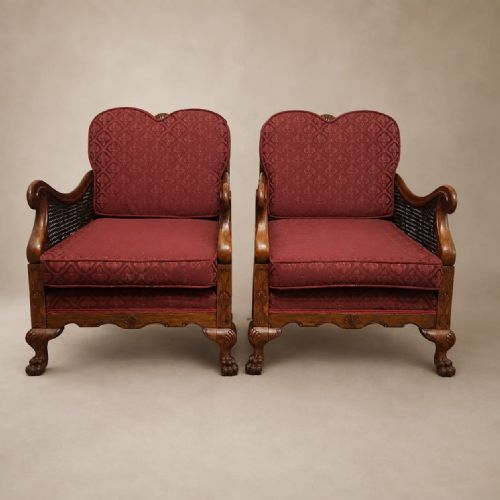
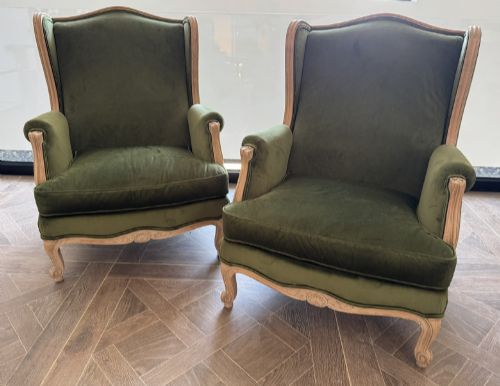
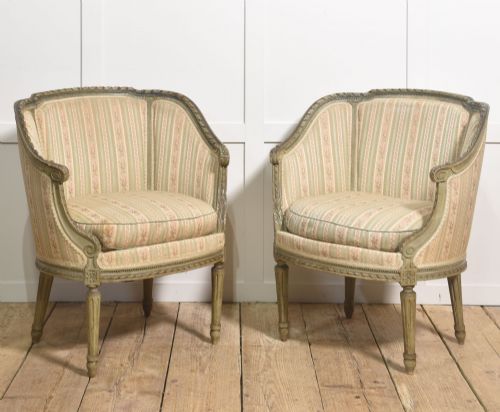
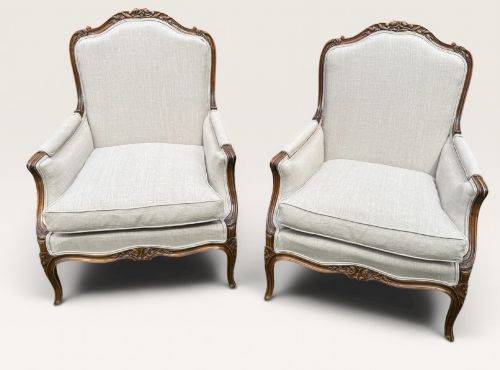
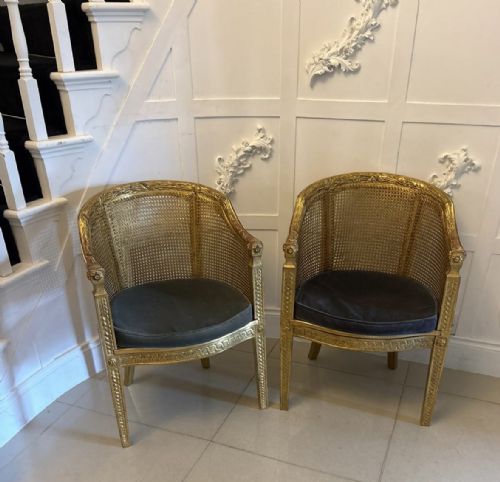
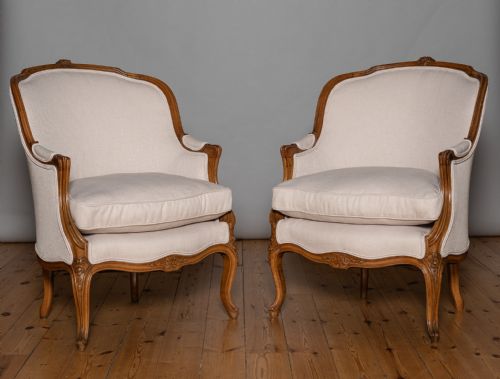
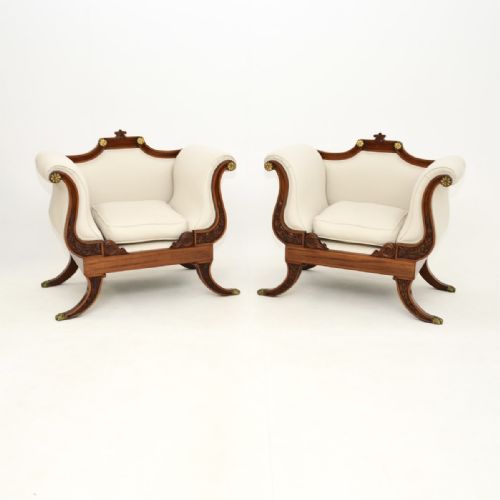


Pair of Bergere Armchairs
A pair of bergere armchairs offers deep, enclosed seating defined by cane panels and upholstered cushions, bringing classic French and English comfort to a room.
Pair of Bergere Armchairs
A pair of bergere armchairs provides matching deep seating framed in timber with woven cane sides and back panels. Buyers searching for a pair of bergere armchairs frequently encounter French Louis XV and Louis XVI styles alongside early twentieth century walnut and painted versions.
The form developed as an enclosed, comfortable seat for reading or conversation in the eighteenth century and saw major revivals throughout the nineteenth and twentieth centuries. Examples on this page span from Regency models to later Edwardian and 1920s interpretations in oak, mahogany, and beech.
These seating pairs often include loose seat cushions upholstered in velvet, linen, silk, or leather. Many pieces retain original paint, gilding, or polished wood surfaces reflecting their chateau or country house origins.
How they were made
Frames are constructed from hardwoods such as walnut, mahogany, beech, oak, and satin birch, frequently shaped with hand-carved details or finished with paint and parcel-gilt. The characteristic side and back panels are tightly woven from natural cane, sometimes in double layers for added strength.
Upholstery relies on traditional sprung bases and stuffed cushions covered in textiles ranging from simple linen and cotton to coral velvet and decorative silk. Giltwood and painted surfaces were often layered over gesso on timber frames during manufacture.
Some nineteenth century examples come equipped with hidden slide-out footstools for ultimate library comfort.
What varies in quality
The crispness of the wood carving and the depth of the timber frame distinguish finer seating from simpler production. Walnut and mahogany frames with intricate Louis style motifs show superior cabinetmaking compared to plain beech alternatives.
The tightness and regularity of the hand-woven cane panels dictate the standard of the structural work. Original paint finishes and untouched surface patination command distinct appreciation over later repainted or heavily stripped examples.
The Pair of Bergere Armchairs Glossary
- Bergere
- An enclosed upholstered armchair with wooden framing and woven cane side panels. This form emerged in France during the eighteenth century.
- Cane
- Material woven from split rattan used for the sides and backs of seating. It provides flexible, breathable support.
- Fauteuil
- An open-armed wooden armchair with upholstered back and seat. Unlike the bergere, the sides are typically open.
- Giltwood
- Timber coated with a thin layer of gold leaf applied over a prepared gesso ground. It was widely utilised on formal salon furniture.
- Louis XV Style
- A decorative style characterised by asymmetric curves, cabriole legs, and floral carving. It heavily influenced nineteenth-century revivals.
Pair of Bergere Armchairs: Frequently Asked Questions
What is a bergere armchair?
A bergere is an enclosed upholstered armchair featuring solid wooden frames and woven cane side panels. It provides deeper and more enclosed seating than an open armchair.
Most examples include a loose seat cushion and originated in France or England. They appear across various historical styles from the Regency period to the twentieth century.
How do I identify the style?
Style identification relies on the carved details and frame shapes. Louis XV examples display cabriole legs and curved lines, while Louis XVI pieces feature straight tapered legs and neoclassical motifs.
English and Swedish variants often adopt local neoclassical or simpler country house proportions. Examining the timber and decorative carving helps confirm the period.
Are these chairs comfortable?
These armchairs are designed for relaxed sitting with deep seats and supportive upholstered cushions. The enclosed sides and padded backs offer a secure, enveloping posture.
Many surviving pieces feature sprung bases and generous proportions. They function well as library chairs or fireside seating.
How should I care for the cane?
Cane panels require gentle dusting and moderate room humidity to prevent drying and snapping. Avoiding direct heat sources keeps the natural material flexible.
Periodic inspection of the woven areas ensures structural stability. The wooden frames benefit from standard polishing appropriate to their finish.