
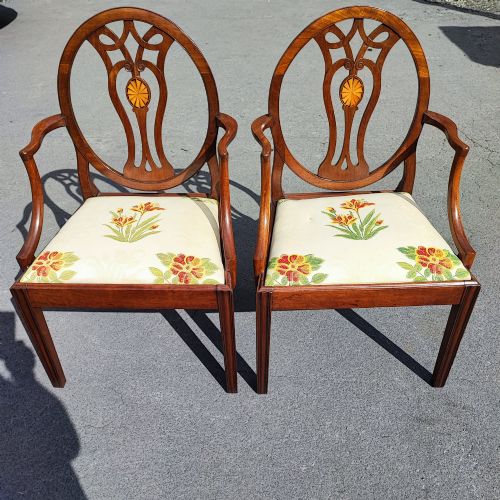


Pair Neoclassical Side Chairs
Pair neoclassical side chairs bring symmetry and refined classical line to a room, offering enduring elegance through balanced proportions and restrained ornament.
Pair Neoclassical Side Chairs
When you search for pair neoclassical side chairs, you encounter seating influenced by ancient Greek and Roman design, emerging through the 18th century and into later revival periods. These pieces serve functional seating roles while functioning as architectural elements within a disciplined interior scheme.
The versions you meet most frequently on this page span the Georgian, Regency, and Louis XVI styles, alongside later Victorian and 20th-century revivals. They appear in forms ranging from straightforward mahogany side chairs to elaborately carved giltwood and painted salon seating.
Makers and workshops across England, France, and Sweden interpreted the style through local materials, producing shield backs, open arms, and upholstered salon formats. Each regional variation maintains a commitment to symmetry, straight tapered legs, and classical motifs.
Materials and construction methods
Cabinetmakers relied heavily on dense timbers such as mahogany, beech, fruitwood, and walnut to achieve crisp, linear carving. Where a more opulent finish was desired, wood frames received giltwood treatments or polychrome paintwork.
Upholstery techniques involved traditional webbing and stuffing finished in silk, wool work, or patterned fabric. Brass accents and inlay work provided subtle contrast to the primary timber structures.
Solid brass side chairs prove that even the most austere neoclassical line can be cast entirely in metal.
Distinctions in craftsmanship
The refinement of the carving dictates the distinction between standard production and exceptional examples, particularly where fluting, paterae, and classical swags are rendered by hand. Sharpness of detail in the timber or gilt surfaces indicates the care taken by the original maker.
Structural integrity depends on the joinery concealed beneath the upholstery, where tight tenons and sound frame construction ensure longevity. The choice of primary timber, from plain painted wood to figured mahogany and gilt walnut, establishes the tier of the piece.
The Pair Neoclassical Side Chairs Glossary
- Neoclassical
- A style inspired by the classical art and architecture of ancient Greece and Rome. It prioritises straight lines, symmetry, and restrained ornamentation over baroque excess.
- Shield back
- A chair back shaped in the outline of a heraldic shield, popularised by designers like Hepplewhite in the Georgian period. This form often incorporates delicate pierced splats and carved wheat ears.
- Giltwood
- Wood that has been coated with a thin layer of gold leaf or gilt gesso. It provides a luminous, reflective surface frequently found on high-status salon chairs.
- Gilt walnut
- Walnut timber enhanced with applied gold leaf detail. This combination brings warmth and richness to formal seating.
- Polychrome
- Painted in several colours, often featuring delicate floral motifs or classical banding. This decorative technique appears on specific 18th-century and revival frames.
Pair Neoclassical Side Chairs: Frequently Asked Questions
How do I style pair neoclassical side chairs?
Place them symmetrically flanking a fireplace, console table, or architectural doorway to establish a formal focal point. Their restrained geometry allows them to sit comfortably alongside both period antiques and modern minimalist furnishings.
Ensure they are positioned where their carved details and silhouette can be appreciated without obstruction. They function well as occasional seating in living rooms, hallways, or bedrooms.
Were these chairs used for dining?
Side chairs and single chairs without arms were routinely produced for dining tables, drawing rooms, and halls. Their compact, armless format allowed them to be tucked neatly against a table or wall when not in use.
Heavier armchairs and salon chairs within this style were typically designated for reception spaces, parlours, or bedrooms rather than daily dining.
How do I distinguish French from English neoclassical chairs?
French examples, such as those in the Louis XVI or French Regency style, frequently feature exposed carved frames in beech, painted wood, or giltwood with generous upholstery. They often lean towards decorative elegance and soft curves within a classical framework.
English pieces, notably Georgian and Sheraton designs, tend to showcase polished mahogany or fruitwood with architectural straight legs, shield backs, and disciplined inlay.
What is a Louis XVI revival piece?
A Louis XVI revival piece is an item manufactured during the 19th or early 20th century that deliberately copies the French neoclassical style of the late 1700s. These pieces utilise period construction methods while reflecting the aesthetic tastes of the later Victorian or Edwardian eras.
They offer the classical aesthetic of Louis XVI design with the durability of a slightly later manufacturing date.