

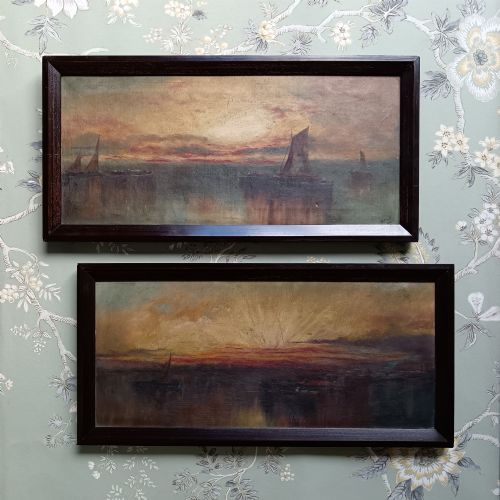
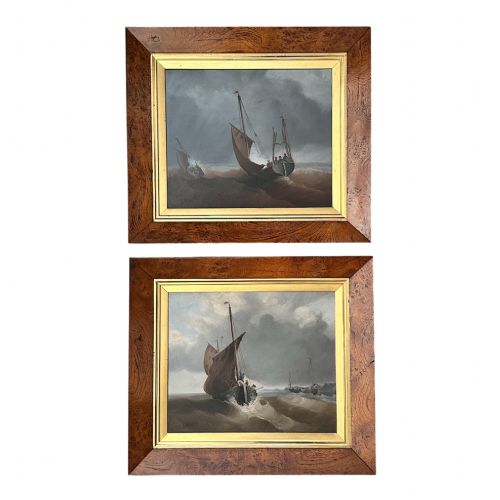
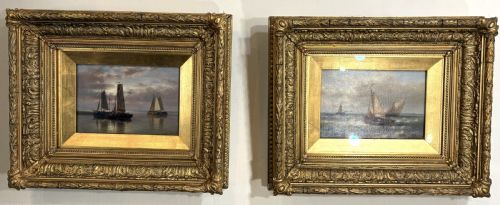


Pair Marine Oil Paintings
Pair marine oil paintings bring together matched coastal views, shipping scenes and maritime subjects in twin frames.
Pair Marine Oil Paintings
When you search for pair marine oil paintings, you encounter matched sets of framed artworks depicting seascapes, coastal views, and maritime traffic. These works typically originate from the nineteenth century and the Edwardian era, capturing waters from Dutch shores to British harbours like Portsmouth and Scarborough.
The subjects on this page lean heavily towards sailing vessels, fishing boats, barques, and Thames scenes. Buyers generally meet matching compositions depicting contrasting conditions such as sunrise and sunset, moonlit waters, or companion ports.
How they were made
Artists painted these works using oil paint applied to prepared canvas or wood panels, capturing atmospheric coastal light and marine details. The resulting surfaces hold the layered pigment of nineteenth-century and Edwardian maritime traditions.
Framing plays a defining role in presentation, utilising wood finished with gesso, gold leaf, and gilt to complement the canvases. These giltwood frames complete the paired presentation intended by the makers.
Pair Marine Oil Paintings Retail Price Guide 2026
Typical asking prices for pair marine oil paintings among the pieces listed under this phrase on Sellingantiques today, from the lower quarter to the upper quarter. They describe what is for sale here now, not the wider market.
The archive and active listings span the Victorian era, the Edwardian period, and the nineteenth century.
What varies in quality
Quality rests upon the skill of the brushwork and the confidence with which the artist handles water, sky, and rigging. Stronger examples display a distinct mastery of light, atmospheric depth, and motion in the waves.
The integrity of the original gilt frames and the clarity of the signatures or attribution add distinction to individual pairs. Matched scale and balanced compositions determine how successfully the two paintings function together on a wall.
John Moore of Ipswich·Abraham Hulk I·Gustave De Bréanski·Pieter Cornelis Dommersen·Adrian Van Porten·George Dodgson Callow·Ebeneezer Colls·Hubert Thornley·John James Wilson·Walter Meegan·Thomas Rose Miles·Francis Moltino·Walter Williams·Frederick J Sang·H Claessens·John Stanley Fox·B Nash
The Pair Marine Oil Paintings Glossary
- Canvas
- A heavy woven fabric stretched across a wooden frame to serve as a support for oil paint. It provides the foundational texture for many maritime works.
- Giltwood
- Wood that has been coated with a thin layer of gold leaf or metallic gilt. This finish gives traditional picture frames their bright metallic sheen.
- Gesso
- A plaster-like mixture applied to wood or canvas to prepare a smooth surface for painting or gilding. It forms the base under many ornate frame decorations.
- Barque
- A sailing vessel with three or more masts. This specific ship type appears frequently in maritime art.
- Board
- A rigid panel used as a painting support instead of stretched fabric. Artists often painted smaller marine scenes directly onto these firmer surfaces.
Pair Marine Oil Paintings: Frequently Asked Questions
What subjects do they show?
These artworks depict coastal views, shipping traffic, fishing boats, and specific harbours such as Portsmouth and Scarborough. Many compositions focus on sailing vessels, barques, and Thames scenes.
Pairs often contrast atmospheric conditions, showing companion views of sunrise and sunset or daytime and moonlit waters.
How were they displayed?
Makers housed these twin artworks in matching giltwood and gesso frames designed to be hung side by side. The shared frames unite the two distinct canvases into a single decorative scheme.
Historically, owners placed them in parlours and reception rooms to bring maritime narratives indoors.
Which periods are represented?
The pieces span the Victorian and Edwardian eras, with many dating across the nineteenth century up to the early nineteen-hundreds. Artists active during these decades recorded both commercial shipping and local coastal life.
Dates recorded on the works often fall between eighteen-sixty and nineteen-ten.
Are they signed by artists?
Several works carry signatures or attributions to named nineteenth-century painters, while others remain anonymous coastal scenes. Signatures help link specific pieces to known practitioners of marine art.
Both signed compositions and unsigned maritime views appear within these matched pairs.