
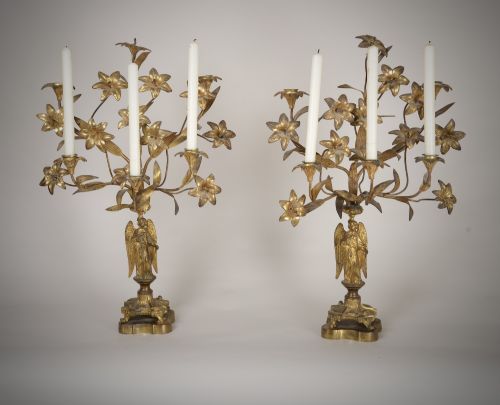
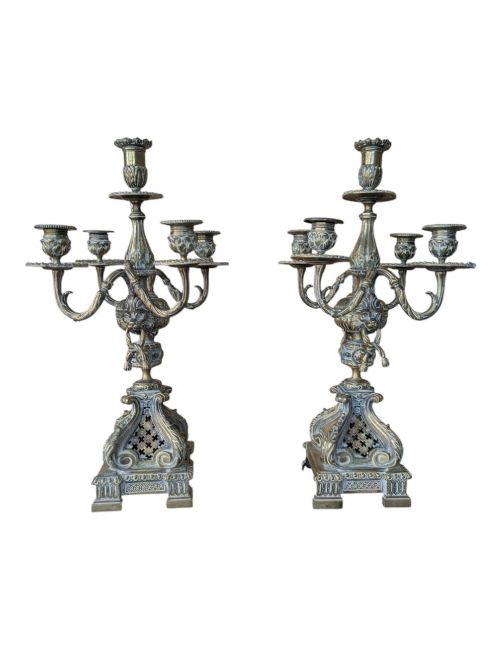
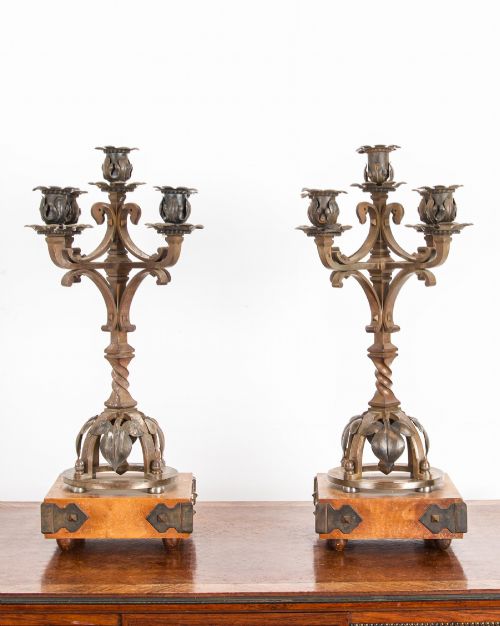


Pair Gothic Candelabra
These pair gothic candelabra bring medieval theatre into a room through pointed arches and heavy metalwork, offering striking vertical presence.
Pair Gothic Candelabra
When you search for pair gothic candelabra, you encounter lighting fixtures shaped by the Gothic Revival and Renaissance Revival movements. These pieces draw heavily on ecclesiastical and medieval design, translating cathedral motifs into domestic and liturgical metalwork.
The selections available here lean heavily into Victorian production alongside twentieth-century reinterpretations, spanning floor-standing candelabras, table branches, and wall sconces. You meet brass, bronze, and iron most frequently, often configured with multiple branches for candlelight.
The forms range from simple ecclesiastical altar pieces to heavy figural or architectural designs featuring trefoils, cusps, and clustered shafts. Most examples on this page date from the nineteenth and early twentieth centuries, reflecting the enduring Victorian appetite for historicist decoration.
Materials and construction
Foundries cast these pieces primarily in brass, bronze, cast iron, and ormolu, utilising techniques that allowed for intricate architectural tracery and sharp relief decoration. Wrought iron variants rely on hand-forging to create scrolling arms and structural supports suited to heavier floor-standing models.
Surface finishes include fire-gilding to create gilt bronze and ormolu, alongside patinated bronze and polished or cast brass surfaces. Assembly typically involves threaded rods and bolted joints that secure the multi-branch arms to central shafts and heavy weighted bases.
Some nineteenth-century makers cast gas light fittings alongside traditional wax candle branches, hedging their bets as drawing rooms flickered between fuels.
Distinctions in quality
Quality rests in the crispness of the casting and the depth of the chased detail, where finer examples preserve sharp architectural mouldings and deliberate surface texture. Heavier metals and robust multi-branch construction indicate superior workshop standards, whereas simpler pieces rely on basic casting with minimal hand-finishing.
The integrity of the original surface patina or gilding separates standard production from exceptional examples. Pieces that retain their heavy original bases, screw fittings, and balanced branch alignment demonstrate greater structural fidelity.
Wm. Tonks & Sons
The Pair Gothic Candelabra Glossary
- Gothic Revival
- An architectural and decorative style drawing on medieval forms, pointed arches, and ecclesiastical motifs. This style dominates the nineteenth-century production seen in these listings.
- Ormolu
- Finely chased gilt bronze used for decorative metalwork. It provides a bright golden surface finish on select nineteenth-century pairs.
- Sconce
- A wall-mounted lighting fixture designed to hold candles or tapers. Several examples take this bracketed wall format rather than standing on a table or floor.
- Tracery
- Openwork stonework patterns translated into metal casting. You see this decorative stonelike lattice supporting the candle cups and stems.
- Patina
- The surface coloration and sheen developed through age and handling. This layer indicates the natural oxidation of bronze, brass, or iron over decades.
Pair Gothic Candelabra: Frequently Asked Questions
How do I clean antique brass candelabra?
Dust gently with a soft brush to preserve the underlying metal and historic surface patination. Avoid harsh chemical polishes that strip away the aged character accumulated over the decades.
For stubborn residue, use a damp cloth followed by immediate drying. Protect the original finish rather than attempting to achieve a bright modern shine.
Were these made for churches or homes?
Makers produced both ecclesiastical altar pieces and domestic variations for Victorian parlours and dining rooms. Altar pieces tend to feature heavier brass construction and Christian symbolism.
Domestic pairs often incorporate Renaissance Revival or secular Gothic motifs designed for sideboard display. Both settings relied on heavy cast metals to support multiple candle branches safely.
How do I date a pair of candelabra?
Examine the casting quality, assembly screws, and base construction for clues to the period. Nineteenth-century examples often display sand-casting textures and hand-chased surface details.
Twentieth-century pieces from the nineteen-twenties or thirties may show lighter gauge metal and simplified joints. Comparing the stylistic cues to known Victorian or Arts and Crafts production helps narrow the decade.
Can I use standard candles in them?
Measure the diameter of the drip pans and candle sockets before purchasing standard taper candles. Many older sockets accommodate thinner tapers or require minor adjustment to hold modern candle sizes securely.
Ensure the candelabra sits on a level surface when lit to maintain stability across the branching arms. Drip catchers help protect the metal finish from wax accumulation during use.