



Pair Gilded Accent Mirrors
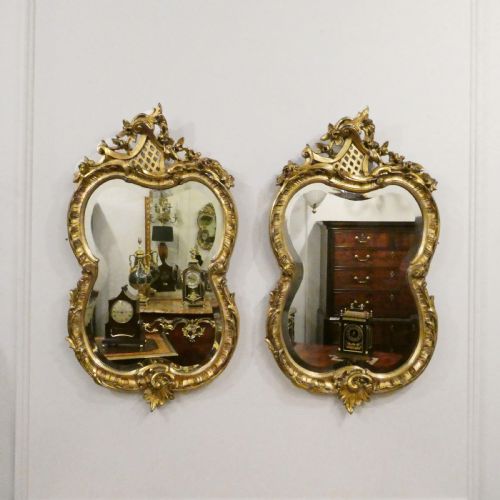
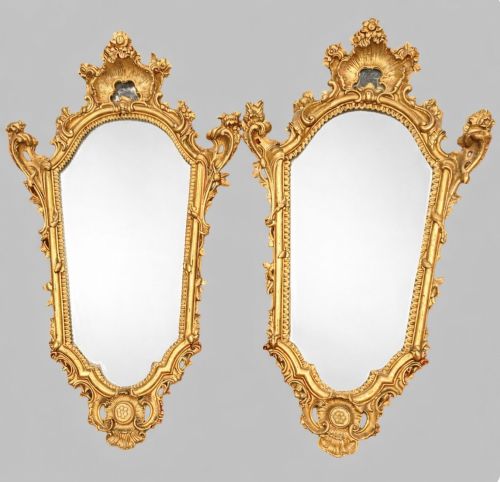
Pair gilded accent mirrors bring instant reflection and decorative balance to a room, sourced here in nineteenth-century French, Italian, and Victorian styles.
Pair Gilded Accent Mirrors
Pair gilded accent mirrors are matching wall-hung looking glasses designed to create symmetry and bounce light around a interior space. They appear frequently in French Rococo, Victorian, and Regency styles from the nineteenth century and the early twentieth century.
How they were made
The construction of these pieces relies on timber frameworks coated in layers of gesso to build up high-relief ornamentation before the application of gold leaf or surface gilding. Carvers shaped the wood and gesso by hand to achieve the curves seen in Rococo Revival and Baroque Revival designs.
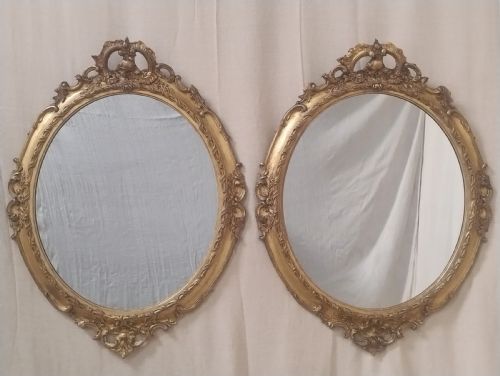
Mirrored glass panels are set within these gilded frames, often accompanied by secondary materials such as velvet backing or wooden support structures. The physical dimensions vary, including specific historical formats like oval wall mirrors.
Materials recorded across the current inventory include giltwood, gesso, timber, glass, and velvet.
What varies in quality
Quality in these items rests upon the crispness of the hand-carved detail and the depth of the gilding applied to the timber and gesso substrate. Finer examples display intricate relief work that retains its definition beneath the metallic leaf.
The integrity of the frame construction and the original character of the glass further distinguish the better specimens. Pieces retaining their original nineteenth-century surfaces and harmonious proportions command greater appreciation among collectors.
The Pair Gilded Accent Mirrors Glossary
- Giltwood
- Timber that has been covered with gold leaf or a gold-coloured finish. This material defines the warm metallic sheen characteristic of traditional wall mirrors.
- Gesso
- A plaster-like mixture applied to wood frames to create a smooth surface for carving and gilding. Artisans used it to build up the heavy relief ornament found on revival pieces.
- Rococo Revival
- A nineteenth-century design movement mimicking the ornate, asymmetric scrolls and natural motifs of the eighteenth-century French style. It appears frequently in the carved frames of this period.
- Regency Style
- An English aesthetic characterised by classical restraint and elegance popular during the early nineteenth century. Mirrors from this tradition often feature cleaner architectural lines.
Pair Gilded Accent Mirrors: Frequently Asked Questions
Where should I hang pair gilded accent mirrors?
These pieces work best positioned symmetrically on either side of a fireplace, doorway, or large piece of furniture. Their matching design creates visual balance and reflects light across the room.
Consider the height at which you mount them to ensure they capture the best angles of the interior space. Matching pairs create a formal focal point on any wall.
How do I date these mirrors?
Dating relies on examining the construction methods of the timber frame, the composition of the gesso, and the style of the carving. Nineteenth-century pieces often show specific revival characteristics such as French Rococo or Baroque motifs.
The materials and backings also offer clues to the period of manufacture, distinguishing nineteenth-century examples from early twentieth-century interpretations.
Are all these mirrors antique?
The selection spans from the mid-nineteenth century through to the early twentieth century, encompassing Victorian and Edwardian periods. Each listing specifies its estimated age based on the style and construction.
Buyers will find items originating from around eighteen-eighty up to nineteen-hundred, reflecting historic revival movements in France, Italy, and England.