
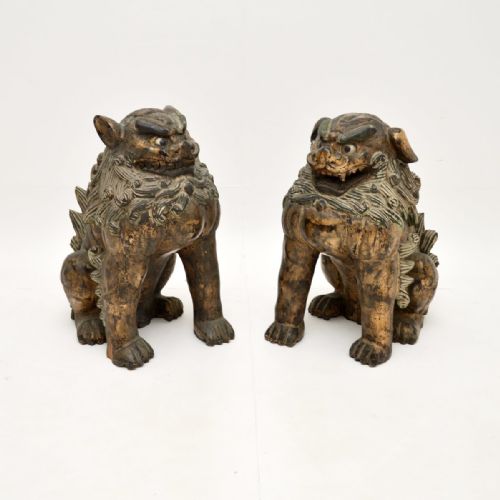
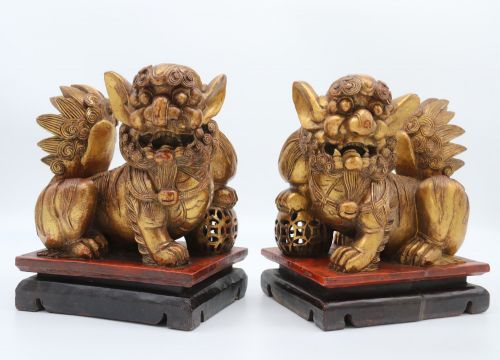


Pair Foo Dog Statues
These pair foo dog statues are protective guardian figures that bring traditional form and presence to any interior.
Pair Foo Dog Statues
When you search for pair foo dog statues, you are looking at guardian figures traditionally placed at entrances for protection. The selection includes decorative figures, sculptures, statues, and bookends.
You are most likely to meet examples in carved wood, bronze, brass, pottery, and stone spanning the nineteenth century up to the 1920s. Styles range from Qing Dynasty and Chinese Traditional to Victorian Chinoiserie.
The assortment demonstrates origins from Chinese and Tibetan workshops, alongside French interpretations of the form. These pieces function as decorative sculptures and functional bookends.
Materials and construction
Carved wood examples utilise traditional techniques, often enhanced with gilt and lacquer surfaces or polychrome paint. Bronze and brass castings provide weight and durability, sometimes featuring fire gilt or patinated finishes.
Ceramic and pottery versions employ glazed finishes such as sancai, while stone and carved stone variants rely on direct sculptural reduction. Jade marble and soapstone are also utilised for smaller bookend forms.
One hefty pair of Tibetan bronze temple lions tips the scales at thirty-five kilograms.
Assessing quality
Quality in pair foo dog statues rests upon the crispness of the carving or casting and the preservation of original surface finishes like lacquer, gilt, and sancai glaze. Heavier metal castings and finer hand-carved details in wood or stone indicate superior craftsmanship.
The overall scale and proportion of the pair affect desirability, with larger temple lions commanding attention through their commanding presence. Consistency between the two companion figures is essential for a balanced matching pair.
The Pair Foo Dog Statues Glossary
- Foo Dog
- A traditional guardian lion figure derived from Chinese Buddhist tradition. They are typically displayed in pairs to guard entrances and spaces.
- Sancai
- A traditional three-colour pottery glaze technique used on Chinese ceramics. It creates varied coloured passages across the body of the figure.
- Chinoiserie
- A European artistic style reflecting Chinese motifs and decorative arts. It appears frequently in Victorian interpretations of oriental forms.
- Gilt
- A thin layer of gold applied to the surface of wood or metal objects. It provides a reflective finish that highlights carved details.
Pair Foo Dog Statues: Frequently Asked Questions
Where should I place pair foo dog statues?
These guardian figures work well on mantelpieces, entryway consoles, or flanking a doorway as intended in traditional settings.
Smaller bookend versions function practically on shelves while retaining the sculptural guardian aesthetic.
How do I date these statues?
Dating relies on material wear, casting techniques, and stylistic markers associated with periods like the Qing Dynasty or the Victorian era.
Examining the base and interior surfaces often reveals tool marks or patination consistent with nineteenth-century or early twentieth-century production.
Are bronze and wood equally common?
Wood and bronze both appear regularly alongside pottery, brass, and carved stone.
Bronze and Tibetan temple lions generally offer greater weight, while carved wood and pottery provide distinct surface textures.
Do these statues come as matching pairs?
The listings consist entirely of paired guardian figures designed to sit together as companion pieces.
Each pair maintains stylistic consistency between the left and right guardian figures.