
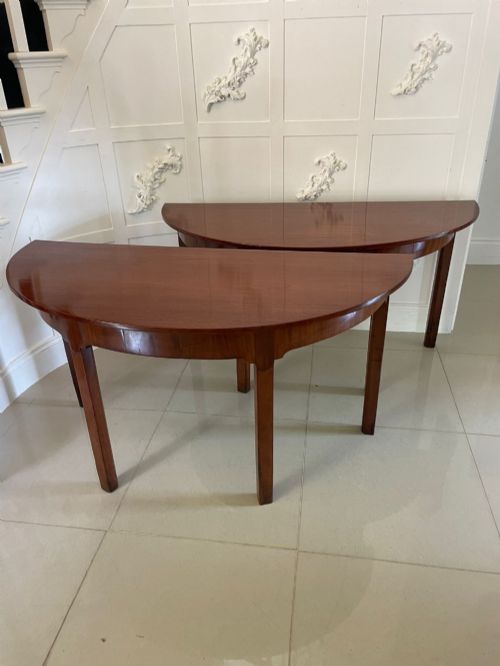

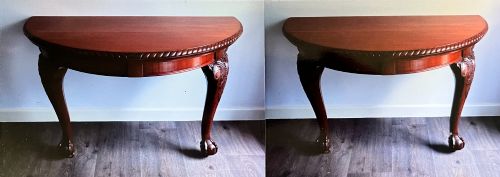






Pair Demilune Tables
When you need pair demilune tables, you are looking at half-round furniture designed to sit flat against a wall.
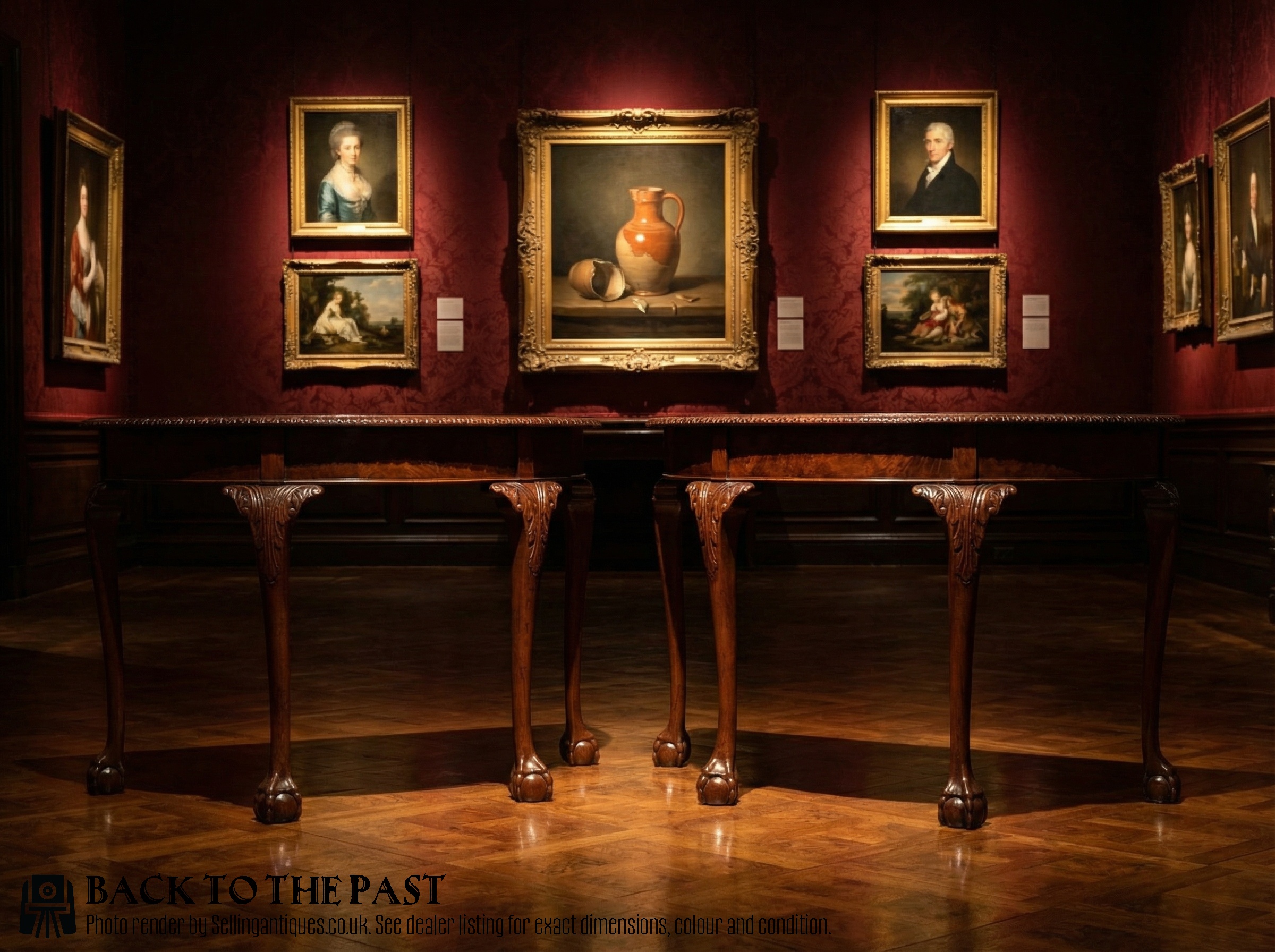
Pair Demilune Tables
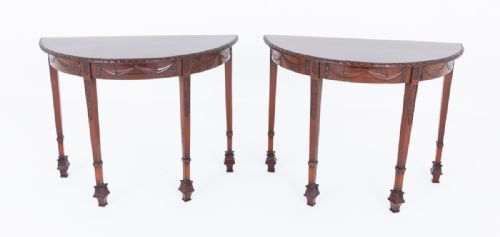
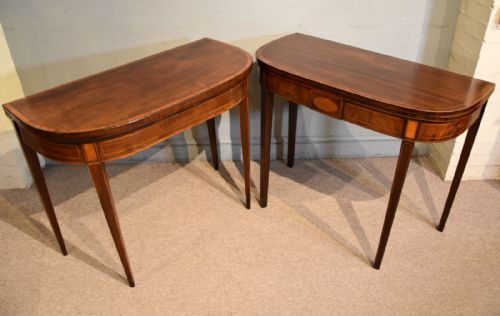
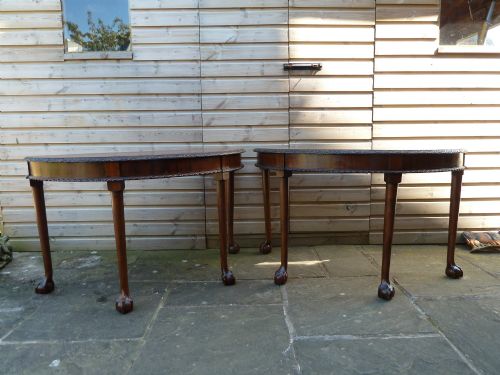
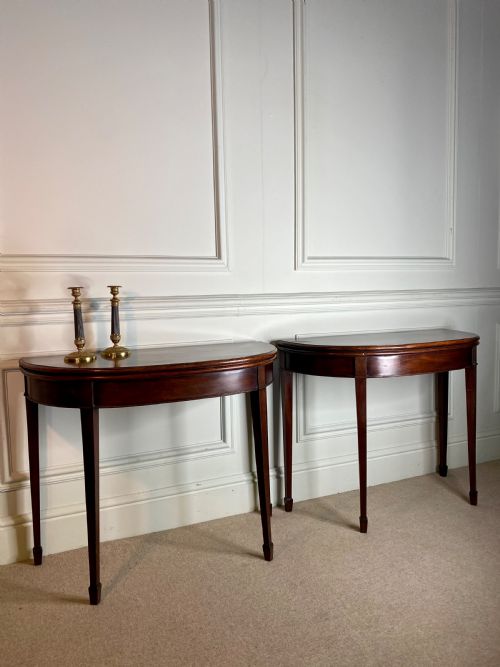
Pair demilune tables are semicircular items of furniture typically utilised as console tables, hall tables, or card tables in period interiors. The pieces on this page span from the eighteenth century through to the twentieth century, encompassing Georgian, Regency, and Victorian eras alongside later revivals.
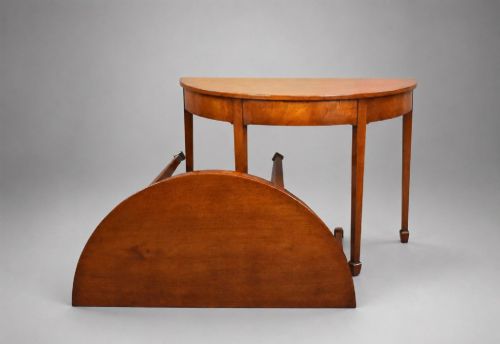
You will most frequently encounter mahogany and satinwood examples from the Georgian and Victorian periods, often configured as side tables or card tables with folding tops. Walnut, painted wood, and marble-topped variants also appear, originating from English, French, Swedish, and Italian workshops.
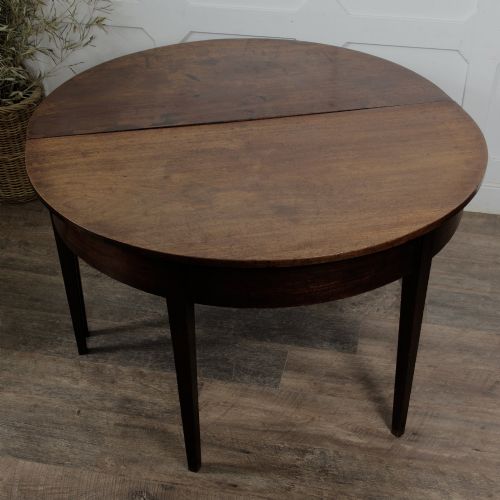
The inventory includes both console tables and card tables built with the characteristic half-round footprint that allows two matching pieces to be joined together to form a full circular dining table. These items serve equally well placed separately against hallway or drawing room walls.

How they were made
Cabinetmakers constructed these tables using native and imported timbers, principally applying mahogany, walnut, and satinwood veneers over solid secondary woods. Boxwood stringing and marquetry inlay frequently decorate the friezes and tops of Georgian and Sheraton period pieces.
Structural stability relies on precise joinery, with hinged leaves utilised on card table variants and sturdy vertical legs supporting the heavy marble slabs found on certain neoclassical and country house examples.
Pair Demilune Tables Retail Price Guide 2026
Typical asking prices for pair demilune tables among the pieces listed under this phrase on Sellingantiques today, from the lower quarter to the upper quarter. They describe what is for sale here now, not the wider market.
What varies in quality
The refinement of the timber figure and the crispness of any carved decoration set finer examples apart from simpler utility pieces. Figured mahogany and delicately banded satinwood indicate higher workshop standards during the Georgian and Regency periods.
Construction methods such as the integrity of the hinge mechanisms on card tables and the quality of the timber matching across both halves of the pair dictate the standing of individual sets.
Maurice Adams
The Pair Demilune Tables Glossary
- Demilune
- A French term meaning half-moon, used to describe furniture with a semicircular plan and a flat back edge.
- Console table
- A table designed to be fixed against a wall, traditionally supported on brackets or console legs rather than four independent vertical supports.
- Card table
- A folding table with a hinged top that opens to reveal a baize-lined surface intended for games of cards.
- Stringing
- A narrow strip of contrasting wood inlaid into the surface of a piece to create decorative geometric borders.
- Neoclassical
- A style of architecture and decorative arts prevalent in the eighteenth and nineteenth centuries, drawing inspiration from the classical art of ancient Greece and Rome.
Pair Demilune Tables: Frequently Asked Questions
How were pair demilune tables used?
These tables served primarily as serving consoles in hallways or drawing rooms, or as card tables when unfolded for evening games.
Matched pairs were frequently separated to flank a fireplace or window, or joined together to form a circular centre dining table.
What periods do these tables come from?
The available pieces originate mainly from the eighteenth and nineteenth centuries, spanning the Georgian, Regency, and Victorian eras.
Later twentieth-century examples and continental pieces from Sweden, France, and Italy also feature in the selection.
How do you arrange them at home?
Place the straight edges flush against a wall in an entrance hall, landing, or reception room to display decorative items on top.
They function effectively as a symmetrical pair flanking a mirror, doorway, or window.
What woods are commonly found?
Mahogany and satinwood dominate the English Georgian output, often enhanced with boxwood stringing and marquetry details.
Walnut, painted timber, and marble-topped variants represent alternative materials seen across continental and later nineteenth-century pieces.