


Pair Classical Mahogany Tables
Pair classical mahogany tables bring matched symmetry and warm timber grain to a room, uniting architectural proportion with functional design.
Pair Classical Mahogany Tables
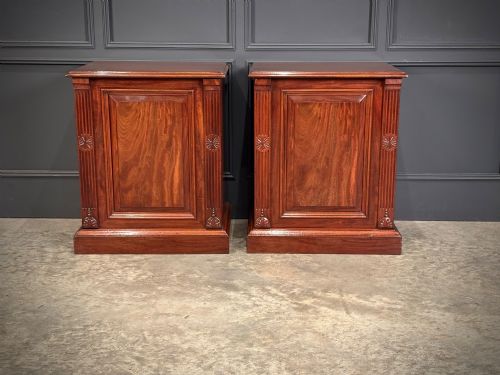
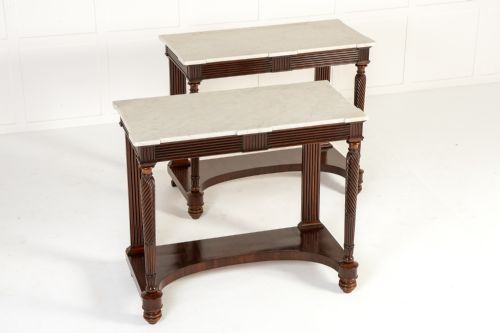
When searching for pair classical mahogany tables, buyers encounter matched sets spanning the Regency, Victorian, William IV, and Edwardian periods, alongside early twentieth-century examples. These furnishings include console tables, side cabinets, bedside cabinets, pedestal cabinets, and desks, reflecting diverse domestic functions.
The form is most frequently met in forms such as bedside cabinets, console tables, and pedestal cabinets produced during the nineteenth century. Makers applied styles ranging from French Empire and Italian Neoclassical to English Regency and William IV, often incorporating architectural details like columns and porticos.
Beyond standard cabinets and consoles, the evidence records card tables, washstands, bonheur du jours, and table lamps configured in pairs. These pieces combine utilitarian purpose with formal decorative schemes appropriate for principal reception rooms and sleeping quarters.
How They Were Made
Cabinet makers utilised solid and veneered mahogany, sometimes selecting fiddle back grain for visual depth on flat surfaces. Structural and decorative elements integrate brass mounts, marble tops, giltwood, cast iron, and hard wood to contrast with the dark timber.
Carving provides classical ornamentation, seen in architectural mouldings, capitals, and supports. Construction techniques range from standard joinery on nineteenth-century side cabinets to specialised framing for marble tops and portico stands.
Object forms range from standard bedside cabinets and console tables to hexagonal pedestal cabinets and table lamps.
What Varies in Quality
The choice of mahogany timber and the selection of grain figure heavily dictate visual success, with matched fiddle back surfaces standing apart from plain stock. Finer examples display crisply executed carved neoclassical details rather than soft or repetitive press-moulded ornament.
Proportion and architectural coherence separate standard workshop production from superior commissions. Well-integrated additions like statuary marble tops and robust brass or giltwood mounts elevate the execution of a pair.
Maple and Co
The Pair Classical Mahogany Tables Glossary
- Mahogany
- A durable tropical hardwood prized for its deep reddish-brown colour and stability in furniture construction. It accepts polish readily and shows various grain figures, including fiddle back.
- Console Table
- A table designed to stand against a wall, frequently supported by wall brackets or console legs. In classical design, these often feature heavy carved ornament or marble tops.
- Portico Table
- A heavy table design inspired by classical architecture, featuring pillar supports resembling a porch entrance. These are often executed in iron and mahogany with statuary elements.
- Pedestal Cabinet
- An enclosed cabinet built upon a column or pedestal base, commonly hexagonal or cylindrical in plan. They function as bedside or side stands.
Pair Classical Mahogany Tables: Frequently Asked Questions
What periods do these pairs represent?
The pieces span the Regency, Victorian, William IV, and Edwardian eras, alongside pieces dated around nineteen-ten and nineteen-hundred. Nineteenth-century production dominates the selection.
Neoclassical and French Empire influences appear frequently across these distinct chronological periods.
How were console tables used?
Console tables stood against walls in halls and reception rooms, often serving as serving surfaces or display stands for decorative objects. Their placement created formal symmetry in grand interiors.
They frequently featured marble tops or elaborate carved mahogany structures to match other room furnishings.
Are bedside cabinets common in pairs?
Bedside cabinets and side stands appear regularly as matched pairs across various nineteenth-century and early twentieth-century dates. They provided symmetrical storage flanking a bed.
Makers utilised mahogany alongside brass, marble, and cast iron to construct these functional bedroom pieces.
How do Neoclassical and Regency styles differ?
Neoclassical style draws directly on ancient Greek and Roman architectural motifs, such as columns, pilasters, and friezes. Regency style represents the English phase of this movement, spanning the early nineteenth century.
Both styles emphasise clean lines, symmetry, and classical proportion.