
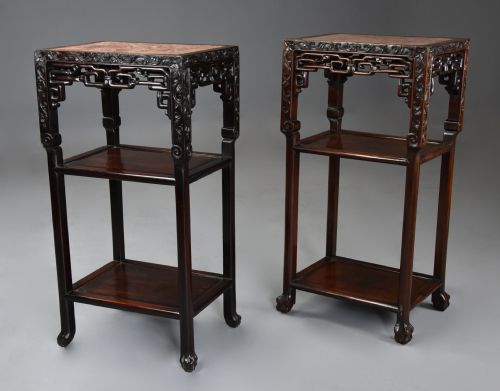
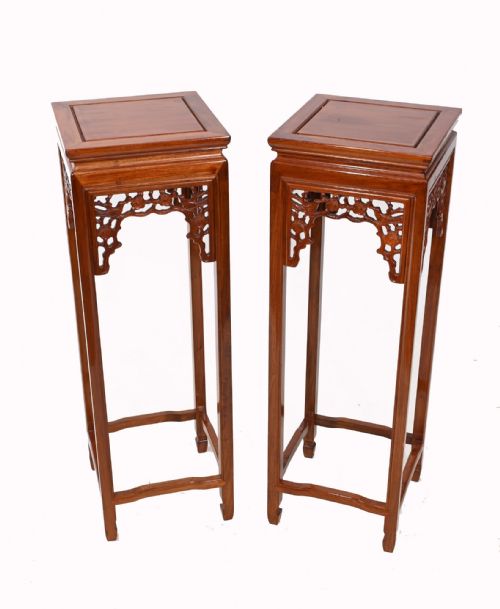
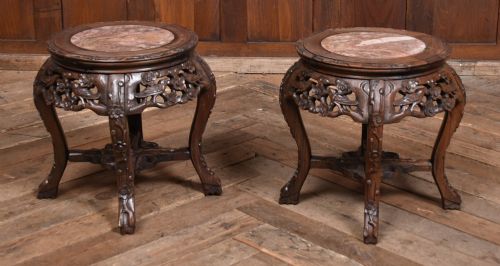
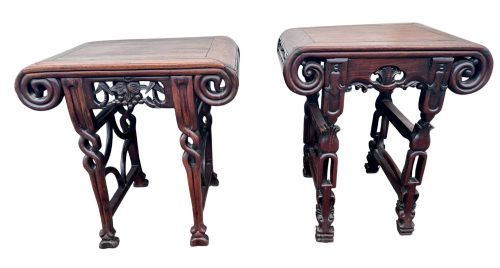


Pair Chinese Pedestal Stands
Pair chinese pedestal stands bring heavy timber, carved detail and marble into rooms to lift plants and urns.
Pair Chinese Pedestal Stands
These pair chinese pedestal stands serve as sturdy supports for plants, vases, urns and lamps within domestic spaces. They function equally well as low stools, side tables, end tables or tall floor plinths.
The versions most commonly met across these listings date from the nineteenth century and the early decades of the twentieth century. Hardwood construction dominates, frequently paired with inset marble tops or mother-of-pearl inlay.
Originating largely within Qing Dynasty and Republic Period traditions, these items reflect both export markets and traditional domestic use. They arrive in matched pairs, offering symmetry for flanking doorways, fireplaces or large furniture pieces.
How they were made
Craftsmen utilised dense timbers such as rosewood, padouk, hongmu and huali, carving the frames with intricate floral and scroll motifs. These heavy woods provided the structural integrity required to bear the weight of large porcelain vessels and stone planters.
Many examples incorporate fitted marble slabs, specifically rouge marble, set flush into the wooden top to provide a cool, durable surface. Lacquer, painted details and mother-of-pearl inlay further embellish the surfaces of select items.
Several stands double as stools, meaning one could theoretically sit upon a nineteenth-century floral carving after watering the begonias.
What varies in quality
Depth and crispness of the wood carving distinguish finer examples from simpler production. Superior pieces display deeply undercut foliage and tight joinery that remains stable without modern metal fasteners.
The choice of materials sets the hierarchy, particularly the selection of figured hardwoods and the quality of the inset marble. Intact mother-of-pearl inlay and preserved original lacquer finishes elevate the standing of individual tables.
The Pair Chinese Pedestal Stands Glossary
- Huali
- A fragrant and durable hardwood utilised in traditional Chinese furniture making. It accepts intricate carving without splintering.
- Hongmu
- A category of dense, dark tropical hardwoods prized for heavy furniture and stands. It translates literally to red wood.
- Rouge marble
- A deep red or reddish-brown decorative stone often quarried for furniture inserts. It provides a contrasting, wipe-clean surface for urns and plants.
- Cloisonné
- An enamel technique where metal wire forms compartments on a vase or tazza body before filling with coloured paste. Fired pieces show distinct metallic boundaries between hues.
- Qing Dynasty
- The final imperial dynasty of China, spanning from the seventeenth to the early twentieth century. Pieces from this era often feature elaborate traditional motifs and dense timbers.
Pair Chinese Pedestal Stands: Frequently Asked Questions
How were pedestal stands used?
These pieces held heavy porcelain jardinières, large bronze urns, lamps and decorative floral arrangements in reception rooms. Their sturdy frames elevated decorative items to eye level for visitors to admire.
They also functioned as occasional side tables, end tables or seating stools depending on their height and top construction.
What woods appear in these stands?
Carpenters built these pieces primarily using dense Asian hardwoods including rosewood, padouk, hongmu and huali. These heavy timbers supported significant weight without warping.
Secondary woods and lacquered timber also appear, occasionally decorated with mother-of-pearl inlay or painted details.
Why do some tops have marble?
Inset marble slabs provided a heat-resistant and waterproof surface that protected the underlying wood from moisture leaking out of plant pots. Rouge marble delivered a striking visual contrast against dark rosewood and huali frames.
This stone insert also offered a cool, stable platform for heavy ceramic urns.
How do I date these stands?
Dating relies on timber density, construction methods, carving styles and recorded period attributes such as Qing Dynasty or Republic Period origins. Nineteenth-century examples typically display hand-carved joinery and heavy tropical hardwoods.
Later pieces from the early twentieth century often mirror these traditional forms while showing slight variations in finish and lacquer.