
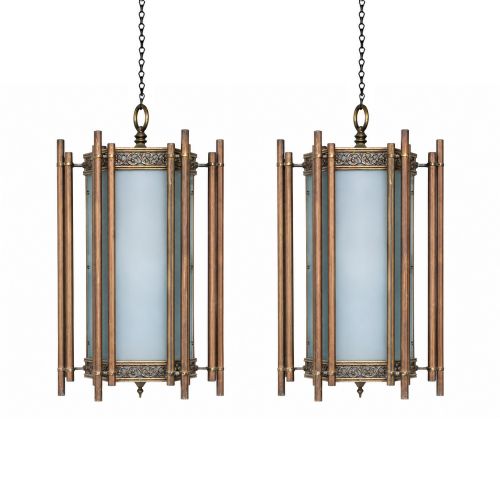
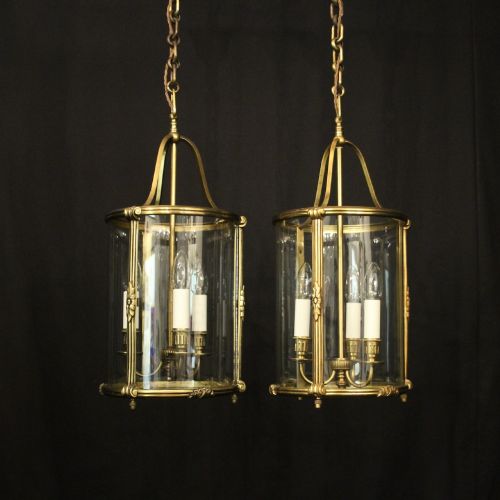
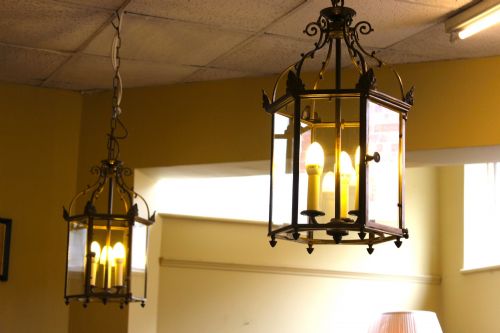


Pair Ceiling Lanterns
Pair ceiling lanterns bring matched illumination and symmetry to hallways and rooms, shaped by French styles and early twentieth-century metalwork.
Pair Ceiling Lanterns
Pair ceiling lanterns encompass matched hanging light fixtures designed for halls, entrances, and principal rooms. When searching for pair ceiling lanterns, buyers encounter French chateau and neoclassical forms alongside early twentieth-century British and American designs.
The selection here draws heavily from the early twentieth century, spanning Edwardian brass hall lights to 1930s steel and brass twin light lanterns. Pieces range from hexagonal and cylindrical glass shapes to monumental hanging lanterns.
Country house coaching lanterns and blacksmith-made cast iron hall lanterns represent the more utilitarian end of the range. French gilded bronze convex lanterns and cut glass hall lanterns provide the decorative counterparts frequently seen in domestic interiors.
How they were made
Makers constructed these lanterns using robust metal frameworks of brass, bronze, steel, copper, and cast iron. Gilded bronze, gilt bronze, and silver gilded bronze provide opulent surface finishes on French examples, whilst other pieces rely on patinated brass or blackened iron.
Glass panels are integral to the construction, utilising clear glass, frosted glass, cut glass, and crystal to diffuse the internal light source. Metal armature sections hold the glazed panels securely within hexagonal, cylindrical, or convex frames.
Some coaching lanterns escaped the stableyard to illuminate grand country house hallways.
What varies in quality
Quality rests in the weight of the metal casting and the precision of the joinery between metal and glass. Heavier gauges of brass, bronze, and steel support complex decorative programs without flexing or distorting under suspension.
The refinement of surface chasing and the depth of gilding distinguish standard production from exceptional French atelier work. Superior glass panels feature deep hand-cutting or crisp bevelling that interacts with light far more dynamically than plain rolled glass.
F and C Osler
The Pair Ceiling Lanterns Glossary
- Gilded Bronze
- Bronze that has been coated with a thin layer of gold or gold leaf to give a rich metallic sheen. This technique protects the underlying metal whilst offering a brilliant decorative surface.
- Convex Glass
- Glass that curves outward, swelling from the metal frame to refract light across a wider angle. It adds considerable visual volume to smaller lantern bodies.
- Cut Glass
- Glass decorated by grinding facets or patterns directly into the surface using a rotating wheel. This process creates sharp geometric reflections when illuminated from within.
- Ceiling Rose
- The decorative circular plate fixed flush against the ceiling to conceal the electrical junction box and anchor the hanging chain. It provides a finished transition between the architecture and the light fixture.
- Hexagonal
- Having six sides and six angles, forming a geometric plan frequently utilised in early twentieth-century hall lanterns. This shape allows multiple glass panels to distribute light evenly in all directions.
Pair Ceiling Lanterns: Frequently Asked Questions
How do I hang a pair?
Matched pair ceiling lanterns work best when suspended at identical heights to create balanced symmetry across a hallway or large landing. Ensure the ceiling structure supports the combined weight of both metal and glass fixtures.
Professional electrical installation is recommended to handle the ceiling roses and secure the suspension chains safely.
Where do they work best?
These lanterns suit high-ceilinged entrance halls, corridors, and principal reception rooms where vertical hanging space allows them to hang freely. Their dual illumination provides practical lighting whilst establishing a strong architectural focal point.
Matching pairs also flank large archways or grand staircases effectively.
How do I date them?
Dating relies on identifying material combinations, manufacturing techniques, and stylistic markers recorded across the periods from 1890 to the 1930s. Edwardian and early 1900s pieces often utilise heavy brass or copper with Arts and Crafts simplicity.
Later 1920s and 1930s examples incorporate French neoclassical gilt bronze or industrial steel and brass combinations.
Are they rewired?
Many antique lanterns require rewiring to meet modern electrical safety standards before installation in a domestic setting. Buyers should inspect the internal lamp holders and wiring paths upon acquisition.
Qualified electricians can easily adapt vintage brass and bronze frames to accept modern LED or standard bulbs.