



Hexagonal Hall Lantern
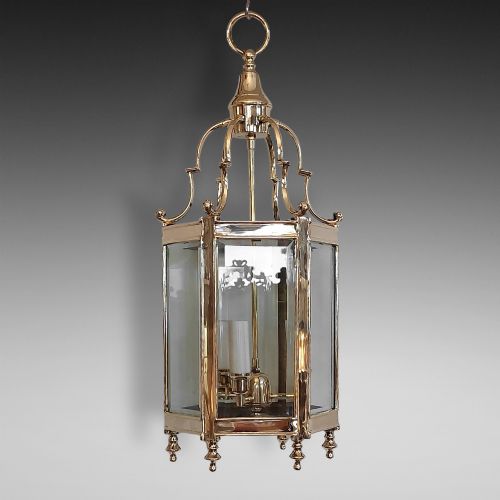
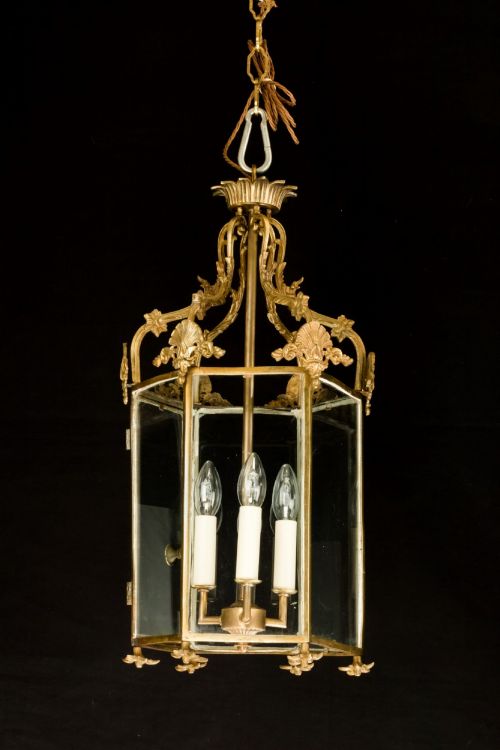
A hexagonal hall lantern commands an entryway with symmetrical panes and proportioned metalwork, offering focused illumination for traditional spaces.
Hexagonal Hall Lantern
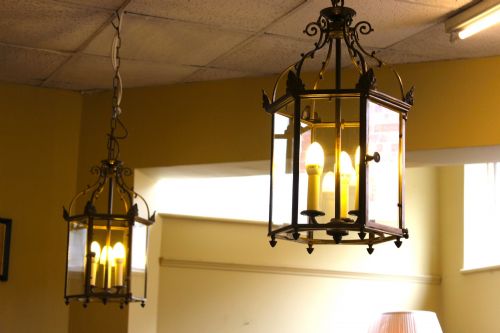
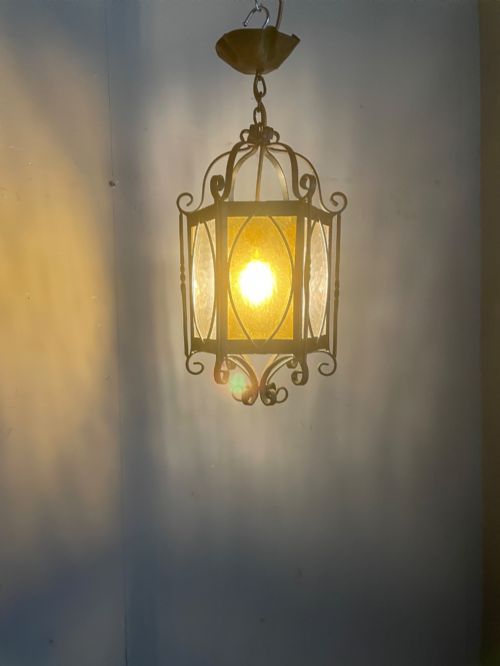
A hexagonal hall lantern provides suspended lighting designed specifically for corridors, vestibules, and stairwells. The six-sided format allows light to disperse evenly across an entrance space while maintaining a defined architectural presence.
Most examples encountered on this page date from the nineteenth and early twentieth centuries, spanning Victorian, Edwardian, and later periods. The selection ranges from restrained brass frames to elaborate French and Gothic designs.
Makers drew on historical vocabularies, producing pieces styled after earlier eras such as the Regency and Regence periods. These objects function primarily as overhead pendant lighting while serving as a focal point for the threshold.
How they were made
Construction relies heavily on metal framing paired with glazed panels. Brass, bronze, and gilded brass form the primary structural skeletons, occasionally supplemented by wrought iron, steel, or copper.
Glass panes are cut to fit the six sides precisely, with bevelled edges appearing on finer examples to refract light. Frames are cast, soldered, or joined mechanically, supporting single or multi-light internal fittings.
Periods represented stretch from the eighteen-sixties through the Edwardian era into the nineteen-thirties.
What varies in quality
Quality rests in the weight of the metal casting and the crispness of decorative detailing. Finer lanterns exhibit careful chasing on bronze or brass mounts and robust structural joints that support the glazing securely.
The choice of glass significantly alters the character of the piece, with thick bevelled panes demonstrating superior craftsmanship compared to plain flat glass. Gilding depth and the integrity of original finishes also distinguish standard production from exceptional examples.
The Hexagonal Hall Lantern Glossary
- Bevelled glass
- Glass panes featuring an angled edge ground around the perimeter. This treatment catches and refracts light as it passes through the lantern.
- Ormolu
- Gilded bronze or brass applied to decorative metalwork. It provides a rich, warm metallic lustre popular in Neo-Classical designs.
- Gothic Revival
- A nineteenth-century style drawing on medieval architectural motifs. Lanterns in this taste often incorporate pointed arches and heavy tracery.
- Regence period design
- An eighteenth-century French style bridging classicism and rococo. Pieces adopting this design feature flowing symmetrical scrollwork and refined ornamentation.
- Pendant lighting
- Lighting fixtures suspended from the ceiling by a chain, rod, or cord. Hall lanterns rely on this configuration to illuminate vertical circulation spaces.
Hexagonal Hall Lantern: Frequently Asked Questions
How do I hang a hexagonal hall lantern?
These lanterns suspend from ceilings using chains or rigid rods connected to a canopy fixed to the structural overhead joists.
Ensure the hanging height clears head height while positioning the light source to illuminate the immediate entryway effectively.
Can I use multiple bulbs inside?
Many larger examples house twin, triple, or more light fittings to distribute illumination adequately through six glass panels.
Check the internal wiring capacity and bulb clearance before installation to match your desired brightness levels.
How do I clean the glass panels?
Carefully wipe the interior and exterior glass using a mild glass cleaner and a soft cloth to avoid disturbing delicate metal frames.
Remove loose dust with a dry brush before applying liquid cleaners to prevent abrasive particles scratching the surface.
How do I identify the period?
Examine the casting techniques, screw types, and decorative motifs against known historical styles like Edwardian or Victorian Gothic.
Material choices such as wrought iron, gilded bronze, or unlacquered brass often provide strong clues to the decade of manufacture.