


Pair Accent Tables Black
These pair accent tables black selections bring together dark finishes and practical surfaces that anchor a room.
Pair Accent Tables Black
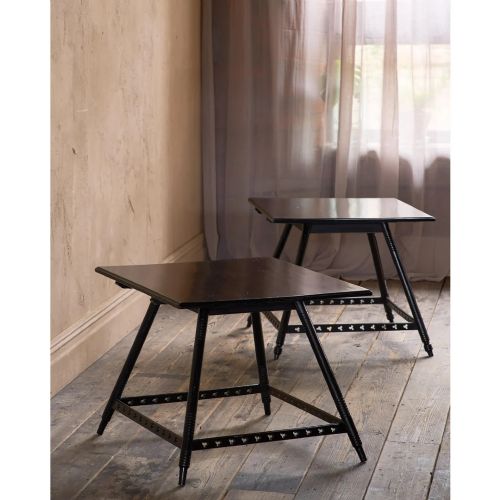
When you search for pair accent tables black, you encounter a selection of side tables, lamp tables, and console tables designed in matched sets. These pieces utilise dark finishes like ebonised wood, lacquer, and paint, spanning periods from the nineteenth century through the 1930s.
The objects frequently display stylistic influences ranging from Chinoiserie and Oriental design to French Neoclassical, Arts and Crafts, and the Aesthetic Movement. Side tables and folding tables dominate the current offerings, often complemented by occasional lamp tables.
Originating across varied European and Asian workshops, these pairs offer dual surfaces for display or illumination while maintaining a cohesive visual weight through their dark palettes.
How they were made
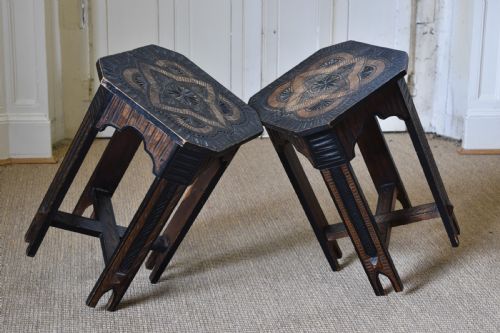
Maker construction relies on hardwoods and ebonised wood treated with traditional lacquer or paint finishes to achieve the characteristic dark surface. Carving techniques such as chip carving appear on structural elements, providing texture alongside smooth lacquered planes.
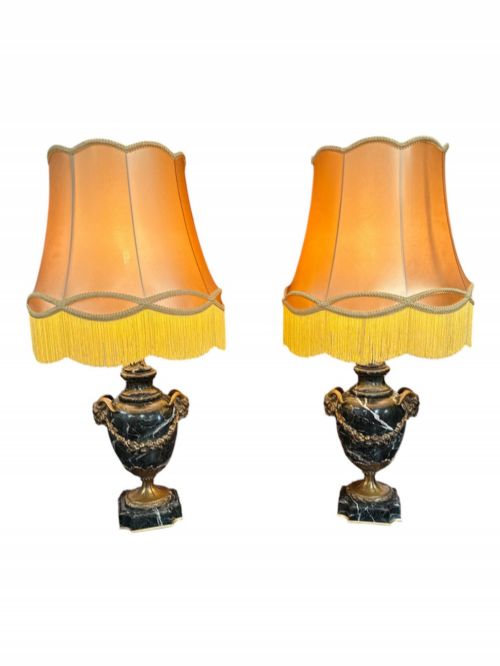
Metal accents in brass and bronze integrate with stone elements like marble, particularly in lamp bases and table tops. Folding mechanisms in specific tables utilise hinged wooden or painted construction for functional portability.
Several folding tables hide their utilitarian hinges beneath intricate Oriental carvings and painted ragwork surfaces.
What varies in quality
Quality rests in the execution of the surface finish, where deep lacquer, even paint application, and precise ebonising elevate a piece. The crispness of carved details, such as chip carving or Oriental motifs, dictates the refinement of the woodwork.
Material integration also separates standard examples from finer ones, notably where brass mountings, marble inserts, or cloisonné elements meet the primary wood structure with exact precision and stability.
The Pair Accent Tables Black Glossary
- Ebonised wood
- Timber stained or painted to imitate ebony. This finish provides a uniform dark surface popular in nineteenth-century and Aesthetic Movement furniture.
- Lacquer
- A durable resin finish applied in multiple layers. It creates a smooth, glossy surface often seen in Chinoiserie and Oriental decorative pieces.
- Chip carving
- A method of removing small triangles of wood from a flat surface to create geometric patterns. This technique adds tactile depth to structural table elements.
- Cloisonné
- An enamelwork technique where metal wire forms compartments on a base. These spaces are filled with coloured paste and fired to create intricate decorative patterns.
Pair Accent Tables Black: Frequently Asked Questions
What defines pair accent tables black?
These listings comprise matched sets of side tables, console tables, and lamp tables sharing dark finishes. They incorporate materials like ebonised wood, lacquer, and paint across various historical periods.
Buyers select them to create symmetrical arrangements in living spaces or bedrooms. Their dark tones provide strong visual contrast against lighter interiors.
How do I date these tables?
Dating relies on stylistic markers and construction methods associated with specific eras like the nineteenth century or the 1930s. Aesthetic Movement and Arts and Crafts influences often point to particular decades.
Examining the underlying timber, joinery, and finish wear helps confirm the period. Match these details against known design movements recorded in the evidence.
How are folding tables constructed?
Folding tables in this category utilise hinged wooden frames designed for easy storage or relocation. Painted ragwork and carved Oriental designs frequently appear on these portable surfaces.
Despite their collapsible nature, sturdy joinery ensures stability when open. They function as versatile accent pieces within a room.
Where do stylistic influences originate?
The styles span European revivals such as French Neoclassical and Regency alongside Asian-inspired Chinoiserie and Oriental motifs. Anglo-Indian designs also contribute carved wooden forms to the selection.
Interpreting these influences reveals how makers adapted global aesthetics for Western interiors. Each style dictates the specific carving and finishing techniques employed.