
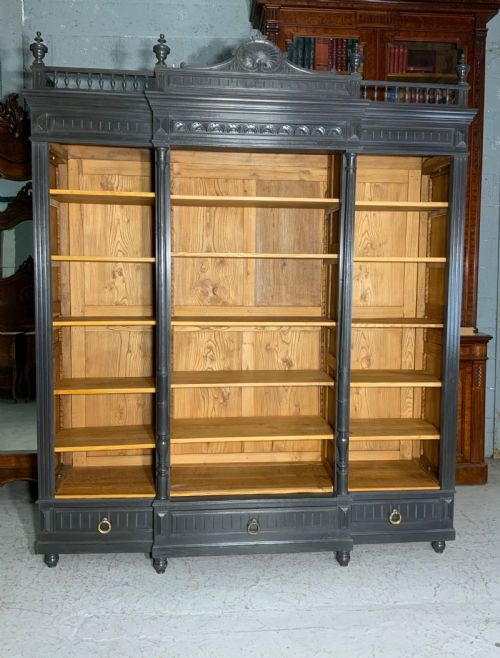
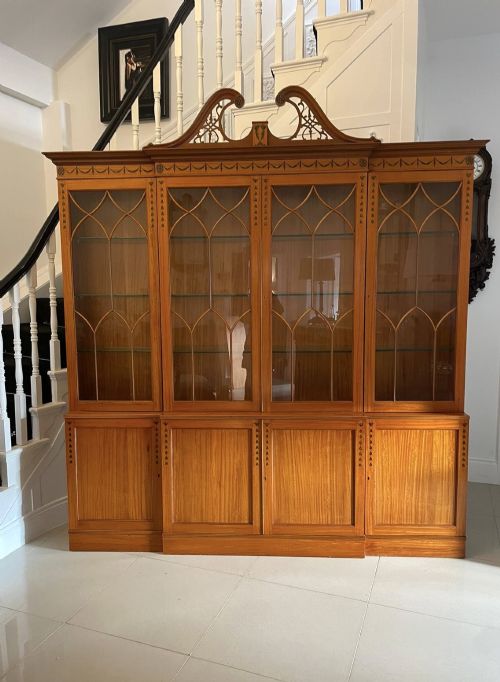
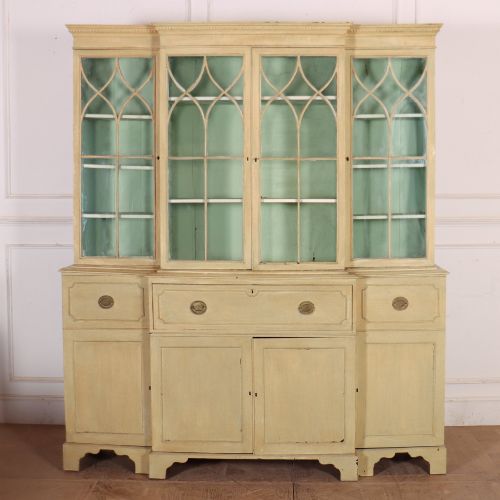
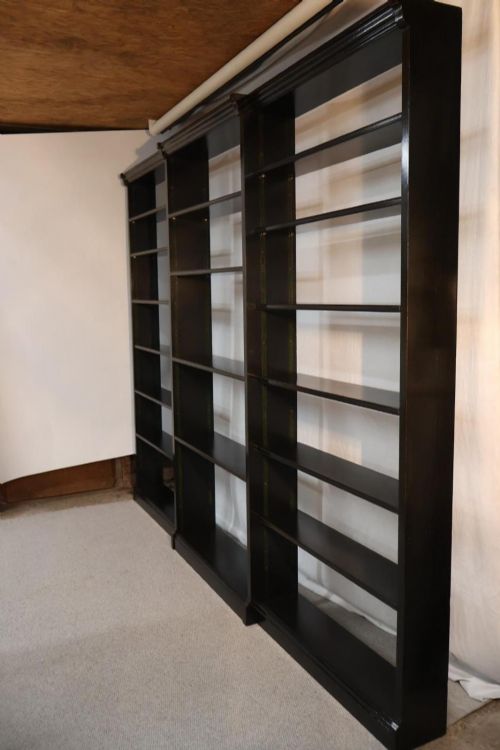


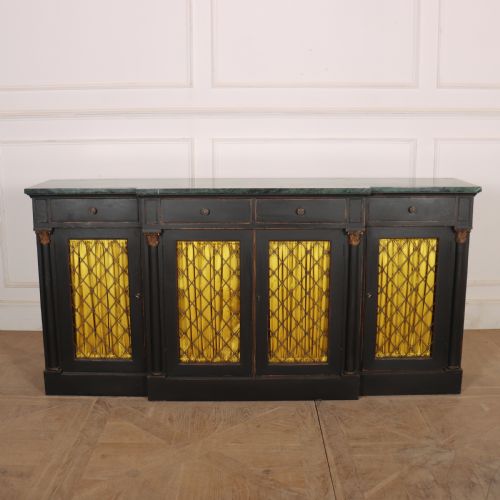


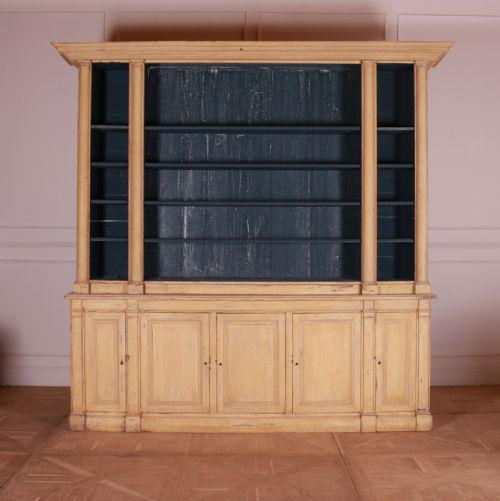
Painted Breakfront Bookcase
A painted breakfront bookcase offers substantial presence and generous storage, uniting architectural proportions with decorative painted surfaces.
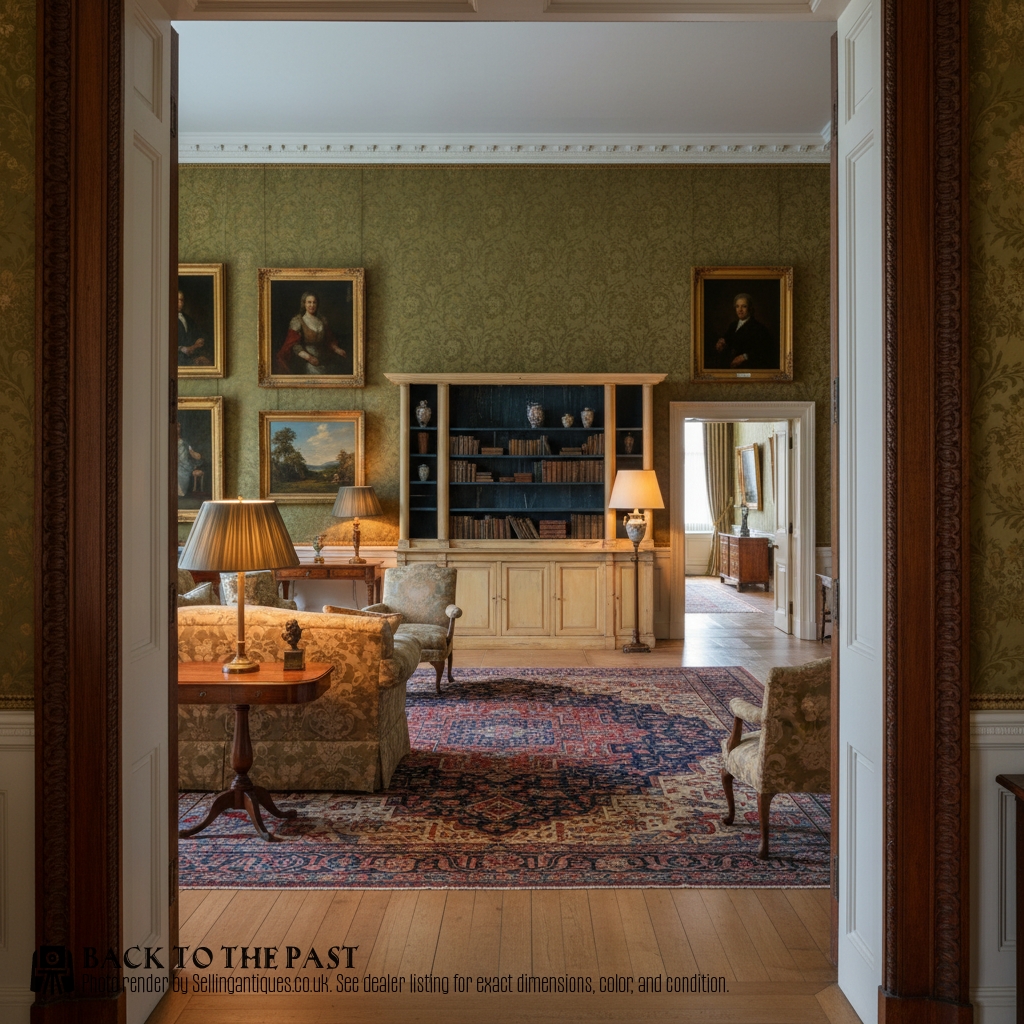
Painted Breakfront Bookcase
A painted breakfront bookcase projects forward in the centre, creating a tiered architectural facade that breaks up a long wall. These pieces primarily date from the nineteenth century into the early twentieth century, spanning English, Scottish, Irish, and French origins.
Most examples encountered here are large library bookcases or display cabinets finished in paint, pine, satinwood, or oak. Formats range from open shelving and glazed doors to fitted cupboard bases and secretaire writing drawers.
Regional workshops produced distinct variations, from restrained English country pieces to elaborate satinwood versions with original painted decoration and French provincial designs.
Materials and construction methods
Construction relies upon solid timber carcases built from pine, oak, mahogany, or satinwood, often enhanced with glass panels and brass hardware. Painted wood surfaces provide the defining finish, sometimes featuring original decorative motifs applied over the base coat.
Glazing takes the form of astral bars or wire mesh to protect the books inside, while larger pieces incorporate multiple doors and breakfront sections to distribute visual weight.
Some nineteenth-century makers concealed entire writing desks inside standard library bookcases for discreet correspondence.
Evaluating quality and execution
Quality rests upon the crispness of the breakfront proportions and the integrity of the original painted surface. Pieces retaining their early or original decorative schemes hold greater distinction than later repainted examples.
The choice of secondary timbers, the delicacy of satinwood grain, and the refinement of brass fittings distinguish standard utility pieces from substantial library cabinets.
Edwards & Roberts
The Painted Breakfront Bookcase Glossary
- Breakfront
- A cabinet design where the central section projects forward from the flanking wings, creating a stepped facade.
- Astral glazed
- Glass doors divided into smaller panes by narrow wooden bars, commonly seen on bookcase fronts.
- Satinwood
- A hard, yellow-toned timber prized for its smooth grain and frequently used in finer eighteenth and nineteenth century cabinet work.
- Secretaire
- A desk form incorporated into a cabinet, featuring a drop-front drawer that conceals small pigeonholes and writing surfaces.
- Dresser base
- The lower section of a kitchen or library dresser, providing enclosed cupboard or drawer storage beneath a flat top.
Painted Breakfront Bookcase: Frequently Asked Questions
How do I care for painted wood?
Protect painted finishes by keeping pieces away from direct sunlight and fluctuating heat sources. Dust gently with a soft cloth and avoid modern chemical polishes.
Maintaining stable room humidity preserves both the timber carcase and the delicate surface decoration over time.
Are these bookcases suitable for modern rooms?
These large cabinets provide extensive shelving and display space while serving as a strong focal point in a room. Their painted surfaces soften the visual weight of substantial timber furniture.
Consider ceiling height and wall space carefully, as breakfront bookcases command significant proportions.
What distinguishes satinwood from pine?
Satinwood is a dense, fine-grained timber with a natural golden sheen, often paired with delicate painted decoration. Pine offers a softer, more utilitarian carcase that typically takes flat paint or country finishes.
Satinwood pieces generally indicate a finer parlour or drawing-room origin compared to utility library or kitchen pieces.