


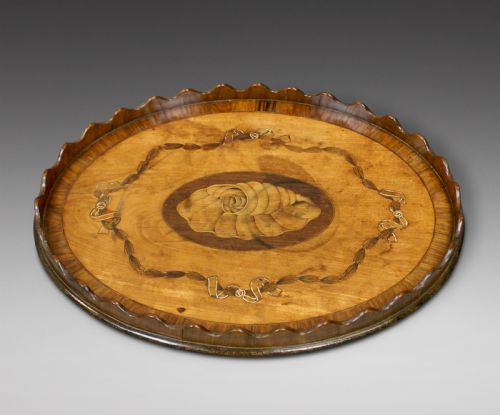


Oval Inlay Wooden Tray
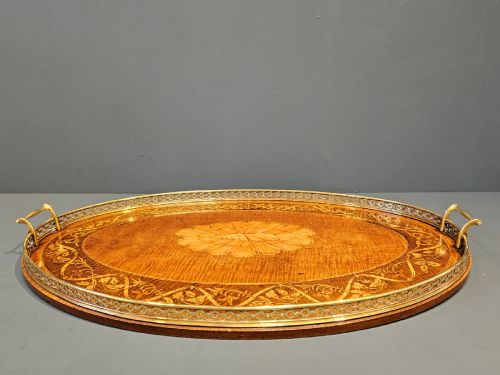
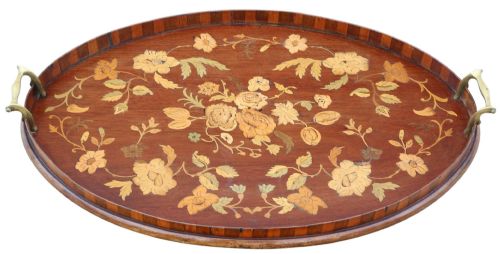
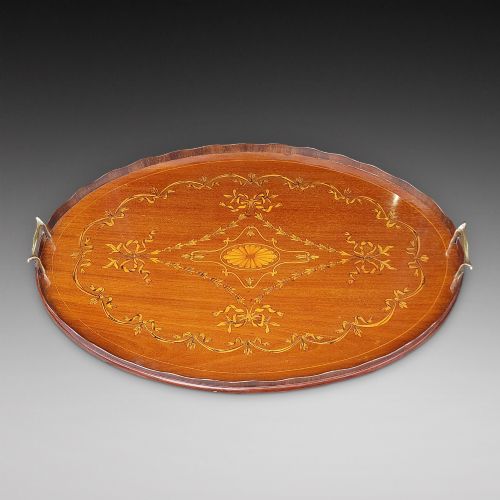
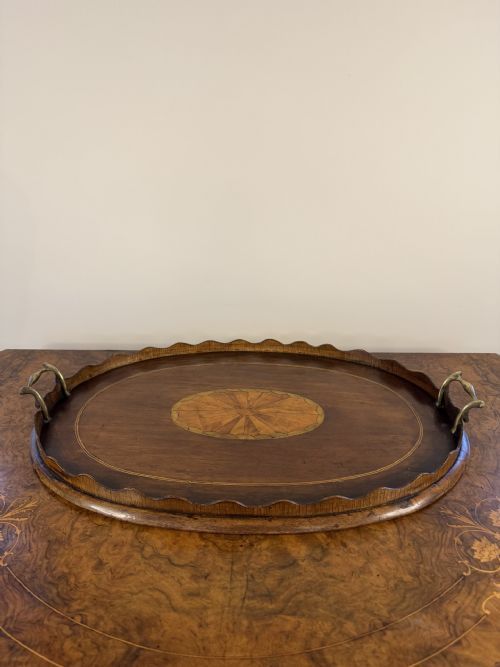
An oval inlay wooden tray brings disciplined Georgian and Victorian craftsmanship to the table, offering both a functional serving piece and a decorative centrepiece.
Oval Inlay Wooden Tray
The version most commonly met on this page is the nineteenth-century mahogany serving tray, frequently enhanced with marquetry or satinwood inlay. Examples also appear adapted as coffee tables, étagères, and tray top occasional tables resting on dedicated stands.
Materials and construction methods
Fine examples integrate brass galleries or handles into the wooden frame, securing the perimeter to protect items carried during service. Joinery relies on traditional cabinet-making techniques suited to maintaining the curved boundary of the oval form.
Listings feature items spanning the 18th Century through to Edwardian periods, utilising mahogany, satinwood, and boxwood.
Assessing quality in antique trays
Quality reveals itself in the precision of the marquetry and satinwood inlay, where tight joints between contrasting timbers indicate skilled hand-cutting. Lesser pieces rely on painted substitutes or careless veneer alignment that disrupts the harmony of the central design.
The choice of primary timber and the crispness of the turned or cast brass handles further divide standard production from superior workshops. Structural integrity in the raised rim and the base panel separates daily utility wares from refined display items.
The Oval Inlay Wooden Tray Glossary
- Marquetry inlay
- Decorative woodwork where pieces of veneer are fitted into a ground material to form geometric or pictorial patterns. This technique defines the surface ornamentation on many Edwardian and Victorian examples.
- Satinwood
- A durable, yellowish timber prized for its lustrous grain and smooth finish. Cabinet-makers utilised this wood extensively for light-coloured banding and full field veneers.
- Gallery
- A raised rim or pierced metal border fitted around the edge of a tray to secure contents. Brass versions frequently complement mahogany foundations on late nineteenth-century pieces.
- Étagère
- A freestanding piece of furniture consisting of a set of open shelves or trays for displaying small objects. Certain listings adapt tray tops directly onto tiered table structures.
- Sheraton Revival
- A late nineteenth-century design style drawing inspiration from late eighteenth-century neoclassical furniture. Pieces from this movement often display delicate satinwood and boxwood inlay on mahogany.
Oval Inlay Wooden Tray: Frequently Asked Questions
How were these trays used?
These pieces served originally for carrying tea services, decanters, and glassware across formal rooms. Wealthy households utilised them during social gatherings for hospitality.
Over time, many surviving examples transition into static display items on coffee tables or remain mounted upon dedicated stands as occasional furniture.
How do I date an oval inlay wooden tray?
Dating relies primarily on timber selection, inlay style, and structural characteristics visible across Georgian, Victorian, and Edwardian eras. Georgian pieces typically display restrained mahogany and boxwood banding.
Later Victorian and Edwardian iterations often incorporate denser marquetry, satinwood fields, or brass galleries reflecting Sheraton Revival influences.
Are these trays suitable for daily use?
Antique trays constructed from mahogany and satinwood possess sturdy timber frames capable of handling careful, light service. However, historic inlay and delicate veneers require protection from moisture and direct heat.
Many collectors prefer to exhibit them flat on tables or mounted on stands to preserve the fragile woodwork from unnecessary wear.
What is a tray top table?
A tray top table is an occasional piece where a removable or fixed tray forms the upper surface. These configurations often pair nineteenth-century serving trays with custom wooden stands.
Such conversions allow decorative inlaid woodwork to function as small side tables, coffee tables, or tiered étagères within modern interiors.