


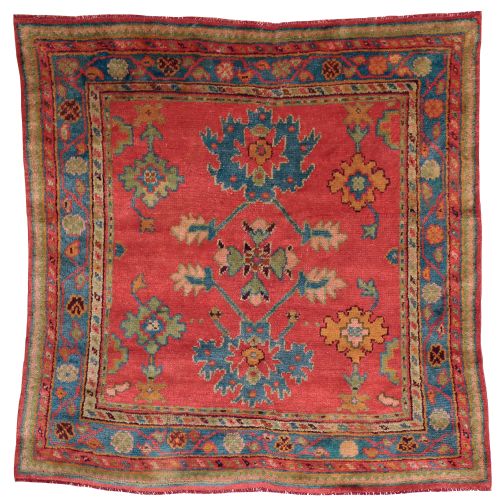


Ottoman Woven Area Rug
An ottoman woven area rug brings centuries of Anatolian and Balkan tradition into a modern room through rich wool and timeless motifs.
Ottoman Woven Area Rug
An ottoman woven area rug spans centuries of textile artistry originating from Anatolia and the broader Ottoman sphere, encompassing everything from expansive carpets to compact village floor coverings. When buyers search for an ottoman woven area rug, they typically encounter nineteenth century pieces alongside early twentieth century revivals that showcase regional weaving traditions.
The selection ranges from large Ushak carpets down to specific village formats like Ghiordes and Milas prayer rugs, as well as flatwoven Pirot or Sarkoy kilims. Village and workshop pieces alike display classic medallion layouts, architectural prayer designs, or folk art patterns passed down through generations of weavers.
Dating across the listings tends to cluster around the nineteenth century and the early decades of the twentieth century, with styles reflecting both urban Ottoman Turkish courts and rural Balkan folk traditions. These floor coverings bridge historical craftsmanship and interior decoration, offering substantial wool texture and complex historical ornament.
Assessing Quality and Execution
Quality in these textiles rests upon the fineness of the weave, the clarity of the classic medallion or prayer design, and the depth of the natural colour palette. A superior piece demonstrates meticulous knotting density and balanced proportions, particularly visible in complex Ushak carpets or finely articulated Sivas examples.
The distinction between standard village production and top tier workshop output lies in the crispness of execution and the sophistication of the secondary borders and field motifs. Exceptional design execution elevates a utilitarian floor covering into a sophisticated textile artwork.
Ottoman Woven Area Rug Retail Price Guide 2026
Typical asking prices for ottoman woven area rug among the pieces listed under this phrase on Sellingantiques today, from the lower quarter to the upper quarter. They describe what is for sale here now, not the wider market.
Current listings feature nineteenth and early twentieth century wool and cotton rugs, spanning Ushak, Ghiordes, Milas, Sivas, and Pirot kilim traditions.
The Ottoman Woven Area Rug Glossary
- Oushak
- A traditional town carpet style originating from western Anatolia, known for larger scale floral motifs and soft, luminous wool. These carpets often feature expansive central fields framed by restrained borders.
- Prayer rug
- A format characterised by a central mihrab or niche design, originally intended for ritual use but celebrated for its symmetrical architectural geometry. The pointed arch directs the eye through the field.
- Kilim
- A flatwoven textile produced without pile by tightly interweaving warp and weft threads. This technique creates a lightweight, reversible floor covering or hanging with sharp geometric patterning.
- Mihrab
- The arched architectural niche depicted on prayer rugs, symbolising a doorway or directional point. It remains a defining design element in Ghiordes and Milas village weaving.
- Medallion
- A central symmetrical ornament placed in the middle of the carpet field, drawing the primary visual focus. Classical Ottoman design frequently employs large central medallions framed by spandrels.
Ottoman Woven Area Rug: Frequently Asked Questions
How do I care for an antique rug?
Vacuum gently without a beater bar and keep the textile away from direct, harsh sunlight to protect the natural wool fibres.
Professional specialist cleaning is essential every few years to remove embedded dust safely without damaging the foundation.
Can I place these rugs in high traffic areas?
Sturdier wool construction and dense pile allow many nineteenth century examples to withstand moderate domestic foot traffic in living spaces.
Delicate flatweaves or fine prayer rugs benefit from placement in lower traffic zones or bedrooms to preserve their historic weave.
How do I distinguish regional rug types?
Look closely at the border arrangements, colour palette nuances, and structural details like the presence of a prayer niche or central medallion.
Town workshop pieces like Ushak differ noticeably in scale and wool quality from compact village examples such as Milas or Kula.
What is a prayer rug?
A prayer rug is a smaller format textile featuring a distinctive architectural niche or arch at one end of the central field.
Weavers across Anatolian villages traditionally designed these for personal devotional use, incorporating symbolic lamps or columns into the field.