
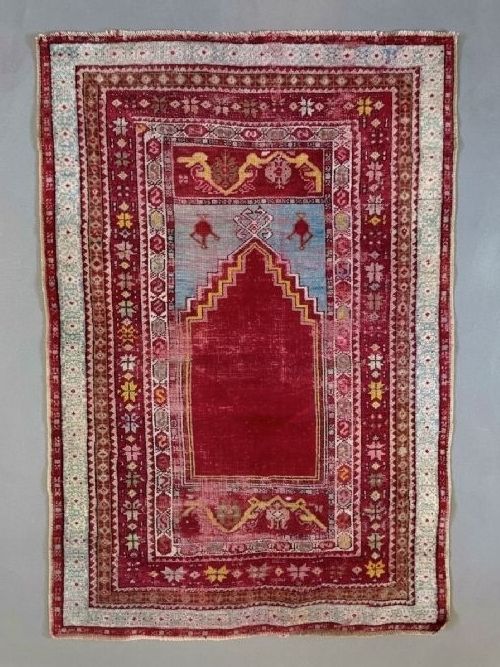


Ottoman Hand Knotted Rug
An ottoman hand knotted rug brings the rich textile heritage of Anatolia into a room through centuries-old weaving traditions.
Ottoman Hand Knotted Rug
An ottoman hand knotted rug encompasses traditional Anatolian carpet weaving, regional village pieces, and formal court workshops originating from Turkey. Buyers frequently encounter nineteenth-century examples, including dedicated prayer rugs and larger decorative carpets carrying classic medallion or multi-niche designs.
The inventory demonstrates substantial regional variety across Western and Central Anatolia, with named formats spanning Ghiordes, Ladik, Oushak, and Milas. These pieces range from compact village prayer rugs with star borders to expansive pale blue and decorative formats designed for major interior spaces.
Materials and construction methods
Weavers utilised wool, hand-spun wool, angora wool, cotton, and silk, occasionally incorporating floss silk for elevated texture and sheen. These natural fibres were dyed using traditional natural dyes to produce soft pastel colours, pale blue, pistachio, and aquamarine central grounds.
The construction relies entirely on hand-knotting techniques performed on vertical looms with cotton or wool foundations. Individual knots secure the pile, creating durable floor coverings and detailed wall art that preserve historical weaving methods.
The listings span multiple nineteenth-century production centres, featuring wool, cotton, silk, and natural dyes across village and workshop formats.
Assessing quality in historical carpets
Quality rests upon the fineness of the knotting, the complexity of the design layout, and the clarity of the natural dye palette. Superior examples display balanced proportions, crisp medallion or prayer niche geometry, and well-preserved pile integrity.
The handling of secondary details, such as border execution and inscription accuracy, separates standard village production from master workshops. Finer silk creations, particularly from Kayseri and Bursa, demonstrate exceptionally precise fibre manipulation and subtle colour graduation.
The Ottoman Hand Knotted Rug Glossary
- Oushak
- A traditional Turkish carpet style originating from the town of Usak, known for large-scale floral motifs and soft wool handles.
- Prayer rug
- A small format rug featuring a directional niche or mihrab design historically used for daily Islamic prayers.
- Natural dyes
- Colourants derived from plants, insects, and minerals rather than synthetic compounds, yielding stable and harmonious patinas over time.
- Saf
- A multi-niche prayer rug containing several consecutive arches designed for multiple worshippers.
- Ghiordes
- An Anatolian weaving centre and associated rug style distinguished by dense knotting and distinctive mihrab designs.
Ottoman Hand Knotted Rug: Frequently Asked Questions
How do I clean an antique rug?
Professional specialist cleaning is essential for historical textiles to protect fragile wool, cotton, and silk foundations.
Routine maintenance involves gentle surface suction without a beating vacuum bar to prevent fibre degradation.
Where were these rugs made?
Production centred across Anatolia, encompassing urban manufactories like Ushak and Kayseri alongside regional villages such as Milas, Ladik, and Ghiordes.
Different towns developed distinct colour palettes, border patterns, and prayer niche configurations.
Can I use these on the floor?
Many surviving pieces function effectively as floor coverings when placed in low-traffic areas with a quality underlay.
Fragile silk examples and delicate wall art formats are better suited for vertical display away from foot traffic.
What indicates an older piece?
Dating relies on material characteristics, structural wear, dye composition, and the presence of regional structural motifs.
Nineteenth-century and earlier examples typically exhibit hand-spun yarns and nuanced natural dye variations.