




Ornithology Wall Picture
These ornithology wall picture examples bring historic bird studies into domestic rooms through detailed prints and watercolours.
Ornithology Wall Picture
An ornithology wall picture represents historical bird studies preserved within timber frames behind glass. These pieces take the form of framed paintings, watercolours and hand-coloured lithographs or engravings.
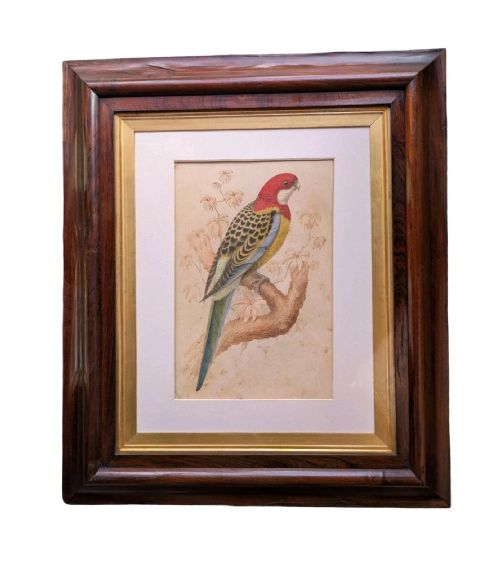
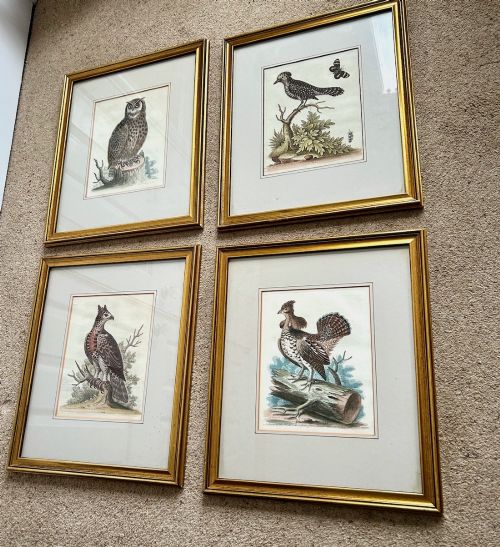
The selections span from the eighteenth century through the Victorian and Edwardian eras up to nineteen-twenty. Examples range from single subject studies like a rosella parrot or lapwing to multi-plate sets depicting waterfowl and game birds.
Buyers encounter English school works and prints by recognised natural history illustrators. Most examples utilise paper mounted in timber frames, often highlighted with gilt or ebonised details.
Materials and technique
Makers set works on paper into timber frames using glass for protection. Many sheets receive hand-colouring applied over underlying engravings or lithographs, while other works comprise original watercolour paintings.
Frames employ timber construction finished with gilt, gold leaf or ebonised surfaces. Mounts frequently feature deep giltwood surrounds that isolate the paper subject from the surrounding room.
The listings on this page span the eighteenth, nineteenth, and early twentieth centuries, featuring watercolours, engravings, and lithographs in timber frames.
Quality differences
Quality rests upon the precision of the initial drawing and the clarity of the printed line or brushwork. Hand-coloured plates show varying degrees of touch, where washes of pigment possess depth or flat opacity.
The integrity of the original framing, including period timber and gilding, separates standard decorative examples from works retaining their historic presentation. Complete sets of matching plates carry distinct appeal compared to single isolated subjects.
R. Hurst·George Edwards·Harry Bright·William Swainson·Eleazor Albin·Rev B. Morris·Archibald Thorburn
The Ornithology Wall Picture Glossary
- Lithograph
- A print made from a stone or metal plate on which an image has been drawn with an oily substance. This technique allows fine tonal gradations suitable for natural history illustration.
- Engraving
- A print produced by cutting lines into a metal plate with a sharp tool to hold ink. The resulting impressions display crisp lines that take hand-colouring effectively.
- Watercolour on paper
- A painting executed with water-soluble pigments upon a paper support. Such works capture fine feather details and subtle plumage colourations.
- Ebonised frame
- Timber treated to resemble ebony, providing a dark contrasting border around the picture. This finish appears frequently in Victorian framing.
- Giltwood mount
- A decorative framing component covered in thin gold leaf or gilt preparation. It adds reflectivity and frames the central subject.
Ornithology Wall Picture: Frequently Asked Questions
How do I date an ornithology wall picture?
Dating relies on the paper type, printing technique, and framing style associated with the piece. Period inscriptions and known artist active dates provide further chronological markers.
Changes in mount design and timber preparation also help place a work within Georgian, Victorian, or Edwardian periods.
Were these pictures originally published in books?
Many historic bird illustrations began as plates within scientific folios and natural history volumes before later being separated for framing.
Publishers issued these works in sets to document avian species for collectors and naturalists of the period.
How should I hang these framed prints?
Position them away from direct sunlight to prevent the fading of watercolours and hand-coloured pigments on paper. Stable indoor humidity protects both the historic timber frames and the paper supports.
Group related sets together at eye level to replicate historical study room displays.
What is the difference between an engraving and a lithograph?
Engravings involve incising lines into metal plates, producing sharp, defined outlines. Lithographs use chemical processes on stone or metal surfaces to create softer tonal areas.
Both methods served as foundations for hand-applied watercolours.