



Ornate Standing Vanity Mirror
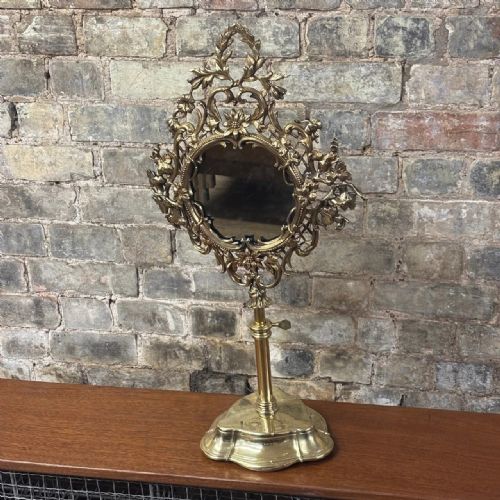
An ornate standing vanity mirror brings elaborate brass, gilt bronze, or carved giltwood and beveled glass to a dressing table.
Ornate Standing Vanity Mirror
When you search for an ornate standing vanity mirror, you are looking at tabletop and dressing mirrors produced primarily during the Victorian and Edwardian periods, stretching from the early nineteenth century through to the nineteen-thirties. These pieces are designed to sit upon a dressing table or chest of drawers, offering a functional reflecting surface framed by decorative metalwork, carved wood, or enamel.
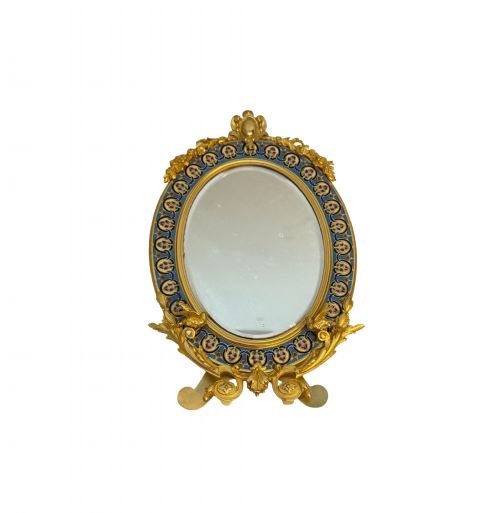
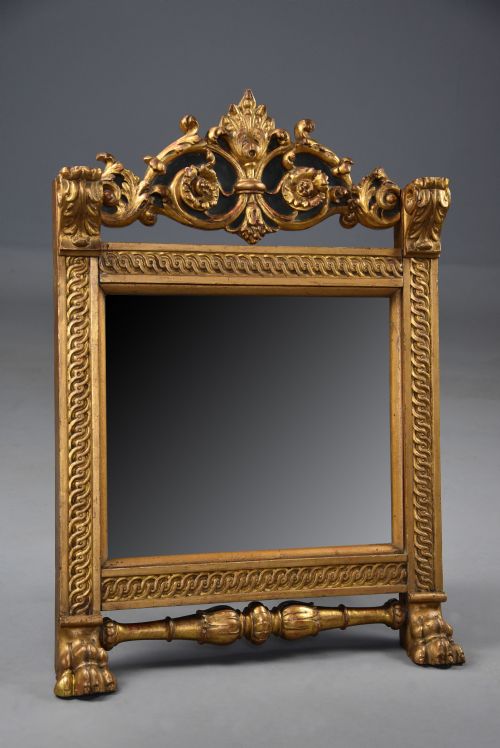
The most common versions you will meet on this page hail from the late nineteenth century, reflecting French Napoleon III, Louis XV, and Rococo revival tastes. You will encounter oval table top dressing mirrors in solid brass, alongside more elaborate examples incorporating champleve enamel and gilt bronze or carved giltwood with easel supports.
Alongside secular dressing table mirrors, the category encompasses distinct decorative forms such as Italian reliquary mirrors featuring sacred flaming heart motifs. These diverse objects share a commitment to ornamental framing, whether executed in heavy cast brass or delicate gilt gesso.
How they were made
The construction of these pieces relies heavily on cast and chased brass, gilt bronze, and carved giltwood supported by gesso. Metal frames are frequently cast in ornate revival styles, sometimes incorporating champleve enamel panels with brightly coloured patterns set into the metal compartments.
Wood-framed examples utilise carved giltwood, where intricate floral or scrollwork details are shaped directly into the timber before receiving a fine layer of gilding. The reflecting surfaces consist of thick mirror glass, often with hand-beveled edges that sit securely within the metal or wooden armatures.
Ornate Standing Vanity Mirror Retail Price Guide 2026
Typical asking prices for ornate standing vanity mirror among the pieces listed under this phrase on Sellingantiques today, from the lower quarter to the upper quarter. They describe what is for sale here now, not the wider market.
What varies in quality
The distinction between standard and superior examples lies in the depth and crispness of the hand-chasing on the metalwork or the intricacy of the wood carving. Heavy, solid cast brass or gilt bronze frames with well-defined champleve enamel work represent a higher standard than lighter, stamped metal alternatives.
Quality also shows in the retention of the original mercury or mirror glass and the stability of the easel stand at the rear. A truly refined piece maintains its original gilding and structural integrity without looseness in the hinged support legs.
The Ornate Standing Vanity Mirror Glossary
- Champleve
- An enamelling technique where recessed areas are gouged out of a metal surface and filled with vitreous enamel before firing. This colourful decoration appears frequently on late nineteenth-century bronze frames.
- Gilt Bronze
- Copper alloy cast and finished with a gold mercury amalgam or electroplating to produce a rich metallic lustre. It provides the heavy, ornate framework for many French dressing mirrors.
- Giltwood
- Timber, commonly softwood or hardwood, carved with ornamental motifs and covered in gold leaf or gold paint. It forms the decorative structure of Renaissance and Rococo revival easel mirrors.
- Bevelled Glass
- Mirror glass featuring an angled edge ground down to a thinner perimeter. This traditional technique creates a prismatic light effect around the margin of the reflection.
- Reliquary Mirror
- A devotional object adapted to incorporate a reflecting glass, often surrounded by sacred symbols such as a flaming heart. These Italian pieces date back to the around eighteen hundred period.
Ornate Standing Vanity Mirror: Frequently Asked Questions
What is an ornate standing vanity mirror?
An ornate standing vanity mirror is a tabletop or dressing mirror featuring a decorative frame made from brass, gilt bronze, carved giltwood, or enamel. These pieces were designed to sit on furniture for personal grooming while serving as decorative objects.
They date primarily from the nineteenth and early twentieth centuries, drawing inspiration from French Rococo, Louis XV, and Renaissance revival styles.
How do you use a table dressing mirror?
These mirrors are placed on top of a dressing table, chest of drawers, or sideboard to provide a moveable reflective surface. They typically rely on an easel stand attached to the back, allowing the angle of the glass to be adjusted.
Because they are portable, they can be positioned to capture optimal natural light during morning routines.
How do you date a vintage vanity mirror?
Dating relies on examining the materials, construction methods, and stylistic revival influences present in the frame. Late nineteenth-century pieces often feature heavy cast brass, champleve enamel, or distinct French Rococo revival motifs.
Later examples from the nineteen-thirties show shifts in manufacturing techniques and simpler decorative vocabularies compared to Victorian and Edwardian items.
What materials were used for these mirrors?
The frames are constructed from solid brass, gilt bronze, carved giltwood, and gesso, frequently ornamented with champleve enamel or polychrome details. The central panels consist of mirror glass, commonly featuring hand-beveled edges.
Support structures at the back typically utilise matching metal or wooden easel arms hinged to the main body.