


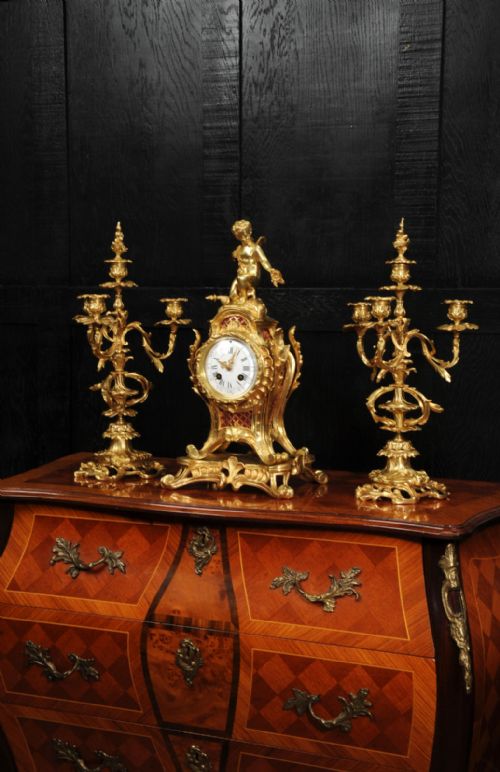


Ornate Gilt Clock Set
An ornate gilt clock set brings dramatic nineteenth-century French and Victorian presence to a mantelpiece, combining striking metalwork with matching side pieces.
Ornate Gilt Clock Set
When you search for an ornate gilt clock set, you encounter nineteenth-century mantelpieces and garnitures spanning the Victorian and Edwardian eras, predominantly built around French styling. These arrangements pair a central clock with matching side garnitures or candelabra to create a balanced decorative display.
The objects on this page largely emerge from the eighteen-sixties through to eighteen-ninety, drawing on Napoleon III, Second Empire, and Rococo Revival tastes. You will frequently find pieces combining marble and porcelain with ormolu or gilded brass.
Most entries function as three-piece sets designed for formal reception rooms, uniting timekeeping with sculptural ornamentation. The forms range from petite Edwardian marble compositions to substantial Victorian architectural ensembles.
Materials and construction
Maker workshops built these garnitures using heavy bronze, brass, or ormolu frames, often mounted upon contrasting dark or white marble bases. The metallic surfaces received rich gilding to catch the candlelight of nineteenth-century interiors.
Clock dials and garniture bodies frequently incorporate hand-painted porcelain panels or detailed champlevé enamel work. Specialised components like Sevres porcelain inserts and glass covers protect the delicate painted faces and internal escapements.
Listings feature items spanning the Victorian and Edwardian eras, predominantly employing gilt bronze, marble, and porcelain within French revival styles.
Judging quality and execution
The distinction between ordinary and superior examples lies in the crispness of the cast metal ornamentation and the depth of the gilding. Finely chased ormolu details and substantial marble bases indicate a higher tier of nineteenth-century production.
The integration of the side pieces with the central clock determines the overall coherence of the garniture. Sets featuring undamaged hand-painted porcelain panels and matching architectural motifs command greater appreciation.
The Ornate Gilt Clock Set Glossary
- Ormolu
- Gilded bronze produced by applying a mercury-gilding amalgam to cast brass or bronze. This technique creates a rich golden finish characteristic of nineteenth-century French metalwork.
- Garniture
- A set of matching decorative objects, typically a central clock flanked by two matching vases, urns, or candelabra. These groups created symmetrical arrangements on Victorian mantelpieces.
- Champlevé enamel
- A technique where troughs are dug into a metal surface and filled with vitreous enamel before firing. It adds vibrant colour and pattern to clock cases and garniture bodies.
- Escapement
- The mechanical linkage within a clock that regulates the release of gear train power to move the hands. Different escapement types govern the precision of the movement.
- Napoleon III style
- A nineteenth-century eclectic aesthetic reviving Louis XIV, XV, and XVI designs with heavy ornamentation. It dominates the French mantel clocks and garnitures of this period.
Ornate Gilt Clock Set: Frequently Asked Questions
What is a clock garniture set?
A clock garniture set consists of a central mantel clock accompanied by two matching side pieces such as urns or candelabra. These sets were designed to sit symmetrically on a fireplace mantel or sideboard.
They became immensely popular during the Victorian period as statement pieces for formal rooms. The side pieces repeat the materials and motifs of the main clock to create a unified decorative scheme.
How do I date an ornate gilt clock set?
Dating relies on identifying the prevailing design style, such as Rococo Revival or Neo-Classical, alongside the choice of materials like marble and ormolu. Victorian and Edwardian manufacturing marks or stylistic clues in the bronze casting help narrow down the decade.
Examining the clock face, enamelwork, and internal escapement mechanisms also provides clear chronological markers. Pieces from the eighteen-sixties often display heavier bronze casting compared to later Edwardian examples.
Where should I place a clock garniture?
These sets suit prominent locations like living room mantelpieces, entrance hall consoles, or large sideboards where the three pieces can be displayed together. Their height and reflective gilt surfaces require a stable, deep surface with good ambient light.
Keep them away from direct sunlight and damp walls to protect the delicate porcelain inserts and the integrity of the gilded metal finishes.