


Ornate Gilded Desk Clock
An ornate gilded desk clock brings nineteenth-century French and English precision into a room through cast bronze, marble, and enamelled dials.

Ornate Gilded Desk Clock
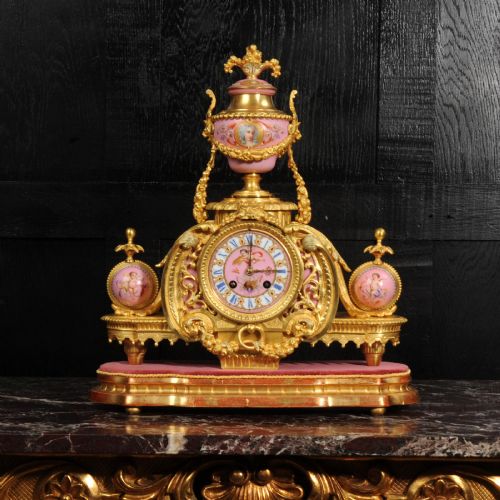
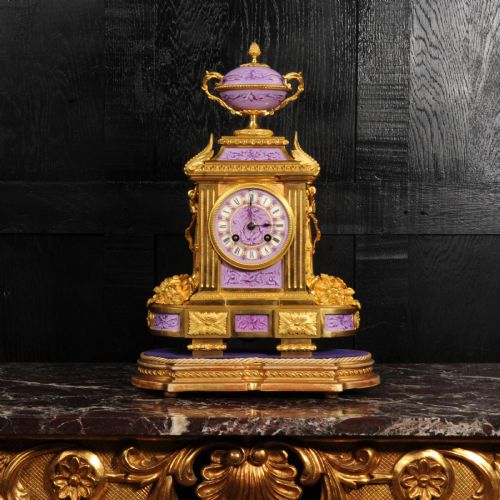
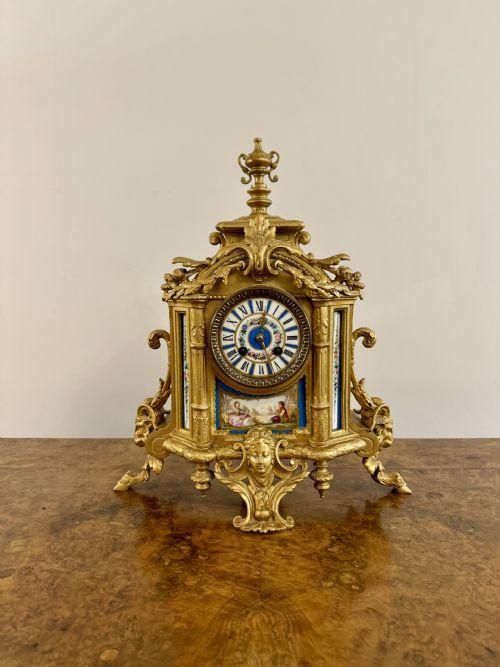
An ornate gilded desk clock encompasses heavy metal mantel pieces, glass-sided crystal regulators, and portable carriage clocks designed during the nineteenth century. These objects combine timekeeping with decorative metalwork, often drawing upon Rococo Revival, Louis XVI, or Victorian aesthetic codes.
The versions most frequently encountered on this page originate from French workshops and English makers dating from the Regency era through to the end of the Victorian period. They appear in forms ranging from small bedside strut clocks to large, architectural ormolu and porcelain mantel pieces.
Makers housed these movements within cases constructed from cast brass, gilt bronze, red marble, and panelled glass. Many examples incorporate painted enamel dials and decorative porcelain inserts depicting floral motifs or classical scenes.
Assessing quality in period timepieces
Quality rests upon the crispness of the bronze casting and the depth of the hand-chased ornamentation across the ormolu surfaces. Superior examples display sharply defined scrollwork and figures without the soft edges typical of later secondary castings.
The sophistication of the internal movement dictates the tier of the piece, with complex fusee mechanisms, striking trains, and repeating carriage complications requiring advanced clockmaking skill. Signed backplates from recognised makers indicate higher workshop standards.
Integration of secondary materials such as hand-painted porcelain panels and bevelled glass panels determines overall refinement. Better specimens maintain original gilding surfaces and matching numbered components throughout the movement and case.
Listings feature French and English production eras spanning the Regency period through to 1910, utilising brass, ormolu, marble, and porcelain.
Achille Brocot·John Barwise of London·Henri Jacot·Dehné of Paris·Howell, James & Co.·E.J.Dent·Paul Garnier·Hay London·FB Adams London
The Ornate Gilded Desk Clock Glossary
- Ormolu
- Gilded bronze produced by applying a mercury and gold amalgam to cast brass or bronze before heating. This technique created a durable, rich golden finish characteristic of French decorative arts.
- Crystal regulator
- A mantel clock housed in a glazed brass or ormolu frame with four glass panels. This design exposes the movement and mercury-filled pendulum to view from every side.
- Fusee
- A conical pulley connected to the mainspring by a cord or chain. It equalises the pull of the spring as it unwinds, ensuring even force is delivered to the gear train.
- Carriage clock
- A small, portable spring-driven timepiece fitted with a handle and glass panels for travel. They often include alarm functions or striking mechanisms.
- Strut clock
- A portable timepiece supported by a hinged prop or stand at the back. These items were designed for desks, dressing tables, and boudoirs during the Victorian period.
Ornate Gilded Desk Clock: Frequently Asked Questions
How do I wind a mechanical desk clock safely?
Insert the appropriate winding key into the designated arbor and turn it smoothly until you feel firm resistance, avoiding any forced movement that might damage the internal spring.
Most nineteenth-century spring-driven movements require winding once a week, while fusee mechanisms may have different power reserves depending on their gear train design.
What is a crystal regulator clock?
A crystal regulator is a mantel clock featuring a heavy brass or gilt metal frame enclosing four bevelled glass panels. This construction lets light pass entirely through the case.
These pieces typically house visible mercury-jar pendulums and ornate enamelled dials, reflecting late nineteenth-century French manufacturing standards.
How do I tell an ormolu clock from gilt brass?
Ormolu involves an amalgamated gold layer applied to cast bronze, exhibiting a warm, deep golden tone with hand-chased surface details. Gilt brass is generally brighter and smoother due to modern electroplating methods.
Examining the underside or hidden interior areas often reveals the heavier, reddish-brown bronze substrate beneath the surface gilding on older pieces.
Were these clocks meant for desks or mantels?
Many smaller pieces, such as strut clocks and carriage clocks, were built specifically for desks, boudoirs, and travel. Larger ormolu and marble pieces were designed for mantelpieces.
Definitions often overlap in historic listings, where heavy metal timepieces are described interchangeably as desk clocks, mantel clocks, or table clocks.