
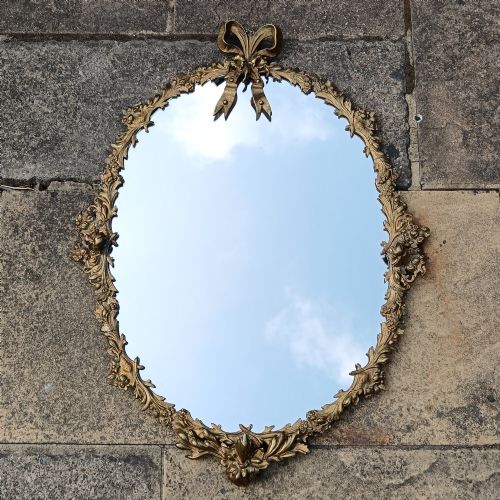
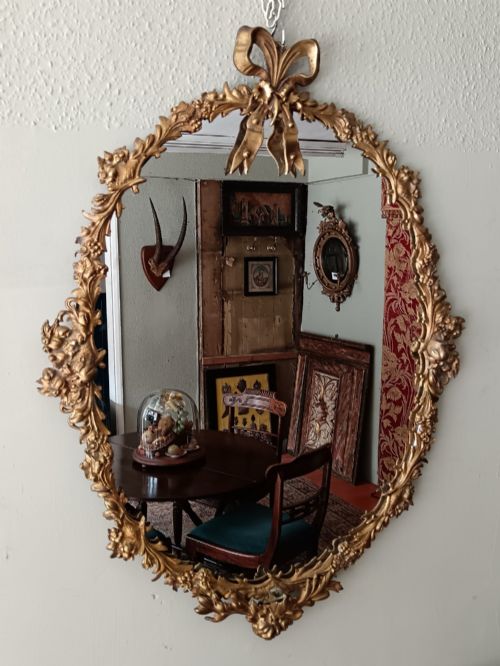


Ornate Brass Frame Mirror
An ornate brass frame mirror brings reflective depth and heavy cast or repousse detail to a room, drawing the eye instantly.
Ornate Brass Frame Mirror
When you search for an ornate brass frame mirror, you encounter pieces that span from the Regency era through the Victorian period and into the 1930s Hollywood Regency style. These items primarily function as wall hanging pieces or small table mirrors designed to catch the light in a hallway or boudoir.
The versions you are most likely to meet on this page include French Louis XVI revival ovals and Victorian cast brass wall mirrors featuring cherubs, masks, or cushion frames. Many originate from the nineteenth century, utilising heavy cast brass, gilt bronze, or repousse work to create deep relief decoration.
Makers and designers drew on historical vocabularies, producing Dutch baroque revivals, Flemish Renaissance revival pieces, and French chateau styles. These mirrors offer domestic interiors a concentrated focal point through pierced metalwork, rams heads, and bevelled glass plates.
Assessing quality and execution
Quality rests in the crispness of the casting and the depth of the repousse work, where sharper chisel marks and undercut details separate superior examples from softer, mass-produced items. The handling of figural elements like cherubs, rams heads, and mask crests reveals the sculptor's skill.
The integrity of the original mirror plate and the weight of the brass frame indicate higher craftsmanship. Substantial metal thickness and well-joined corner joints ensure the frame supports the glass securely over generations.
Some Victorian brass mirrors stare back with small cherubs or fierce mask crests peering over the top edge.
The Ornate Brass Frame Mirror Glossary
- Repousse
- Metalworking technique where the metal is hammered from the reverse side to form a raised design on the front. This method creates lightweight yet highly decorative frames.
- Gilt Bronze
- Bronze alloy treated with a gold wash or mercury gilding to impart a rich golden colour. It appears frequently on French Louis XVI revival pieces.
- Cushion Framed
- A frame profile that curves outward like a pillow towards the outer edge. This shape provides extra volume and catches light from multiple angles.
- Beveled Glass
- Mirror glass with edges ground and polished at an acute angle to create a framed border effect within the glass itself. It adds refractive brilliance.
- Louis XVI Revival
- A nineteenth-century design movement copying the neoclassical restraint and symmetry of the French eighteenth century. It employs classical motifs like ribbons and urns.
Ornate Brass Frame Mirror: Frequently Asked Questions
How do I hang a heavy brass wall mirror?
These frames carry significant weight due to solid brass and wood backing construction. Secure them directly into wall studs using appropriate masonry or timber fixings.
Avoid relying solely on plaster wall plugs for larger Victorian cast pieces to ensure the weight distributes safely.
Are the mirror plates original?
Many nineteenth-century examples retain their original silvered glass plates, which often display light foxing or small age spots. These natural surface changes confirm the antique status of the glass.
Inspect the back of the frame to see if the retaining pins and wood backing appear undisturbed over time.
How should I clean a brass frame?
Dust the metal gently with a soft, dry cloth to remove surface particles. Avoid aggressive chemical polishes that strip away the aged patina accumulated over decades.
Preserving the darker recessed areas maintains the visual depth intended by the original maker.
What distinguishes Regency from Victorian styles?
Regency frames tend to show cleaner classical lines influenced by Greek and Roman antiquity. Victorian examples often embrace heavier, more exuberant ornamentation like deep relief scrolling and figural crests.
Examining the casting style helps place the piece within its nineteenth-century decade.