





Ormolu Putti Candelabra
These ormolu putti candelabra bring French and Italian decorative metalwork into a room, combining cast figures with functional lighting.
Ormolu Putti Candelabra
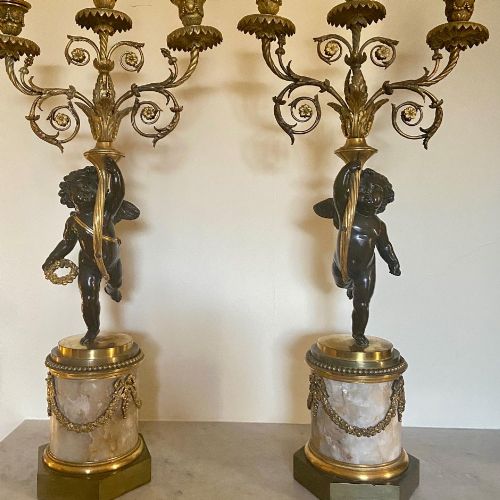
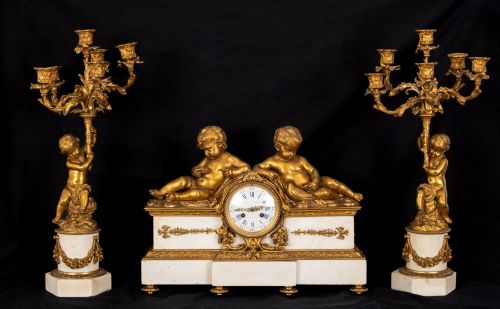
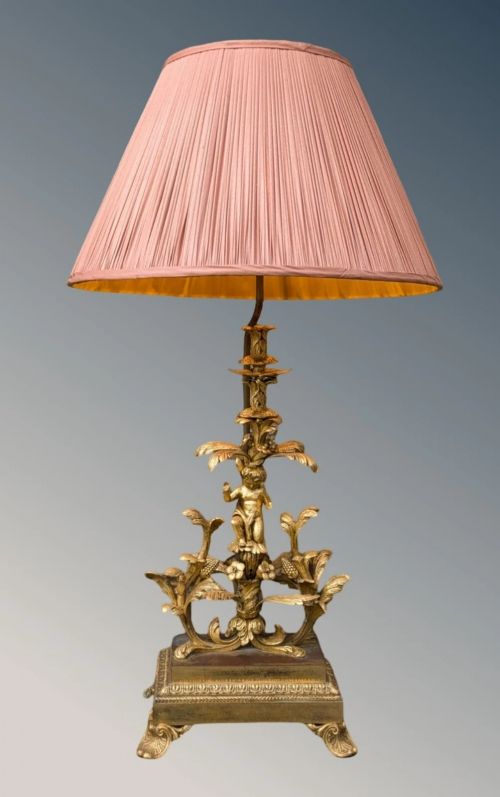
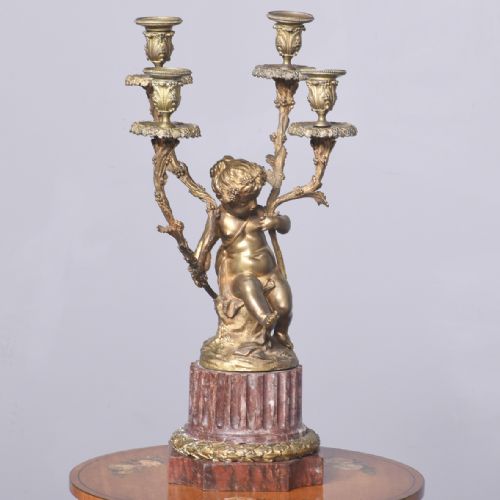
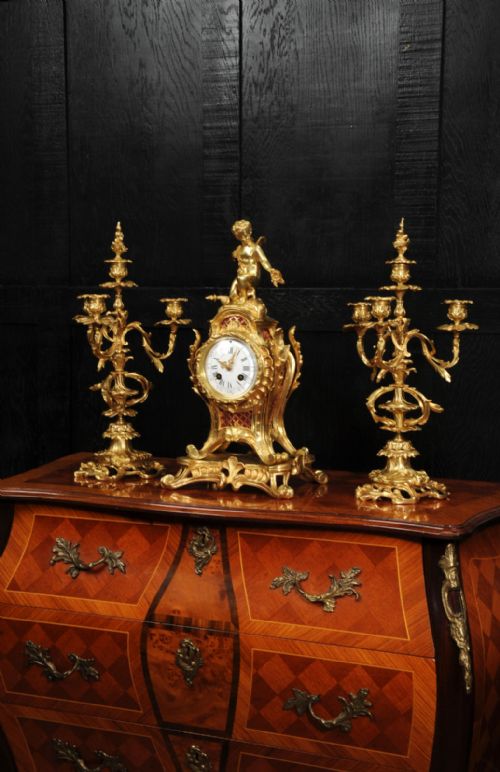
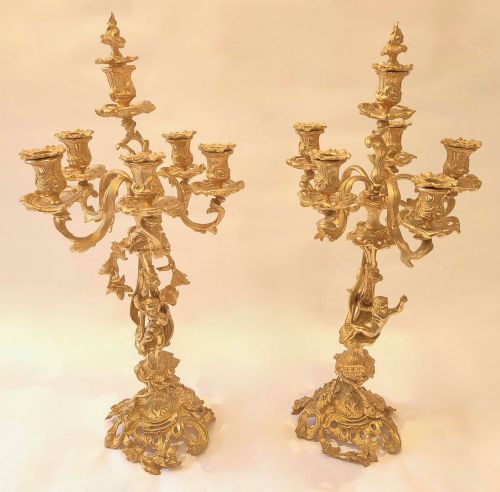
When you search for ormolu putti candelabra, you encounter figural lighting pieces originating predominantly from nineteenth-century France and Italy. These objects pair cast figures of cherubs or putti with multiple candle arms, frequently appearing alongside matching clock garnitures, mantel clocks, and table lamps.
The dominant aesthetic draws heavily on French Rococo Revival and Louis XVI styles, reflecting earlier eighteenth-century designs interpreted by later workshops. Pairs of multi-branch candelabra represent the standard format, mounted on bases of marble, white marble, or porphyry.
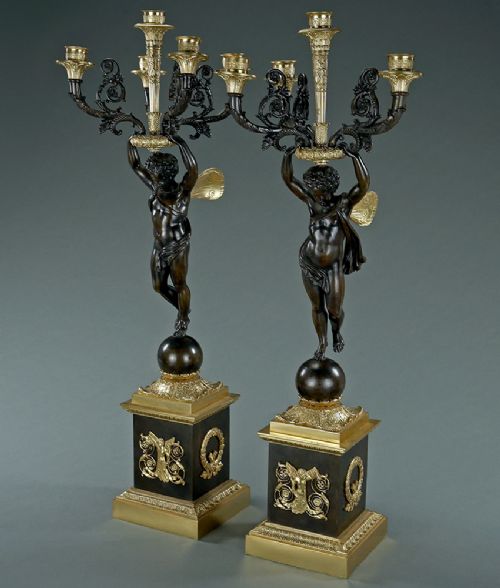
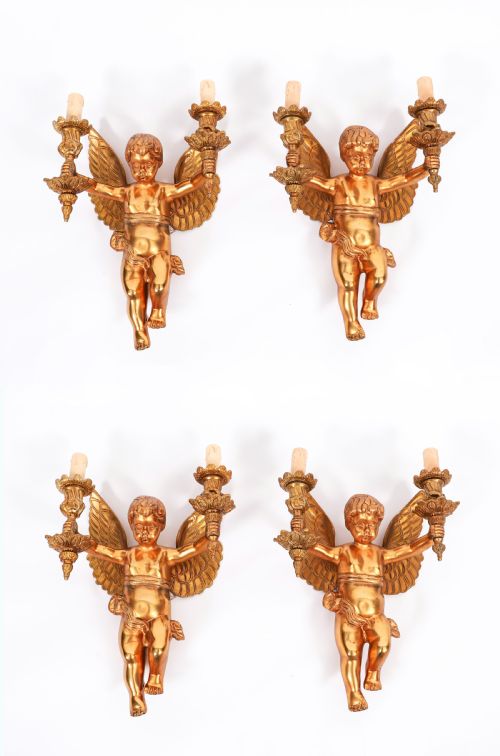
Beyond standard tabletop candelabra, the listings encompass related wall sconces, chandeliers, and occasional single candlesticks. Figures of winged putti, cherubs, and cupids support the bronze framework, often holding branches or standing atop classical plinths.
Materials and Technique
The construction relies on a combination of cast ormolu, gilt bronze, patinated bronze, and occasionally brass or gilt metal. Artisans cast the figurative elements in bronze before applying a gold mercury amalgam or modern gilding to create the characteristic bright ormolu surface.
Plinths and bases incorporate natural stone materials such as white marble, red marble, and porphyry, providing a heavy contrasting foundation for the metalwork. Secondary components utilise enamel details, fluorspar, and glass lustre drops to catch the candlelight.
Chasing and hand-finishing define the surface quality of the bronze figures, separating the feather details on wings and the soft contours of the cherubic forms. Assembly involves threaded rods and pins to secure the bronze and marble sections together tightly.
Winged putti frequently balance multi-branch candelabra with expressions of solemn concentration, portraying cherubs hard at work carrying heavy illumination.
Execution and Detail
The refinement of the casting and subsequent hand-chasing marks the distinction between standard production and superior examples. Master modellers rendered the musculature and facial expressions of the putti with anatomical precision, whereas lesser pieces exhibit softer, shallower detail in the metal.
The quality of the gilding itself dictates the visual depth of the ormolu, ranging from flat, uniform modern plating to the rich, variable tones of period fire-gilding. Furthermore, the selection and turning of the underlying marble or porphyry bases indicate the overall ambition of the piece.
Francois Redmond·Claude Clodion
The Ormolu Putti Candelabra Glossary
- Ormolu
- Finely chopped gold-mercury amalgam applied to a bronze base, producing a bright golden surface. This technique was perfected by French metalworkers during the eighteenth and nineteenth centuries.
- Putto
- A plump, often winged child figure derived from classical art and frequently utilised in Renaissance and Revival decorative objects. In these pieces, they act as structural supports for the candle arms.
- Garniture
- A coordinated set of decorative objects, typically comprising a central clock flanked by matching candelabra or vases. These sets formed symmetrical centrepieces for nineteenth-century mantelpieces.
- Patinated Bronze
- Bronze treated with chemical solutions to create a dark brown, green, or black surface coloration. This dark finish provides contrast against the bright ormolu components.
- Louis XVI Style
- A neoclassical design vocabulary characterised by straight lines, symmetry, and classical architectural motifs. It experienced a major revival during the nineteenth century across French metalwork.
Ormolu Putti Candelabra: Frequently Asked Questions
Were these candelabra electrified later?
Many nineteenth-century candelabra underwent conversion to electricity during the twentieth century to serve as functional table lamps. Such alterations often involved drilling through the original bronze stem or threading wire through the candle nozzles.
Collectors evaluate whether conversions are reversible without damaging the structural integrity of the antique bronze. Unaltered examples retaining their original hollow sockets remain less common.
What is a clock garniture set?
A clock garniture is a matched ensemble consisting of a central mantel clock accompanied by two side pieces, such as candelabra or urns. These matched suites were designed to display symmetrically on parlour or drawing-room mantelpieces.
The components share identical casting styles, materials like marble and ormolu, and figural motifs such as putti. Finding a complete, unified set from the nineteenth century is a notable feature for collectors.
How do I date a nineteenth-century candelabrum?
Dating relies on examining the casting methods, the composition of the bronze, and stylistic cues from Revival periods. Pieces marked with specific nineteenth-century design movements or attributed to known modellers help narrow the timeframe.
The wear patterns on the base and the method of joining the candle branches to the central figure provide further physical evidence of age.