
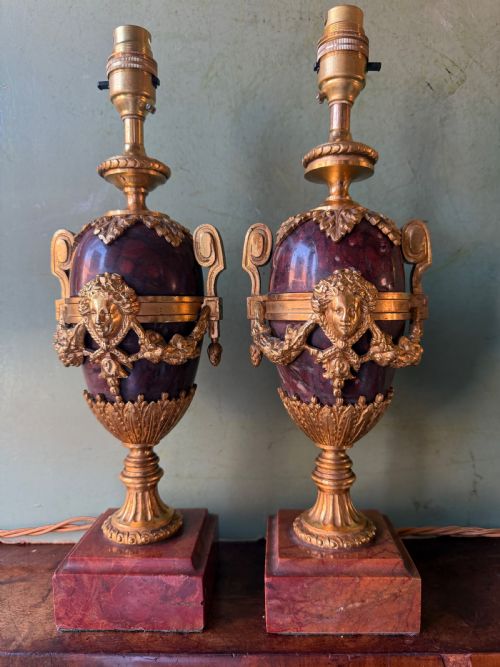
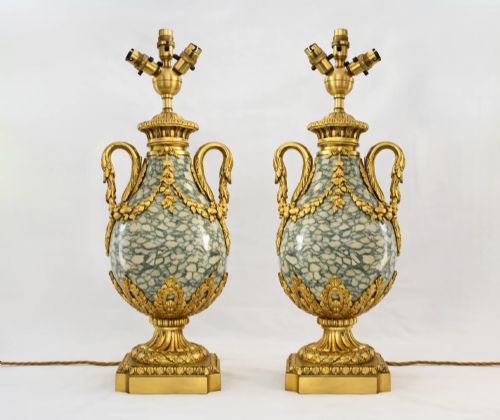


Ormolu Mounted Marble Lamps
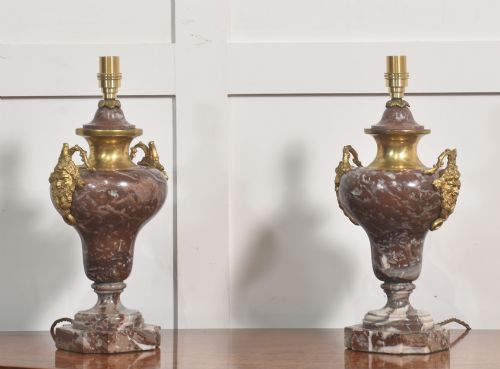
Ormolu mounted marble lamps combine carved stone bodies with cast gilt metal mounts, bringing sculptural weight and French period styling to a room.
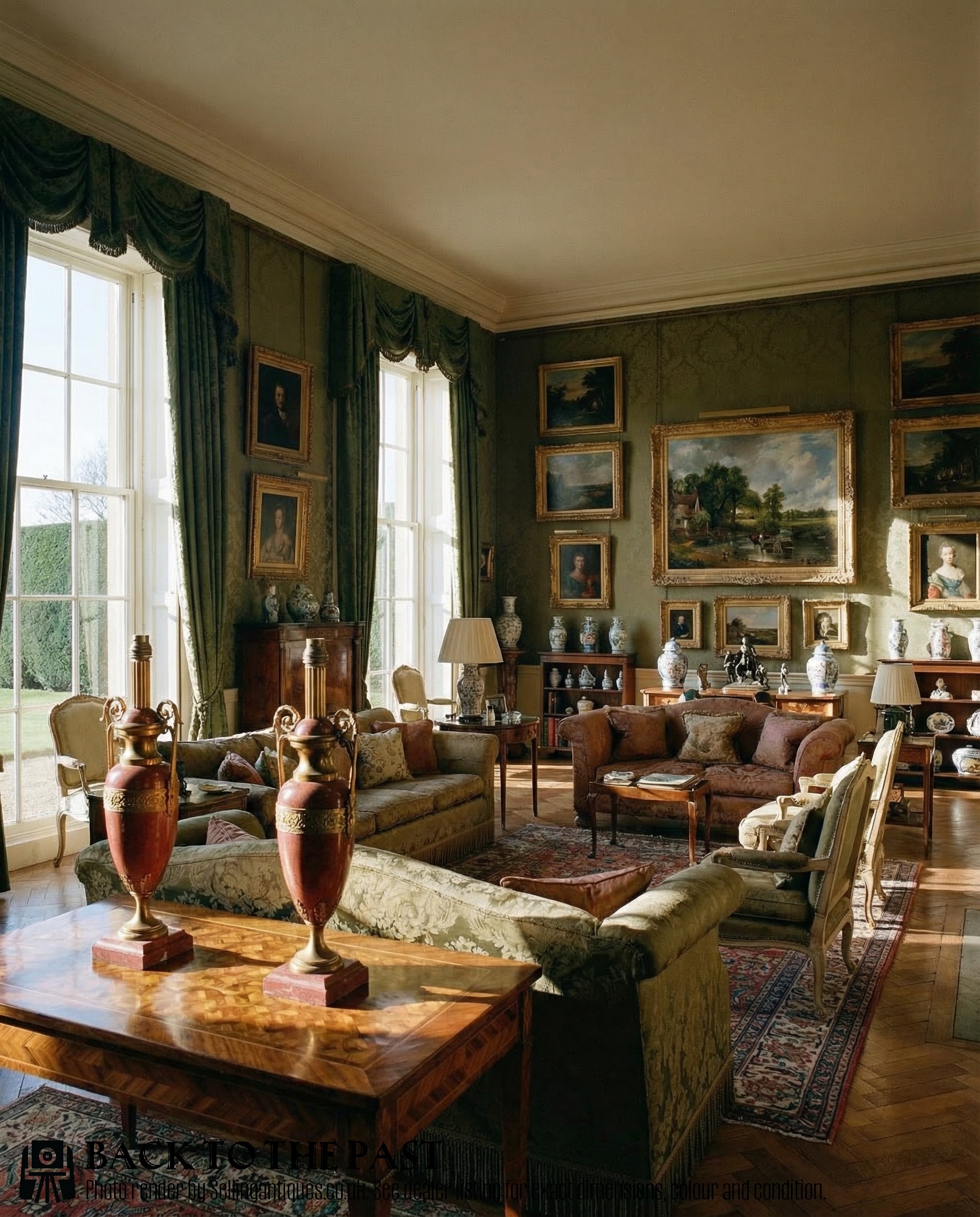
Ormolu Mounted Marble Lamps
When you search for ormolu mounted marble lamps, you encounter decorative lighting rooted primarily in nineteenth century French design. These pieces adapt classic forms like cassolettes, vases, and classical columns into functional table lighting.
The objects combine solid stone bodies with detailed metallic trims, often following Louis XVI, Louis XV, or Empire stylistic models. Pairs appear frequently across the listings, showing the historic preference for symmetrical arrangement on side surfaces.
Originating largely from French workshops, these lamps utilise materials selected for both colour contrast and tactile weight. The resulting forms range from restrained classical cylinders to ornate rococo silhouettes.
Materials and Construction
Makers shaped natural stone bodies from white, green, onyx, siena, and various red or rouge marble varieties. These stone sections were turned on lathes or carved by hand to create urn, column, or vase bodies.
Ormolu, or gilt bronze and brass, was cast and chased to create decorative mounts, handles, collars, and bases. These metal elements were pinned or fitted mechanically to the stone components rather than welded directly.
Several nineteenth-century stone urns originally served as perfume burners before starting a second life holding lamp bulbs.
Assessing Quality and Execution
Quality rests heavily on the crispness of the bronze chasing and the depth of the fire gilding on the ormolu mounts. Finer examples show sharp, undercut leaf motifs and mounts that contour precisely to the marble profile.
The stone selection itself dictates the calibre of the piece, with richly variegated, flawless marble blocks commanding greater visual presence than plain or heavily repaired stone. The structural integration between the heavy metal mounts and the stone body determines stability and long-term durability.
The Ormolu Mounted Marble Lamps Glossary
- Ormolu
- Finely chopped or ground gold amalgam applied to bronze, though often used to describe gilt brass or bronze mounts. It provides a warm, durable golden finish that resists tarnishing.
- Cassolette
- A decorative vessel shaped like an urn or vase, often reversible to function as a perfume burner or candle holder. In lighting, the form is adapted to house electrical fittings while retaining its classical proportions.
- Louis XVI Style
- A neoclassical design vocabulary characterised by straight lines, symmetry, and classical motifs such as urns, swags, and fluted columns. It heavily influences nineteenth-century French decorative arts.
- Rouge Marble
- A rich red ornamental limestone often marked with white or grey veins. It was quarried extensively in France and used for high-end decorative objects.
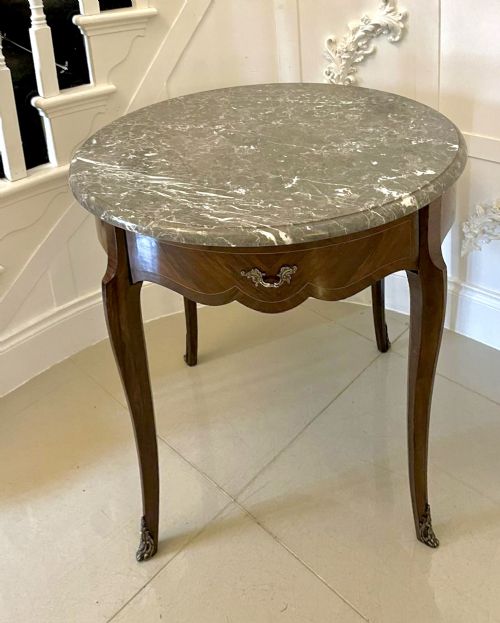
- Gueridon
- A small round table, often with a marble top and gilt mounts, serving a similar display function in a room scheme. Some listings pair these tables directly with matching lamps.
Ormolu Mounted Marble Lamps: Frequently Asked Questions
What periods do these lamps come from?
The available selection primarily dates from the nineteenth century, with strong representation from the Victorian era and the later decades of the eighteen-hundreds. Specific pieces trace back to periods like the Restauration or draw inspiration from earlier eighteenth-century designs.
Craftsmen in later decades deliberately revived these classical French styles, making nineteenth-century interpretations the most commonly encountered antiques in this category.
Are these lamps sold as pairs?
Many of the entries on this page consist of matching pairs, reflecting their original purpose as garnitures or mantel ornaments adapted for lighting. Single lamps do appear occasionally, but symmetrical pairs dominate the available selection.
Buying a pair provides balanced placement on side tables, cabinets, or larger chests within a room arrangement.
How do I identify Louis XVI style?
Louis XVI style is marked by geometric symmetry, straight architectural lines, and restrained classical ornamentation rather than the flowing curves of earlier rococo design. Look for motifs like acanthus leaves, classical urns, swags, and fluted columns.
This aesthetic values proportion and balance, making the lamps easy to integrate into formal interior schemes.
What marble types are used?
The listings feature a diverse palette of natural stones, including white marble, green marble, onyx, siena, and variegated red rouge marble. Each variety introduces distinct veining patterns and colour tones that contrast with the golden ormolu mounts.
Some pieces utilise uniform dark stone, while others showcase heavily veined or pink-tinted specimens selected for decorative impact.